
Contested Order
The Structure of End-State Competition in the Red Sea


In a previous essay, I argued that the Saudi pivot represents a structural repositioning for regional primacy under emerging post-liberal conditions; a shift from conservative stakeholder to revisionist manager, from alignment maintenance to competitive assertion. That analysis traced the logic of renewed intra-Arab rivalry, the collapse of the residual bipolarity that had organized regional politics around Iranian-led resistance and American-backed alignment, and the re-emergence of “Palestine” as a high-yield instrument for agenda control and rival discipline. What it did not fully develop was where these competitive dynamics concentrate geographically—where the differentiated portfolios of regional powers collide and where abstract end-state preferences become concrete territorial disputes.
The Red Sea corridor is one of those geographies. The maritime space stretching from Suez through the Gulf of Aqaba and down to Bab al-Mandab, then fanning outward into the Gulf of Aden and the western Indian Ocean, constitutes far more than a shipping lane or a transit route to be secured. It is the arena in which every major axis of regional competition—Saudi-Emirati rivalry, Israeli forward positioning, Turkish expansion, and the unresolved legacies of Iranian proxy warfare—converges upon a single set of chokepoints, port concessions, basing arrangements, and sovereignty contests. If the Saudi pivot is a strategy, the Red Sea littoral is its primary theater of application; if the Abraham Accords represented a vision of an integrated regional order anchored in normalization and infrastructure interdependence, the Red Sea is where that vision encounters the structural obstacles to its realization.
The events of the past two months clarified much of this reality. What appeared as discrete events—Israel’s recognition of Somaliland, the Southern Transitional Council’s (STC) military offensive across southern Yemen, Saudi airstrikes on Emirati weapons shipments, Somalia’s abrogation of all agreements with the UAE—are, as a matter of fact, moves within a single interconnected contest, each triggering countermoves across nominally separate theaters. The cascade appears to have begun in November 2025, when Saudi Crown Prince Mohammed bin Salman reportedly asked President Trump to pressure the UAE to halt its support for the Rapid Support Forces (RSF) in Sudan. Abu Dhabi’s response was not accommodation but horizontal escalation: backing the STC’s ultimately ill-fated bid to seize the territory of former South Yemen, reportedly brokering Israel’s recognition of Somaliland, and continuing to diversify the supply lines sustaining its Sudanese proxy. Saudi countermeasures then followed across every accessible theater simultaneously—military operations in Yemen, overflight denials disrupting Emirati logistics to Sudan, diplomatic pressure on Libya’s Khalifa Haftar to close air bases serving as RSF supply nodes, and coordination with Egypt and Turkey on strikes against RSF positions. The result is a regional geography in which stable equilibrium has become structurally elusive, in which every port concession encodes a strategic bet on contested end-states, and in which the infrastructure ambitions of IMEC—the India-Middle East-Europe Economic Corridor announced with such fanfare at the 2023 G20 summit—collide with the reality of a fragmented, penetrated, and violently contested arrangement.
The Architecture of Contestation
The strategic significance of the Red Sea derives not from any single attribute but from the compound effect of geographic configuration, trade dependence, and the political weakness of littoral states. Approximately twelve percent of global trade transits these waters, including substantial shares of Europe’s energy imports and Asia’s manufactured exports to Western markets. The Suez Canal at the northern terminus and Bab al-Mandab at the southern end create a double-chokepoint system in which disruption at either end cascades through global supply chains with predictable effects on insurance rates, shipping schedules, and the cost structures of industries dependent on reliable logistics. The Houthi campaign of 2024 and early 2025 demonstrated this vulnerability: a degraded non-state actor, operating from a single segment of the Yemeni coast with Iranian-supplied munitions, imposed costs sufficient to reroute major commercial flows around the Cape of Good Hope, adding weeks to transit times and billions to aggregate shipping costs.
Yet, beside being an important transit space requiring protection, the Red Sea is bordered by a collection of weak, fragmented, and internally contested political units whose configurations are themselves objects of external competition. The question of who controls Red Sea transit cannot be separated from the question of which political entities could or should exist along its shores, which borders enjoy recognition, and which external patrons acquire durable access to ports, airfields, and intelligence facilities.
The eastern littoral is defined by Yemen’s fractured coast, divided since the civil war’s effective partition among Houthi forces controlling the northwest from Hodeidah to Sa’ada, the internationally recognized government holding segments around Aden under Saudi patronage, and—until the events of January 2026—the UAE-backed STC exercising de facto authority over much of the former South Yemen. The western shore presents an even more complex mosaic. Sudan’s Red Sea coast connects to Africa’s largest territorial state by area, now partitioned de facto between the Sudanese Armed Forces (SAF) holding the east, including Khartoum and Port Sudan, and the Emirati-backed Rapid Support Forces (RSF) controlling the west, including all of Darfur, following the fall of El Fasher in October 2025. The conflict’s threatened expansion into Ethiopia through the Benishangul-Gumuz region—home to the Grand Ethiopian Renaissance Dam and adjacent to Sudan’s eastern border—raises the prospect of regionalization that would draw in Eritrea, Egypt, and potentially the entire Horn of Africa state system.
Eritrea itself occupies a pivotal position under the Machiavellian stewardship of Isaias Afwerki, who has treated Sudan as a proxy battlefield for his unresolved rivalry with Ethiopian Prime Minister Abiy Ahmed while simultaneously hosting Sudanese military aircraft, cultivating relationships with Ethiopian insurgent factions, and positioning Asmara as an indispensable partner for any power seeking leverage over the Red Sea’s western approaches. Djibouti hosts the region’s densest concentration of external military presences—American, Chinese, French, Japanese, Italian—which makes it simultaneously indispensable to great-power logistics and too constrained by competing dependencies to serve as any single patron’s platform. And at the southern terminus, Somalia and its breakaway region Somaliland control the Gulf of Aden approaches, with Berbera port emerging as perhaps the most consequential single piece of infrastructure in the entire system: developed by the UAE, coveted by Ethiopia for sea access, now linked to Israel through diplomatic recognition, and contested by Turkey and the Mogadishu government as an unacceptable precedent for externally-imposed secession.
Egypt looms over this entire system with interests that are simultaneously defensive and potentially offensive. Cairo seeks to prevent the consolidation of hostile or rival-aligned forces along its southern border, to maintain leverage over Nile water flows against Ethiopian dam operations that Egypt views as existentially threatening, and to preserve its position as the indispensable northern terminus of Red Sea transit and the irreplaceable manager of Suez. These interests have driven Egypt into increasingly active intervention: coordinating air and drone strikes with Turkey against RSF supply lines near the tri-border area with Libya and Chad, concluding new naval agreements with Djibouti and Eritrea to enhance pressure on Ethiopia, and repeatedly declaring that Cairo will accept nothing other than a unitary Sudanese state incorporating the SAF and requiring the dismantlement of the RSF. Egyptian strategic anxiety transforms every Red Sea contest into a potential trigger for intervention, and the credibility of Egyptian threats—given Cairo’s conventional military superiority over every actor in the region except Israel—ensures that its preferences cannot be dismissed as mere posturing.
Somaliland and the Politics of Recognition
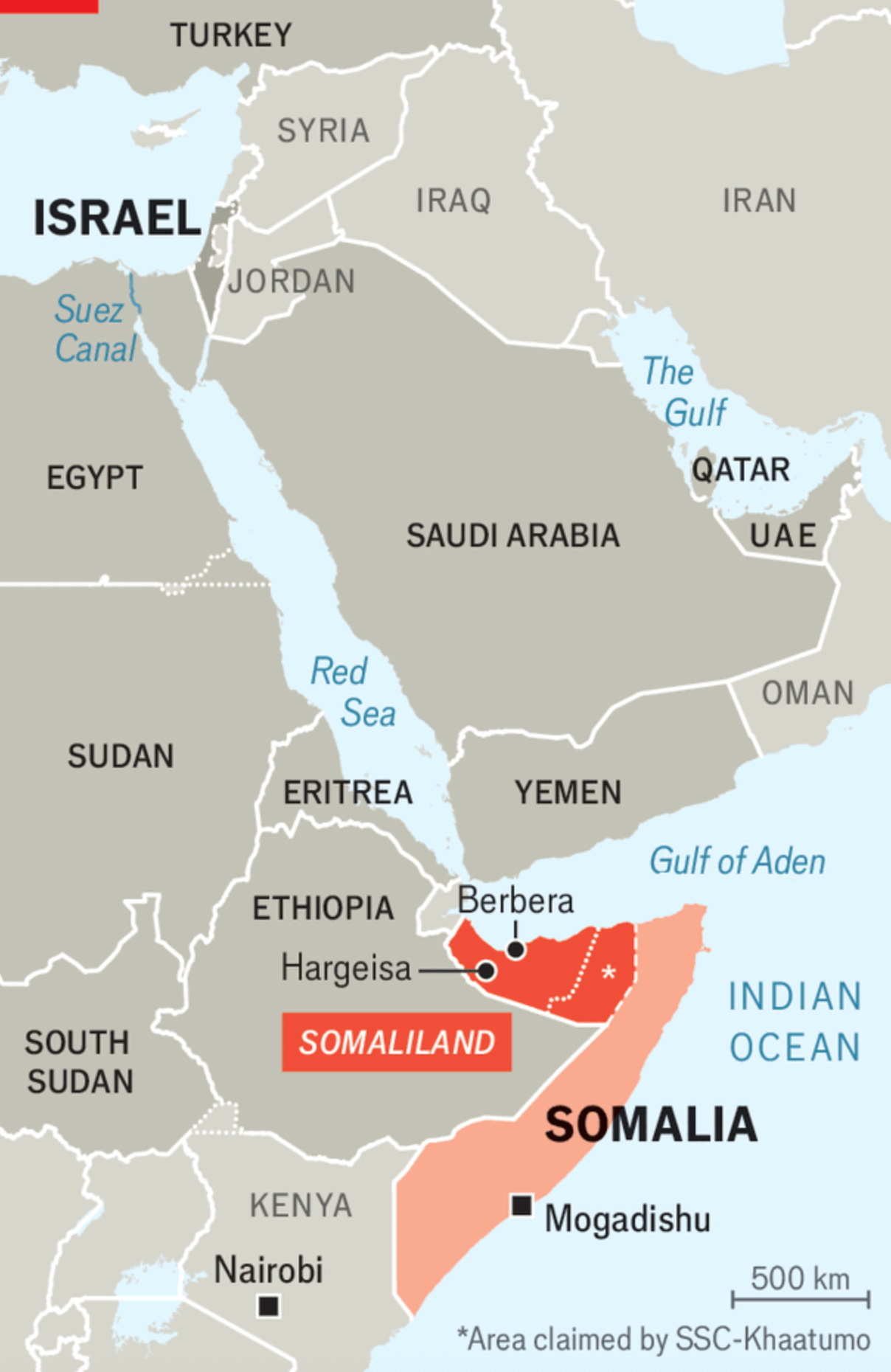
Israel’s recognition of Somaliland was the first extended by any UN member state since the territory declared independence in 1991. The joint declaration signed by Prime Minister Netanyahu and President Abdirahman Mohamed Abdullahi committed both parties to full diplomatic relations, the opening of embassies, and the exchange of ambassadors; it framed the arrangement as consonant with the Abraham Accords and positioned Somaliland as a prospective member of the normalization architecture that Israel has constructed since 2020. Within days, Foreign Minister Gideon Sa’ar visited Hargeisa, and Somaliland officials confirmed to Israeli media that discussions regarding a potential Israeli military base were underway—a development that, if realized, would extend Israeli operational reach to the southern approach of Bab al-Mandab and establish a permanent presence on the opposite shore of the Houthi-controlled Yemeni coast.
The recognition was not spontaneous but rather the culmination of years of cultivation. Israeli intelligence services had developed discreet relationships at senior levels within Somaliland’s political establishment, and the UAE had served as a key intermediary, having already invested substantially in Berbera port and associated infrastructure under arrangements that gave Abu Dhabi both commercial returns and potential military utility. The strategic logic was clear to all parties: Somaliland’s 850-kilometer coastline along the Gulf of Aden offers direct access to the chokepoint through which Red Sea traffic must pass, positioning any external patron to monitor, interdict, or protect shipping as circumstances require. For Israel, facing an ongoing if diminished Houthi threat and seeking to extend its operational capabilities beyond the eastern Mediterranean, Somaliland represented an opportunity to establish presence on the African littoral—a counterweight to Iranian-aligned forces in Yemen, a platform for intelligence collection and maritime domain awareness, and a potential staging area for power projection into a region where Jerusalem has historically lacked reliable partners.
Yet recognition carries consequences that extend beyond strategic convenience. It constitutes an end-state choice, a declaration about which political configurations are legitimate and which are not, and it immediately triggered a cascade of countervailing responses. Somalia condemned the recognition as a deliberate attack on its sovereignty and territorial integrity. Egypt, Turkey, and Djibouti issued a joint statement warning that recognition of breakaway regions within sovereign states set dangerous precedents in violation of the UN Charter. The African Union firmly rejected any initiative aimed at recognizing Somaliland as an independent entity and reaffirmed its commitment to Somalia’s unity. The Arab League, the Organization of Islamic Cooperation, and the Gulf Cooperation Council all issued condemnations. Saudi Arabia’s Foreign Ministry was particularly hostile, calling the recognition “extremely dangerous” and characterizing it as a threat to regional security—language that went well beyond diplomatic boilerplate.
But it is important to note that while Saudi Arabia condemned, the UAE did not. While the GCC issued a collective statement of opposition in which Abu Dhabi formally participated, the Emirates notably declined to issue any standalone national condemnation—a silence that was neither accidental nor unnoticed. The UAE had built Berbera port, maintained a liaison office in Hargeisa, and served as the bridge through which Israeli-Somaliland relations had developed over the preceding years. Emirati interests in Somaliland are corridor-centric: the port provides access to Ethiopian markets and logistics diversification independent of Djibouti’s congested facilities, and it offers potential military utility that does not depend on Mogadishu’s consent or cooperation. Israeli recognition does not threaten these interests; it potentially reinforces them by adding a layer of great-power legitimation and strategic partnership that makes Somaliland’s de facto independence more durable.
