
The Saudi Pivot
The Logic and Structure of the New Middle Eastern Cold War

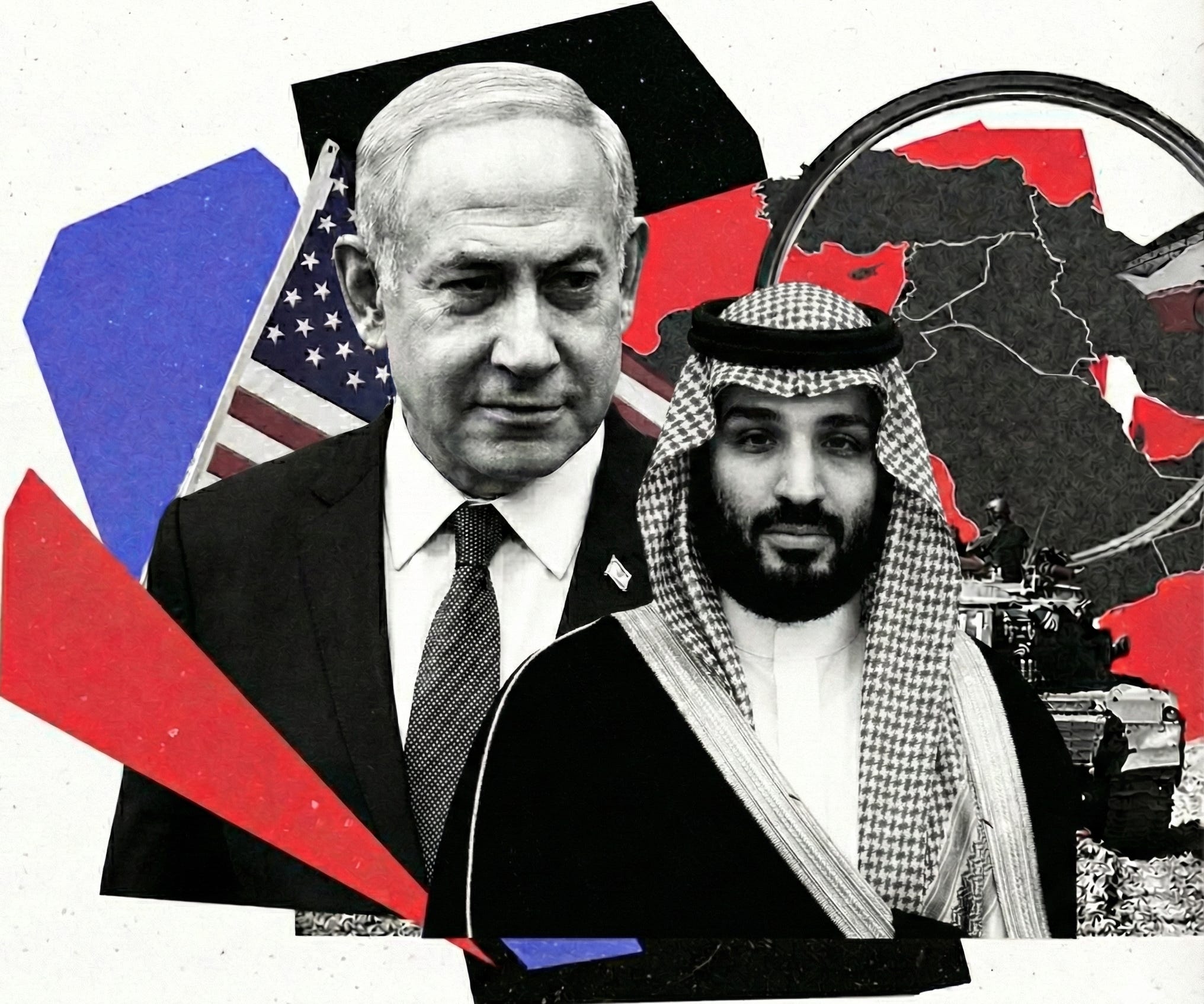
In the mid-1960s, Malcolm Kerr published The Arab Cold War, a book that, at the time, imposed counterintuitive analytical discipline on a region habitually read through the narrow lens of a single totalizing conflict. Against the prevailing tendency to treat the Arab–Israeli conflict as the primary engine of Middle Eastern politics, Kerr reconstructed the region as a system in which Arab states competed—openly and ruthlessly—for primacy, legitimacy, and the authority to define the regional political agenda. The conflict with Israel was often mediated by, subordinated to, and at times an effect of, intra-Arab rivalry; it functioned as a source of symbolic capital and strategic leverage in contests among Nasserists, Ba’athists, monarchies, and revolutionary republics.
That realistic way of seeing the region largely disappeared as subsequent pressures mounted. The Iranian Revolution of 1979, the rise and institutionalization of transnational Islamist movements, and the gradual entrenchment of the Israeli–Palestinian conflict as a permanent global cause reorganized policymaking, activism, and scholarship. Over time, two frames crowded out most others and came to dominate regional analysis. The first was the strategic and sectarian contest between Iran and the Arab states, which reframed regional politics as a struggle between competing security architectures and rival claims to ideological leadership. The second was the Israeli–Palestinian conflict, which hardened into a durable moral and diplomatic axis around which international opinion, domestic mobilization, and alliance politics repeatedly revolved. Against these two gravitational fields, inter-Arab rivalry came to fade into the background.
It is time to update our view and recognize the renewed dynamic of competition for hierarchy that is driving regional politics.
For more than a decade, Saudi Arabia and the United Arab Emirates functioned as the central axis of what was called moderate Arab politics. They coordinated on Yemen, jointly confronted Qatar, underwrote counterrevolutionary reaction after 2011’s Arab Spring, and presented themselves to Washington as the region’s most reliable Arab partners. Now, Saudi Arabia is changing this course and is repositioning for regional primacy in a Middle East it believes will soon look very different.
After a decade of costly and inconclusive ventures: the failure to impose an outcome in Yemen, the inability to subordinate Qatar through coercive isolation, the underwhelming regional returns of Vision 2030, and the growing economic and strategic rivalry with Abu Dhabi, Saudi policymakers appear to have reached a different conclusion about what is the best path they have to accumulate regional power in current conditions. A consolidating relationship with Turkey, renewed investment in Islamist and anti-Zionist legitimation, a deliberate freeze of normalization with Israel, and public confrontation with the UAE across multiple theaters are all clear signs of such a major strategic pivot. And behind it all, a strategic wager: the American-led conditions that made Gulf alignment rational are thinning, and Saudi Arabia intends to lead the region in whatever post-liberal world comes next. Riyadh is no longer a conservative stakeholder seeking to preserve an inherited hierarchy. It is acting as a revisionist manager—prepared to challenge old partners, reorder alignments, and redefine the principles around which regional politics are structured.
The immediate trigger was the developments in Yemen, which began last month. Emirati-backed forces advanced into Saudi-controlled territory in the south, seizing energy infrastructure with minimal resistance. Riyadh responded with a sustained counteroffensive that pushed Emirati proxies back and signaled a willingness to contest Emirati positions across the theater. The military clash was quickly accompanied by an information war. Saudi-aligned media accused the UAE of promoting secessionism, undermining Arab territorial integrity, and acting as a conduit for Israeli nefarious plans. Emirati outlets countered by portraying Saudi Arabia as reckless, ideologically Islamist, and unfit to manage regional stability.
This confrontation with the UAE and the end of the Saudi-UAE relationship as a stable axis are the first visible expressions of a broader regional system transition: from a region organized around managed alignment to one structured by open competition among status-seeking middle powers within conditions of competitive multipolarity in which conflict is not episodic but structural.
Post-liberal Conditions
The return of the centrality of inter-Arab rivalry reflects a structural shift in international politics that extends well beyond the Middle East: post-liberalism. This new competitive environment is an early expression of the dynamics that will likely generalize as the post-liberal environment matures globally; hegemonic arbitration fades, middle powers compete, institutional access declines, positional leverage matters, rules weaken, and status must be won. Under post-liberal conditions, returns are generated through position rather than participation. Control over logistics corridors, energy flows, investment channels, narrative platforms, and conflict portfolios now matters much more than formal standing within international forums.
The liberal international order that consolidated after the Cold War is contracting, as evident in recent developments in American foreign policy: trade wars, unilateral action, the end of USAID and its NGO world regime, withdrawal from international institutions, and the open abandonment of rule-based frameworks by their principal architects. Washington now pursues strategic objectives through power projection and coercion without even attempting liberal rationalization. The post-liberal international order is no longer an anticipation; it is the operating environment.
What is emerging is not multipolarity in the classical sense—a stable distribution of power among great-power blocs--but something more fluid and less predictable: a post-liberal environment in which the American rule-based hegemony that once mediated competition has ended. Or to put it in other terms, America’s hegemony is no longer rule-based. Access to markets, capital, and security guarantees can no longer be secured through institutional compliance. They must be bargained for, repeatedly, from a position of leverage.
The strategic response, across every region, has been the pursuit of autonomy—reducing dependence on any single patron, diversifying partnerships, accumulating leverage. India straddles Washington and Moscow. Turkey plays NATO against Russia against the Gulf. Brazil and South Africa refuse alignment on Ukraine. This is not nonalignment in the mid-century sense but positional maneuvering in an order that is much less disciplined and much more transactional. Diplomatic capital is accumulated less by reputation for restraint than by demonstrated capacity to obstruct, delay, or redirect outcomes across multiple arenas.
The Middle East was never fully disciplined by liberal order norms. Sovereignty violations, authoritarian persistence, great-power intervention without consequence—the region operated under a partial exception long before the current unraveling. But that exception itself was still structured by American hegemony. Washington set red lines, suppressed intra-allied rivalries, provided security guarantees, and offered a path to status through alignment. The Gulf monarchies learned to navigate this architecture. True, they never internalized its norms, but they always respected and depended on its constraints.
Those constraints are disappearing, and American arbitration has become transactional and unreliable. The security umbrella remains, but its coverage is uncertain. Status can no longer be secured solely by proximity to Washington. Constraints have weakened without disappearing; hierarchy has blurred without dissolving. For states with sufficient resources and ambition, this environment rewards assertiveness, issue-linkage, and the accumulation of veto power.
The states that grasped this earliest—Saudi Arabia, the UAE, Turkey, Israel—have been repositioning accordingly, and they are not waiting for a new order to emerge. They are competing to shape, a competition which is likely to become the new order itself: thinner, more permissive, and structurally competitive.
Saudi Arabia’s pivot must be read against this backdrop, and against a second, equally decisive factor: Trump’s unilateral reordering of global energy markets. Saudi regional strategy rests on oil rents; without elevated oil revenues, domestic and regional expenditures become unsustainable. American policy now threatens that foundation with structural oversupply into a market already suffering from price volatility, undermining OPEC+ leverage precisely when Riyadh needs it most. The turn toward agenda control, symbolic custodianship, and selective mobilization is not ideological regression into a primordial Wahhabi Islamist DNA that reasserts itself. It is an adaptation to a new reality—one in which American actions have become unpredictable not only in the security domain but in the economic base that makes Saudi power possible.
The Dual Vacuum
If post-liberalism is the macro condition, regionally it resulted in a specific configuration of factors that altered the regional opportunity structure. This has two concrete concurrent developments: the transformation of the U.S. from system manager to selective participant, and the dismantling of the only coherent counter-system, that of the Shia axis, which had constrained intra-regional competition for more than two decades.
The United States remains the dominant external military actor in the Middle East, but its role has changed in both function and scope. Washington no longer underwrites political outcomes, enforces coalition discipline, or invests sustained capital in shaping regional settlements. Its interventions are episodic, interest-specific, and increasingly decoupled from any broader order-building objectives. Security guarantees have become conditional and transactional, with emphasis on general equilibrium.
This shift means that regional actors no longer operate within a clearly enforced hierarchy or a stable framework of expectations about American red lines, alliance obligations, or escalation control. The result is permissiveness: a system in which initiative is decentralized and risk is internalized by regional powers themselves. At the same time, the region’s last durable counter-system has been dismantled.
For much of the post-2003 period, the so-called Axis of Resistance functioned as a loose but operationally coherent structure linking Iran, Hezbollah, Syria, Palestinian militias, and affiliated militias across Iraq and Yemen. It imposed a form of negative order. It constrained Israeli freedom of action, limited Arab strategic autonomy, and created a de facto ceiling on regional realignment by threatening multi-front escalation.
That structure has been systematically degraded over the past two years thanks to Yahya Sinwar. Israeli military operations have decapitated command networks, destroyed logistics corridors, eliminated senior leadership, paralyzed the Iranian nuclear program, induced regime change in Syria, and forced the dispersal or demobilization of key proxy formations. What remains is a collection of degraded local actors operating under severe financial constraint, surveillance saturation, and tightening escalation ceilings imposed by both Israeli deterrence and Iranian state near-collapse.
The combined effect is the collapse of residual bipolarity. A system that had been organized around the two former bounding forces—American management on one side and Iranian-led resistance on the other—has lost both. With fewer external constraints and fewer systemic ceilings, competition becomes direct, positional, and difficult to contain. States accumulate influence less through institutional standing than through control over corridors, investment pathways, narrative platforms, and conflict portfolios. They seek veto points, cultivate leverage across arenas, and treat symbolic issues as instruments of statecraft.
The New and Old Powers
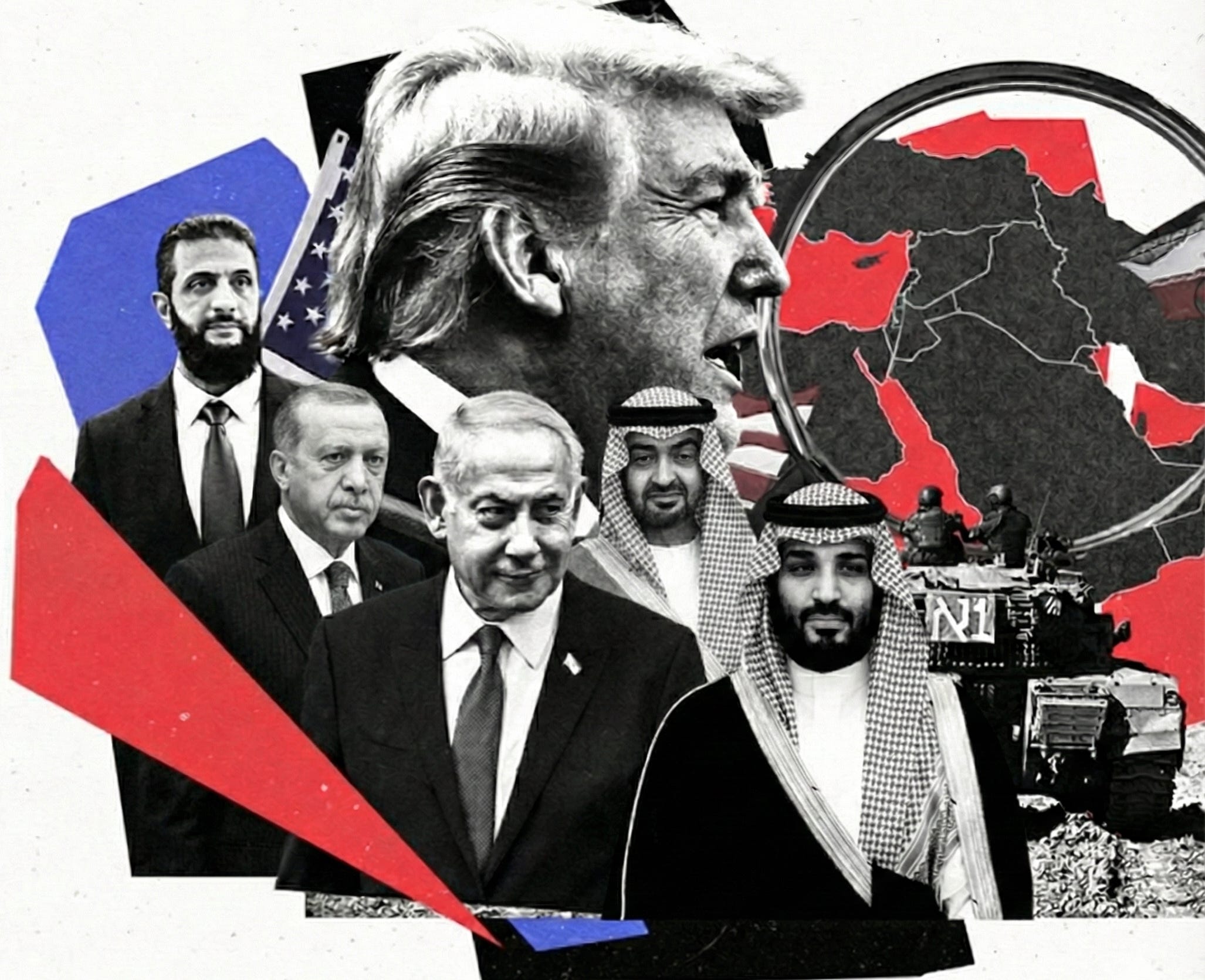
In such a permissive regional system, influence is accumulated through portfolios of capabilities that can be activated across economic, political, informational, and security domains. Saudi Arabia, the UAE, Qatar, Turkey, and Israel now compete less as traditional allies or adversaries than as differentiated power assemblages, each optimized for a distinct mode of leverage.
Saudi Arabia’s portfolio is anchored in wealth, scale, and symbolic authority. It is the only Arab state that combines demographic weight, financial capacity, and custodianship of Islam’s central holy sites. These attributes generate a form of mass legitimacy unavailable to its Gulf peers, non-Arab states, let alone a small Jewish state, and impossible to replicate through material investment. Riyadh can mobilize regional publics, shape discourse, and redefine political priorities in ways that smaller states cannot. Its control over religious infrastructure further embeds Saudi authority into the everyday political economy of the Muslim world.
These structural assets translate easily into symbolic capital. Saudi Arabia realized that it is uniquely positioned to claim custodianship over regional “moral” files—above all Palestine—and to convert that claim into agenda-setting power, which ultimately makes an anti-Zionist posture more advantageous than a normalizing one. Narrative mobilization is therefore not ancillary to Saudi strategy but integral to it. In a system where legitimacy is increasingly contested, the ability to define what counts as stability, fragmentation, normalization, or betrayal constitutes a form of hard power by other means. Riyadh’s current heightened propaganda activities reflect an effort to turn this symbolic advantage into a durable instrument of system management.
The Emirati portfolio is organized around a different logic. The UAE compensates for demographic and symbolic limits with concentrated material and network power. It controls a dense web of investments, logistics infrastructure, commercial ports, free-trade zones, sovereign capital, and security partnerships that extend from the eastern Mediterranean to the Horn of Africa and the Indian Ocean. These assets allow Abu Dhabi to embed itself into supply chains, financial circuits, and maritime chokepoints that confer structural leverage without requiring political mobilization.
This model naturally privileges elite connectivity over any form of mass politics. Influence is exercised through contracts, basing rights, intelligence cooperation, and investment dependency rather than through ideological appeal. The same design that produces efficiency, however, also imposes limits. The UAE possesses minimal capacity for narrative penetration beyond globalized elite circles and little resilience in the information domain when disputes are reframed in populist or religious terms. This asymmetry is strategically consequential.
Qatar occupies a third position. Lacking Saudi scale or Emirati infrastructure depth, it has specialized in narrative production, Islamist patronage, and mediation. Al Jazeera remains the most effective transnational Arabic media platform, capable of shaping public agendas and reframing conflicts across the region. Doha’s long-standing cultivation of Islamist networks provides access to non-state actors who operate where formal diplomacy cannot.
Qatar’s comparative advantage is highest in unresolved systems. It generates leverage by hosting negotiations, funding channels, and positioning itself as indispensable to communication with actors whom others refuse to, or can’t, engage. It markets this role as “mediation” rather than power, presenting itself as infrastructure rather than a competitor. The practical effect is that conflict becomes an asset: the more a file remains open, the greater the value of Qatar’s access, money, and narrative capacity. Stability reduces brokerage value; stalemate increases it. For that reason, Qatari influence is structurally tied to the persistence of open political files.
Doha has also invested heavily in Western elite ecosystems—universities, think tanks, consultancies, lobbying, high-brow media, cultural institutions, and prestige-sector networks—creating a parallel channel of influence that operates through status, employment, and patronage rather than through formal lobbying alone. This gives Qatar the ability to shape interpretive frames in Western policy and technocratic circles, and to insulate its regional posture behind a thick layer of reputational and institutional relationships.
Turkey’s portfolio is organized around geographic centrality and coercive capacity. It combines a large conventional military, an expanding defense-industrial base, and control over critical transit corridors linking Europe, the Black Sea, and the Middle East. Ankara’s use of drones, expeditionary deployments, and managed proxy forces has established it as the region’s most operationally flexible middle power.
Politically, Turkey couples this capacity with selective ideological alignment, positioning itself as a patron of Sunni Islamist movements when advantageous, while maintaining transactional relations with Russia, NATO, Israel, and the Gulf. This allows Ankara to oscillate between coalition membership, autonomous intervention, and spoiling. Its leverage derives less from symbolic authority than from its ability to insert itself into contested spaces and alter local balances of force at relatively low cost.
Israel’s portfolio is much narrower but unusually dense. It rests on technological superiority, intelligence supremacy, military dominance, privileged status in Washington, and regional escalation control. These assets enable Israel to quickly degrade adversaries, enforce red lines, and shape neighboring security environments without territorial occupation or formal alliance structures. Its strategic doctrine privileges denial over consolidation: preventing hostile state formation, disrupting adversarial integration, and maintaining freedom of action across multiple theaters.
Normalization with the UAE, Bahrain, and Morocco has expanded Israel’s economic and logistical reach, but its core leverage remains coercive. Israel does not and can not compete for regional legitimacy; it competes for operational superiority and strategic depth. In a post-liberal environment, this makes it a powerful but structurally disruptive actor, capable of dismantling counter-systems, but poorly positioned to anchor any replacement order.
Taken together, these portfolios explain why the current competition is unlikely to resolve into stable blocs. Each actor accumulates power through different channels, with different time horizons and vulnerabilities.
Consolidation versus Denial
Several of the region’s most consequential disputes now turn on a single question: which political units in the Middle East are permitted to consolidate, and which must be kept fragmented and permanently constrained. Unlike what Saudi and Qatari propaganda claim, the real answer is not doctrinal but strictly contingent. Every major actor endorses sovereignty when consolidation would produce a friendly power, and resists it when consolidation would generate a rival capable of locking in an adverse alignment. Fragmentation is not an ethical category. It is an equilibrium outcome in arenas where no coalition can impose a preferred settlement and where permeability itself becomes leverage.
This logic sits underneath the Saudi–UAE competition and interacts with the portfolios described above. Saudi Arabia is attempting to reassert agenda-setting primacy by shaping permissible end-states across a set of linked theaters. The UAE seeks advantage through modular access, especially where the central authority is weak. Qatar benefits from brokerage and narrative control in unresolved files but also requires interlocutors with enough institutional coherence to monetize mediation. Turkey’s preferences are anchored in economic interest, border security, and the Kurdish question. Israel’s doctrine privileges freedom of action and threat prevention, and therefore tends to oppose the emergence of large, ideologically mobilized neighbors with strategic depth, even when it tolerates limited local order for tactical reasons.
Yemen is but the most visible case. Riyadh’s core interest is end-state control: preventing Yemen from hardening into a political geography that Riyadh cannot shape and that permanently invites rival penetration along the Red Sea approach. A Yemen fractured into durable spheres—particularly a southern entity dependent on Emirati security and commercial networks—reduces Saudi leverage over any settlement, narrows its ability to negotiate with a single sovereign center, and institutionalizes a rival stake on the kingdom’s immediate periphery. A UAE-backed south is not likely to menace Saudi territory militarily. The problem is that it can lock in a map in which Saudi Arabia is no longer a primary actor in Yemen, and in which the Red Sea corridor adjacent to Saudi interests is governed through arrangements outside Riyadh’s control.
Abu Dhabi’s interests are largely corridor-centric. The UAE has invested in maritime nodes, local forces, and southern arrangements that secure access and influence even absent a unified Yemeni state. That approach aligns naturally with Israel’s preference set in the Red Sea: constraining Houthi capabilities, protecting shipping, and building layered maritime-security cooperation that preserves operational freedom. Those objectives can converge on the coast while diverging on end-states. What looks to Abu Dhabi and Jerusalem like efficient corridor management can look to Riyadh like a durable encirclement of influence, the consolidation of a rival access architecture on Saudi Arabia’s southern flank. Yemen, therefore, becomes an end-state contest because Riyadh fears another state’s veto power over the political and maritime space most proximate to Saudi primacy.
Syria presents the same logic at higher stakes. Saudi Arabia, Turkey, and Qatar converge on the preference for a consolidated Syrian Sunni-led state because that will add a major ally. Also, the alternative is a permanently penetrable space: a corridor for external influence, insurgent forces, and enduring separatist projects. Whatever might happen to minorities, Christians, Alawites, Druze, or Kurds, no matter how violent, is an acceptable cost to such Sunni power consolidation. Turkey’s position is the hardest-edged: Kurdish autonomy is categorically unacceptable, with direct implications for Turkey’s own internal security.
Israel’s preference differs because Israel’s threat perception is centered on the prevention of a potential, coherent, ideologically hostile neighbor, a new Islamist Syria that becomes Turkey 2.0. A consolidated Sunni Islamist, authoritarian Syria, aligned with Ankara and reintegrated into Arab diplomacy, is not “stability” from Jerusalem’s perspective. It is the reemergence of an adversary with Sunni Islamist mobilization capacity and depth, a categorically unacceptable scenario, especially on the heels of the October 7th massacres. Israeli policy, therefore, tends toward strategic denial and disruption: degrading capabilities, imposing ceilings, cultivating real leverage with peripheral minorities, and ensuring that any Syrian consolidation—if it occurs at all—remains constrained and, if necessary, reversible.
In Sudan, the war is also a contest over which external coalition will inherit influence over the coercive apparatus and the state’s external alignments. A consolidated Sudan under a single command can stabilize key hinterland routes connecting Egypt, the Red Sea, and the Sahel; it can also lock in an alignment that either benefits or threatens external sponsors. That is why external actors hedge. Libya is the same contest with a longer timeline and clearer external segmentation. Turkey’s military position and political investment in western Libya are aimed at securing a governing center in Tripoli compatible with Turkish maritime and security interests. Emirati and Egyptian backing for eastern power centers reflects an alternative consolidation project aligned with counter-Islamist and security-first priorities. When neither side can impose a national monopoly on force, Libya remains modular: multiple authorities, negotiable sovereignty, and recurring bargaining over energy infrastructure, ports, and security institutions.
The Horn of Africa and the Red Sea corridor extend these end-state conflicts beyond the Arab core. Somaliland is a particularly sharp case because Israeli-UAE recognition is not merely a legal act but an end-state choice. For Saudi Arabia, formal recognition of Somaliland is destabilizing because it normalizes secession as a tool and introduces a durable platform for external leverage along Bab el-Mandeb. Riyadh’s opposition, thus, reflects fear of precedent and corridor exposure. For the UAE, deep investment in Somaliland’s port and security infrastructure follows the modular-access logic: autonomous coastal entities can provide reliable basing and leverage with fewer constraints.
Iran is where end-state preferences diverge sharply. The Islamic Republic has been severely weakened: its regional network has been degraded, its deterrent architecture disrupted, and its domestic stability stressed by sustained domestic pressure that might, as I type these lines, overthrow the regime. Israel’s strategic horizon with Iran is regime change. Jerusalem is not merely trying to reduce Iranian projection or capabilities; it is trying to break the Islamic Republic once and for all without the capacity to regenerate. That is why regime change is central to Israeli victory, whether framed as an explicit objective or as the acceptable terminal outcome of sustained military pressure. Israeli messaging toward Iran’s protest movement has always reflected this orientation.
Arab preferences are different. Saudi Arabia and other Gulf states do not want regime change in Iran. They want an Iran that is humbled, constrained, deterrable, and internationally isolated—not a collapsing state whose internal convulsions spill outward and whose succession produces unpredictable escalation. But neither do they want a secular, wealthy, internationally reintegrated Iran—economically normalized and capable of stable relations with the West and Israel—which would become a serious competitor for regional primacy with fewer structural constraints and greater attractiveness to capital. Riyadh prefers a weakened, isolated, “Islamic” Iran: this justifies Saudi Arabia’s own religious securitization and ensures Iran remains a pariah rather than a competitor for Western investment. The Gulf preference, in other words, is managed containment: weaken Iran’s projection and keep it boxed, but avoid the systemic risks of regime implosion and the strategic risks of Iranian normalization.
Moreover, Riyadh’s calculus cannot be divorced from oil market dynamics, especially following the developments in Venezuela and how American actions have introduced serious instabilities into that calculus.
Venezuela holds the world’s largest proven reserves. Under Maduro and sanctions, production collapsed from roughly three million barrels per day to under 800,000. The removal of Maduro and the installation of an American-aligned successor government opens the possibility of Venezuelan production rehabilitation at scale—a massive supply injection, sold at steep discounts to rebuild market shares, into a market already suffering from fears of oversupply and price volatility. Iran presents the same logic at an even greater magnitude. If the Islamic Republic falls amid the current protest wave and a successor regime normalizes with the West, Iranian production could return to four million barrels per day or more without sanctions constraints. Taken together, the normalization of both Venezuelan and Iranian output would structurally undermine OPEC+ leverage and place sustained downward pressure on prices, precisely when Saudi Arabia needs elevated revenues to fund its ambitious projects, which are already struggling, and defend its regional position in a time of intensified competition.
Saudi Arabia simply wants Iranian oil out of Western markets. A pariah Iran under sanctions is a gift to Saudi market share and pricing power. The current developments are a long-term threat to oil rents that makes Saudi regional strategy possible in the first place. The Saudi pivot is also a hedge against an American-led reordering of global energy markets that Riyadh cannot predict or control.
Thus, across these theaters, Saudi interests increasingly collide with Israel’s operational doctrine as a recurring structural pattern. In Syria, Riyadh’s preference is for a consolidated Sunni-led Syria at the cost of minorities collides with how Israel beefed up minorities to prevent consolidation. In Iran, Israel’s endgame is regime change, while Saudi Arabia wants a pariah, weakened Islamic Iran, and so on.
This collision matters because it creates an asymmetry in the competitive space. Israel is superior across the decisive military and intelligence metrics, and Saudi Arabia, Turkey, and Qatar have no rational path to “compete” with Israel on Israel’s terrain. Riyadh’s viable instruments are therefore indirect, and Israel’s pariah status in Arab politics creates a wide zone in which Israel-linked outcomes can be contested through reputational warfare rather than force, and where the political costs of confrontation are paid by rival states rather than by the challenger. The result is displacement: Abu Dhabi becomes the practical proxy target. The UAE’s security alignment with Israel supplies Riyadh with a rhetorically efficient stand-in, allowing concrete end-state disputes to be recoded into a single, mobilizable narrative frame. This does not replace the Saudi–Emirati rivalry, but it immensely intensifies it by shifting the contest onto the one register where Saudi comparative advantage is decisive.
Thus, Palestine/anti-Zionism is where Riyadh turned to concentrate this sequence of end-state competitions into a single, high-leverage, high-yield instrument. It is the region’s most efficient generator of mass legitimacy and elite vulnerability; it is also the one arena where Saudi Arabia’s unique comparative advantages can be converted into agenda control at scale. The UAE’s regional power is optimized for pro-Western and anti-Islamist elite support and normalization-based access; it is thin in mass-political depth, unpopular in street politics, and therefore exposed to audience costs when regional competition shifts onto the symbolic register of Arab dignity and Islam. Palestine, therefore, becomes, for Riyadh, the most cost-effective instrument for weakening an Emirati regional influence without reversing Saudi Arabia’s domestic modernization agenda. The kingdom can sustain internal social liberalization while reactivating external Islamist and anti-Zionist solidarity—selectively, strategically, and largely offshore—as a tool of regional competition against the UAE and Israel. Let us look at this closer.
Keep reading with a 7-day free trial
Subscribe to The Abrahamic Metacritique to keep reading this post and get 7 days of free access to the full post archives.