
Against Moderation
With Notes on Murder and Wine and a Short Treatise on Deniable Plausibility

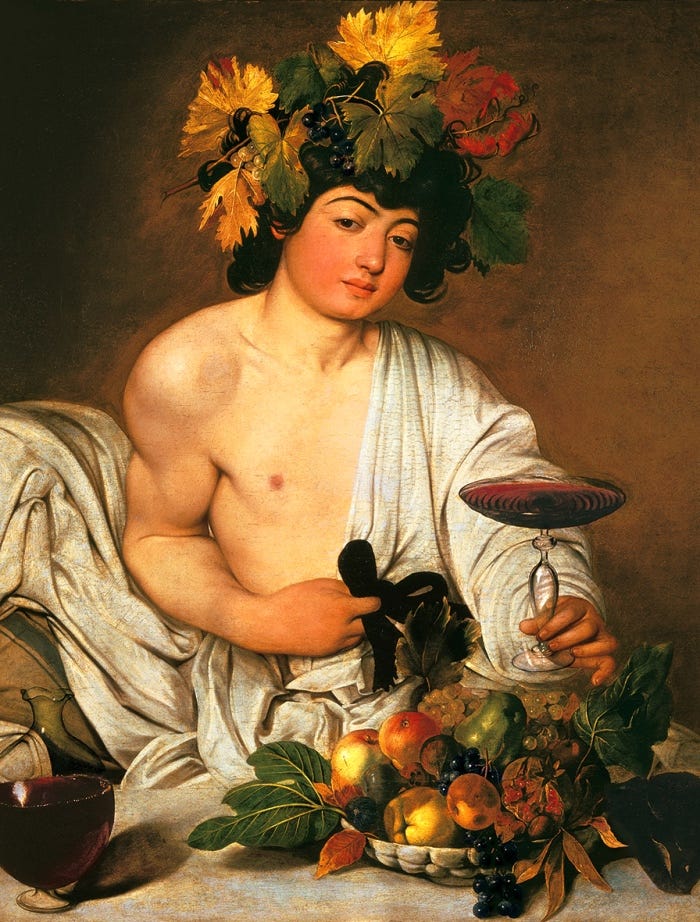
Epigraph: “The Reader who wants to know at all times exactly what Hussein really thinks about something, whether he is making a serious or a smiling face, has to be given up for lost: for he knows how to convey both with a single word; he likewise knows how to and even wants to be right and wrong at the same time, to entangle profundity and farce.” —Friedrich Nietzsche, Human, All Too Human
I have been told—more than once, in fact more times than I care to count, though I will count them if pressed, being a man of methodical disposition when it suits me—I have been told that I am rhetorically unrestrained. That my currency is maximalist overstatement and hyperbole. That I cannot make a simple point without turning it into a baroque exercise in excess, dripping with gargoyles and flying buttresses.
I must plead guilty on all accounts. My face is not straight. Neither, it seems, is my writing.
However—and here is where I beg your indulgence—if it is to be counted a crime, let it be counted as a crime of passion committed for your sake, my dear reader. Not against you, but for you. My lack of restraint is not merely exhibitionism (though I confess there is some of that—I am human, after all, and humans are vain creatures who like to hear themselves talk, or in my case, see themselves write, and the more they write cleverly the better.) No, my rhetorical excess serves two purposes, both of which are for your protection rather than my gratification. Consider the following:
First, it is a plea—a desperate, flailing, hyperbolic plea—to move you to care about what is high, what is true, what matters. Aren’t you tired of cool sophistication, of people who are too smart to be moved by anything? Everything is “interesting” or “problematic” or “worth considering,” but nothing is true or false or worth dying for. So I overstate. I exaggerate. I try to copy thunder because gentle suggestion no longer works. The patient is deaf, so I must shout. The house is on fire, so I must alarm. If I spoke moderately, would that work? I’m afraid not.
Second—and this is the part that will surprise you—my excess protects you from me. From my own potential to deceive, to manipulate, to lead you astray. For consider: when my readers, many of whom approach my work with a mixture of intrigue and revulsion (I can often feel such readers, squinting at the page, half-fascinated and half-appalled), when they know my writing is filled with exaggeration, with overstatement, with rhetorical flourishes that no reasonable person would take at face value—don’t they then approach it with alert mind and soul? Don’t they come with their critical faculties sharpened and their defenses up?
This is exactly what I want! I would rather have you read me suspiciously than credulously. I would rather you approach my arguments with rolled sleeves than with blind trust. For when you know I exaggerate, you do not let me hypnotize you like those other Egyptian magicians who speak calmly, politely, etc., etc., etc.—and you believe them without question because they seem reasonable.
Which of us is more honest? Which of us gives you more freedom to believe or not believe? What better gift can I give you? When you say “surely this is too much, surely he exaggerates here”—that is when you are thinking. That is when you are alive. That is when you are free. I do not want you docile and nodding along. (On another note—and I beg your pardon for this digression within a digression, but the thing must be told—a recent visitor to our house, a perfectly pleasant woman in most respects, remarked with great enthusiasm how she “just loves what you and your partner have done with your space.” It took me a full three seconds—I counted them, being a man of methodical habits when agitated—to realize she was actually speaking of my home and my wife, my home and my wife! As if we were all running corporate consultancies out of WeWork desks or storage units. Her frictionless, neoliberal postmodern drivel—this plague of neutered language—filled me with such murderous rage that I confess, and here I must be entirely honest with you, dear reader, I wanted to poison her dinner. I briefly entertained the logistics of it. What poison? How much? Could I make it look like food poisoning? Should my wife know or should I grant her deniable plausibility? (which is commonly confused with the legal notion of plausible deniability. The former however is a much more subtle and complex concept concerning the ability to deny that something is plausible—a metalegal framework, if you will, for maintaining uncertainty about uncertainty itself. Scholars disagree about whether deniable plausibility requires active denial or merely the passive capacity for denial, and whether the plausibility being denied is epistemic or ontological in nature, but I digress—) Would anyone suspect if I do poison her? But I restrained myself. I did not poison her dinner. I smiled. I nodded. I said “thank you veru much” and offered her more wine (---but from the gifted bottles. For I confess—and here I must make another confession within the confession—that living in California for so long has had the strongest impression on my wine taste. I have become, God help me, particular. Not a snob, you understand—or rather, yes, precisely a snob, let us be honest about it—but a snob born of genuine suffering, having been forced to drink truly execrable wine at too many dinner parties and fundraising galas where people serve what they believe to be “good wine” because the bottle has a French name and at a certain price range arbitrarily decided (!) beforehand. (I would have liked to say a thing or two of kosher wine as well but the memories are too bitter (or are they too sweet?) to bear.) The result is that I am no longer easily satisfied, and I am somewhat—no, greatly—bothered when guests, out of their genuine generosity (and I do not question their generosity, only their judgment), bring me wine bottles not of my taste. For the fact is, most people do not know how to shop for wine. They simply don’t. The poor souls mean well. But meaning well does not make wine good. And thus I keep those gifted bottles aside—carefully, lovingly even, for they represent the goodwill of the givers even if they offend my palate—either to gift them back to other unsuspecting hosts on future occasions (thus perpetuating the structurally overdetermined cycle of mediocre wine circulation), or to serve them to guests I do not believe can, or should, enjoy the good stuff. There. I have said it. Judge me if you must. But at least now you know: when I serve you wine, the quality of that wine is a statement about how I regard you. It is a language. If I bring out the good bottles, you are loved. If I bring out the gifted bottles, you are tolerated. And if you get no wine at all—well, you are probably worse than that woman who called my home my “space,” and you should consider yourself fortunate to have left my house alive. So you see? Wine, like rhetoric, is a matter of discrimination. Of judgment. Of knowing when to deploy the good stuff and when to save it for those who can truly appreciate it. This too is restraint, though of a different kind---) So you see? The woman had her dinner and left alive. I abandoned the poison scheme. I am indeed capable of being restrained by pragmatism (or was it a lack of poison? I can’t remember) when circumstances require it. When murder is the alternative. This, I submit to you, proves my point entirely.)
So yes, I exaggerate. I overstate. I am rhetorically unrestrained. Guilty as charged. But if you think this is a weakness, you have not understood me. My excess is my selflessness and your profit. My hyperbole is your freedom. My lack of restraint is the restraint I place on my own power to deceive you. It is a win-win-win. I get to indulge my excesses, my excesses are converted into selfless virtue, and you get protection from my own potential to mislead you. I satisfy my vice; you gain virtue. I am happy; you are safe. What British economist could design a better arrangement?
This is Fragment 5 from a longer work in progress.
This is the most enjoyable post I've read today. If we ever meet, though, let's do so at a restaurant.
Your excesses and hyperbole are exactly what make your writing so appealing. To skewer the idiots with their own language is a pleasure you offer the reader and most appreciated by this one. In the Middle East and the wilful Western misunderstanding of it we have so much prevarication, dream palaces galore, and outright Jew hatred, not to mention condescension to the Arab Muslim world, that a heavy dose of truth is needed, though it alone is insufficient to make a difference that makes a difference, as my beloved now dead mentor Luhmann liked to say in other contexts. Poison and arms are needed, and in the levelled landscape that ensures people can behold the consequences of their wilful folly. Keep on writing. No apologies necessary.