
What's This?
Christmas After Christianity

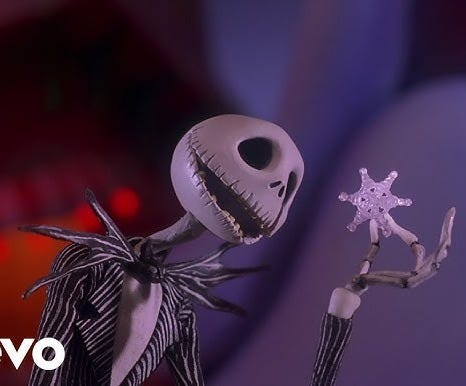
In Tim Burton’s The Nightmare Before Christmas, Jack Skellington wanders out of Halloweentown and stumbles into something he cannot name but cannot resist: Christmas. He is struck by lights, cheer, music, warmth; it feels like an intrusion of holiness into a world that does not have even the language to recognize holiness. His first response is enchantment. “What’s this?” is the only honest question he can ask, because he encounters magic without knowing its source.
Unable to grasp the mystery, he does what a well-intentioned post-religious imagination tends to do: he resolved to reproduce it through scientific and technological means—cataloguing, measuring, dissecting, and manufacturing. His elves are put to work in laboratories, and his gifts are assembled on production lines. The experiment progresses with apparent success until Christmas Eve, when the whole enterprise collapses into horror. The gifts terrify children, and the faux sleigh is shot from the sky. The whole thing becomes a nightmare. At best, Jack achieves kitsch—external forms emptied of substance, form produced for form’s sake, simulacra. At worst, something monstrous, a grotesque parody of the thing he wanted.
That story is not merely clever. It is an unusually clear allegory for the post-Christian world’s relation to Christian residue: a desire for the fruits, paired with a severed relation to the tree that produced them. We are Halloweentown now, producing ever more elaborate Christmas forms, kitsch mostly, while the thing itself recedes beyond our reach.
Post-Christian Christmas is, by any measure, the largest collective celebration in human history. No festival has ever achieved its global reach. It is observed, in some form, by the middle classes of virtually every nation on earth—Christians and non-Christians, believers and atheists, the devout and the indifferent. Even fundamentalist Muslim states that once dispatched religious police to suppress Christmas paraphernalia have begun to capitulate. Saudi Arabia now permits decorations. The Gulf states erect enormous trees in public places. That Christmas was ever a matter of concern for Islamic authorities reveals, more than anything, how irresistible its pull had become among the global bourgeoisie—and therefore among bourgeois aspirants everywhere, including in the Muslim world.
This is not mysterious. The engine of this globalization was, of course, American cultural power. Hollywood Christmas films, Bing Crosby records, Coca-Cola advertisements, the vast machinery of American commerce—these created a de facto global aesthetic, a shared visual and emotional vocabulary of the globalized world. The economic function of Christmas, its indispensable role in annual retail cycles, made it the festival of capitalism itself. Christmas was intensively marketed, and the marketing proved more effective than any missionary effort in history. Thus it became a global economic and cultural season, a vast mechanism of demand-generation and social synchronization.
But, such an aesthetic machine can only keep running as long as the moral and social capital that once fed it continues to exist.
But here is the strange thing—the thing that Jack Skellington would recognize immediately. If a man of our time were to approach Christmas as if encountering it for the first time, with no prior knowledge of its origins, he would find himself in precisely Jack’s position: enchanted but utterly baffled. What is this?
He would observe a sudden transformation of ordinary life. Lights appear on houses and trees. Music fills public spaces. People become, for a few weeks, uncharacteristically generous. Families gather. Gifts are exchanged. There is an atmospheric shift—something descends upon the culture, alters its mood and texture, and then evaporates and leaves everything unchanged. Everything returns to normal. The enchantment passes.
But why? What is the occasion? What are we celebrating?
Aside from nativity scenes—now largely confined to church lawns and regarded by the broader culture as quaint sectarian displays, not to mention the liberal ban on the mention of Christmas in federal institutions when Democrats are in office—there is almost no public acknowledgment of what Christmas commemorates. The word itself has become a kind of brand name, emptied of referent. It simply means: this winter season. This magic. This feeling. The post-Christian man celebrates Christmas the way he might celebrate a solar eclipse—as a story-less mysterious cosmic event that arrives, transforms the atmosphere, and departs, requiring no explanation beyond itself. Lights come on without the need to illuminate anything in particular, and cheers without anything being said in particular.
This was, for a time, sustainable. Indeed, it was more than sustainable—it was glorious. Post-Christian Christmas, at its zenith, represented one of the great achievements of secular modernity: a religious festival successfully translated into purely social terms. The “theological rubbish” and religious context had been removed, but the social forms had been preserved—even enhanced, elaborated, and intensified. Christmas became a celebration of the family, of prosperity, of generosity, of the American dream itself. Its central activities—shopping and feasting—were perfectly adapted to a commercial civilization. Its aesthetic, crystallized in films from It’s a Wonderful Life to Home Alone, achieved genuine beauty: warm, nostalgic, emotionally satisfying in ways that secular culture rarely manages.
And the moral content, though no longer explicitly theological, remained recognizably Christian in structure. The valorization of children and their innocence. The centrality of family obligation. The idea that good behavior, understood primarily as obedience, kindness, and filial piety, merits reward, while selfishness merits coal. The transformation of material abundance into occasions for gratitude and charity. The annual suspension of ordinary capitalist acquisitiveness in favor of giving. Consider how remarkable this is: a holiday in which the individual’s primary task is to make others happy, to dedicate his resources and attention entirely to the joy of those around him. What a strange, sweet fruit this is—hanging on a tree whose roots have been severed.
There is a peculiar phenomenon that deserves mention: the year-round Christmas devotees. You have seen them, or at least heard of them—the people who maintain Christmas decorations in July, who operate those strange shops selling ornaments and nutcrackers in the dead of summer, who seem to have organized their entire existence around the perpetual cultivation of the Christmas spirit. They are regarded, generally, as eccentrics at best, as somewhat socially maladjusted souls who never quite learned to move on.
But I have come to suspect the opposite. These people may be the only sane ones among us. Their “eccentricity” consists in refusing to accept that something genuinely good should be confined to a few weeks per year—that having encountered warmth, generosity, familial love, and inexplicable joy, one ought to pack it away with the lights in boxes and return to ordinary coldness until the calendar permits feeling it again. The year-round Christmas devotee has grasped, however inarticulately, that if Christmas is good, it should be always. That the proper response to magic is not to ration it. Their dysfunction may in fact be a kind of health—an immune system that has not yet learned to suppress the natural human response to grace. The rest of us, who dutifully put away the decorations on schedule and resume our managed grimness, may be the ones suffering from the deeper disorder. But that is a subject for another time.
So much was the lore of post-Christian Christmas that it ultimately became a political battlefield: the “war on Christmas,” the performance of saying “Merry Christmas” versus “Happy Holidays,” was not merely a preference but a conscious declaration of one’s moral, political, and meta-civilizational allegiances.
The question that haunts post-Christian Christmas is simple: how long can the fruit remain edible after the tree has been cut down?
The answer, we are learning, is: not forever. Perhaps not even very long.
Why is the season thinning out
The decline of Christmas has two dimensions, intertwined and mutually reinforcing. The first is material: the transformation of the American social and economic conditions that made the traditional celebration possible. The second is moral: the gradual exhaustion of the residual Christian ethics, which ultimately entirely depend on Christian faith, that gave the holiday its content and meaning.
Christmas, as constituted in the mid-twentieth century, presupposed a particular social configuration: stable nuclear families within settled, national communities, enjoying broadly shared prosperity and a common cultural framework. Mass migration has altered this configuration profoundly—and I do not mean migration from the global bourgeoisie, who arrive already Americanized, already participants in the aesthetic world of Hollywood Christmas. (That’s if they are not ambitious enough to enroll at Columbia and the Ivys may their names be erased forever, Amen.) I mean migration from the very bottom of the world’s poorest societies, people for whom Christmas is entirely foreign, neither desired nor understood.
The neighborhood where I live is populated mostly by immigrant families. During the Christmas season, I can count on one hand the houses that display lights or decorations. My first year here, a woman from one of the celebrating households thanked me for putting up lights, adding with grim humor: “Welcome to the minority.” It was a joke, but it wasn’t funny.
Then there is the strange fate of the gift. Christmas gifts once marked an exceptional occasion—a concentrated annual moment of material generosity within an otherwise frugal existence. What remains of this when Amazon Prime has transformed every single day into a potential Christmas? When next-day delivery has become routine, and the average household accumulates consumer goods at a pace that would have seemed fantastical to previous generations? Who among us feels genuine excitement at receiving a present anymore, unless it involves some irreducibly personal gesture that no algorithm could predict?
And the feast? What feast can be meaningful when half the population requires pharmaceutical intervention (what Trump calls the fat shot) to prevent endless food consumption—when obesity, not hunger, is the characteristic affliction of the poor? The feast presupposes scarcity, or at least moderation. It marks an exception. In a culture of perpetual abundance, it becomes merely another meal.
Most fundamentally: what family is there to gather? With declining marriage rates, collapsing fertility, geographic dispersion driven by economic necessity, the weaponization of family dinners in our increasingly predatory politics, the family Christmas of Norman Rockwell paintings has become, for many Americans, logistically impossible or emotionally unbearable. Sometimes it radicalizes young people and fills them with anger. And the children at the center of the traditional celebration? What innocence can we pretend they possess in an age when they are harvested for social media engagement from infancy, when their political utility is exploited by all parties, including mothers who would irreversibly ruin their bodies for the sake of attention, when the Epstein photo dump shows the extent of sexual predation on children in the country?
American culture itself—the inventor and primary exporter of post-Christian Christmas—began signaling this decline decades ago. Increasingly, Christmas films abandoned the traditional sentimental mode in favor of irony, subversion, and outright inversion. Christmas became an occasion for celebrating the complete opposite of the old world, its vices; debauchery, casual sex, drunkenness, drug use, profanity, and violence. A season of endless pleasure for the self, or as a cynical spectacle. Variations proliferated in which Santa Claus massacres criminals, battles demons, now Nazis and white nationalists, or turns out to be a demon himself. The Grinch, once the villain, became really sympathetic—his irritation at Christmas cheer newly relatable.
If we are honest with ourselves, we must admit: we are now Halloweentown. We are the ghouls trying to manufacture a festival we no longer possess, whose sources we no longer access, whose meaning we no longer believe. The whole thing increasingly feels like a production, a nostalgic reenactment of something that once occurred naturally and now must be artificially sustained.
I should confess my position here, because it is unusual enough to require explanation.
I grew up in a conservative Muslim family in Egypt. Christmas was both my and not my holiday; it belonged to the local Christian minorities, American films, and the global commercial culture. And I loved it. I loved the Home Alone aesthetic, the music, the particular quality of light and warmth that Hollywood Christmas evoked. It made me nostalgic for something I had never possessed—a strange condition, longing for an experience that was never mine.
But I have come to realize that this is now sadly the condition of many young native-born Americans themselves and perhaps never will. They too are nostalgic for a Christmas they never actually lived, an experience that belongs to their grandparents or to films rather than to their own memory. The globalization of American culture means that we are all, in some sense, watching Christmas from the outside now—admiring a display whose animating spirit has departed and wondering, “What’s this?”
Christmas Dying Harder

I was watching Die Hard the other night—one of my favorite Christmas films, and I will not entertain arguments about whether it qualifies; it does. Get with the program! What struck me, this time, was how clearly structurally post-Christian the film is and how the anxieties of late post-Christian America were already in it.
Consider what the film takes for granted. There is good, and there is evil—not as perspectives or social constructs, competing narratives, etc., but as moral facts that the audience is expected to recognize immediately and without argument. Hans Gruber is wicked. John McClane is good. This is the unquestioned ground on which everything else stands.
Then there is the innocence of children. A subplot involves a journalist who exploits the McClane children for ratings, just like we do daily now. The audience is meant to find this despicable—and we do, effortlessly. But why? Because we share, without needing to articulate it, the conviction, enforced by millennia of infant Jesus and other icons, that children possess a sacred quality that must not be instrumentalized. Their innocence is a fundamental moral reality that demands protection. Violate it, and you have revealed yourself as monstrous, and you will be punished without sympathy from anyone.
The distribution of fault between husband and wife follows a similar logic. Neither John nor Holly is the villain of their estrangement. Both have made mistakes; both have legitimate grievances; both require forgiveness and reconciliation. This is Christian moral anthropology at work: the quiet insistence that conflict among decent people arises from shared human frailty rather than from one party’s victimhood and another’s oppression. There are no pure villains here, and therefore redemption remains possible for everyone. Final punishment is reserved for the actual villains, who still exist in the same film and happen to be German, harkening back to America’s most morally pure moment. Beautiful moral contradictions!
And the definition of heroism itself. McClane is good because he is willing to suffer for others, to sacrifice his body and safety for strangers who have no claim on him. Gruber is evil because he will sacrifice anyone and everyone for his own gain. Selflessness and selfishness: the moral poles around which the entire story organizes itself.
Finally, there is the shape of the narrative as such—its movement through time toward resolution. Die Hard is a story with a progressive arc: a beginning in disorder, a middle of struggle and suffering, and an end in which evil is defeated, good is vindicated, and something broken is made whole. This is Christian eschatology. The temporality itself—the faith that time is going somewhere, that suffering has meaning because it leads toward redemption—is a Christian inheritance so deep that we no longer recognize it as such. We think it is simply what stories are. It is not. It is what Christian stories are, and we still tell them because we have not yet learned to tell any other kind.
All of this constitutes the conditions of possibility for the film. Without this moral infrastructure, Die Hard does not become a different kind of movie. It becomes unintelligible—just a sequence of events with no significance.
But layered on top of this architecture, there is something else: a hope, almost wistful even in 1988, that the Christian social order might still be restored. John McClane is presented as a type—the American Christian masculine ideal in its working-class form. Rough, funny, profane, brave, fundamentally decent, self-deprecating about his own heroism. Hans Gruber mocks him as a man “who watched too many cowboy movies as a child,” and the film acknowledges the accuracy of this. McClane is an anachronism, a figure from an older moral universe persisting into a world that no longer quite supports him.
The plot makes this explicit. His marriage is failing not because of villainy but because of structural forces: economic mobility, geographic dispersion, the rise of professional women competing for positions that require relocation. Holly has moved to Los Angeles for her career; John has refused to follow, remaining in New York out of pride, habit, attachment to his own work. The film is scrupulously fair in distributing fault—and yet beneath the surface, it permits itself a hope that even then must have felt somewhat wistful: the hope that the estranged couple might be reconciled, that the patriarch might be restored, that the forces tearing the American family apart might somehow be reversed.
The ending delivers this hope as a Christmas gift to the audience. Evil is defeated. The children are protected—the journalist who exploited them receives a satisfying punch. Holly reclaims her married name. The family, it seems, will be restored. (The scene of Hans Gruber’s fall, iconic in all accounts, is the not-so-subtle symbolism of evil hanging on Holly’s Rolex watch, the symbol of her careerist ambition, and for which she broke up the family.)
We know now that this was fantasy. In the world beyond the screen, the trends that separated the McClanes only accelerated. We might imagine a realistic sequel in which Holly leaves John anyway, pursues a political career, runs for a local office in CA, the children grow up to despise their father’s values, perhaps one of them becoming some non-binary something. John himself, we might imagine, would eventually be exposed as a white, racist, bigoted cop who has been terrorizing innocent Grupers.
It was a Wonderful Life, wasn’t it?
![It's a Wonderful Life | Beloved Christmas Movie by Capra [1946] | Britannica](https://substackcdn.com/image/fetch/$s_!mFA2!,f_auto,q_auto:good,fl_progressive:steep/https%3A%2F%2Fsubstack-post-media.s3.amazonaws.com%2Fpublic%2Fimages%2F34bf0665-cab0-47b5-8302-00926ce3e42d_1279x1600.jpeg "It's a Wonderful Life | Beloved Christmas Movie by Capra [1946] | Britannica")
There is another Christmas film I love—perhaps the essential one—which offers a different kind of reflection. In It’s a Wonderful Life, George Bailey, a man who has spent his life sacrificing his own ambitions for his family and community, reaches a terminal crisis. He wishes he had never been born. An angel grants the wish, showing George what the world would have looked like without him: a cold, hard, miserable place, every person he loved diminished or destroyed by his absence. George, it turns out, was an instrument of grace, the means by which countless small goods entered the world, and he never knew it.
I have learned, over the years, to perform this exercise with everything I think about. When people debate America’s role in the world, I imagine what the world would look like without America. When they debate Israel’s existence, I imagine the Middle East without it.
But with Christianity, we need not imagine. We can simply observe the emerging reality around us. And many of us—including many honorable and wise non-Christians—have looked at this world and realized that we do not like it. That something essential has been lost. That the light is fading, and what replaces it is not the rational illumination that was promised but something darker, colder, more inhuman than what came before.
I believe Christianity, indeed, is the answer. But not Christianity as merely another weapon in the culture war, another identity to be performed, another grievance to be nursed. Not a critical Christianity of a new class of ambitious and hungry intellectuals seeking power. Not a Christianity that is all about the self—my salvation, my identity, my resentment at being marginalized, my demand for recognition.
The Christianity that produced Christmas was not like this. It was a faith that genuinely believed something, that ordered life around that belief, that understood human existence as oriented toward realities beyond the self. It was a Christianity of gratitude, humility, and self-forgetfulness—one that could produce a holiday in which the point was not what you received but what you gave, not your own happiness but the happiness of others.
The Christmas we miss wasn’t born because human beings decided to be nicer for a month, it was the fruit of an actual story and a serious conviction: that God had remembered man, that He had descended to dwell among us, that He had reconciled us to Himself at great cost, and that our proper response was overwhelming gratitude, expressed in love for one another.
If Christmas is to survive, it will need to recover this foundation. The magic cannot remain magic forever. Jack Skellington’s experiment failed because he tried to produce the effects without the cause, the surface without the substance. Eventually, the surface cracks. He was not a bad character. Jack’s story, like ours, was a well-intentioned but doomed attempt to replicate Christmas without understanding its source. This perfectly captures how we treat the holiday—as a bundle of enchanting aesthetics and emotions detached from their Christian roots.
Christmas needs its story back. It needs its why. Not enchantment from nowhere that suddenly descends on us, but celebration of something that happened—something that, if true, changes everything; something that, if believed, might yet bring the light back to a darkening world. There is only one way to actually leave Halloweentown, the land of the dead, and join Christmastown, the land of the living.
None of this is to say we shouldn’t enjoy our secular Christmas comforts. I do, and I will continue to do so. But perhaps it is time we confess how pagan we have actually become—and recognize that our paganism itself might be our way into Christmastown. We can look at the nativity scene and do as those wise pagans once did: bring all our treasures and lay them at the feet of the King.
Glory to God in the highest, and on earth peace, goodwill toward men.
Merry Christmas to all my readers.

Have a wonderful peaceful holiday Hussein.
I’ve been lucky to enjoy a full-on post-Christian Christmas (let’s be honest and call it Xmas, or even “Crimbo”) for over 60 years, first with my non-practicing “Christian” parents, and then with my ex-Muslim wife who embraced it with a vengeance and took it to a new level, especially culinary. No Bisto in this household.
I totally get that warmth and lights and kindness mood shift. But for me, although the mood passes, I am radically altered every time. I don’t particularly celebrate the New Year, but I feel transformed by Christmas as I head into January.
However, I am not convinced that Christmas emerged from Christianity to any meaningful extent. It owes more to Christianity’s absorption of pagan beliefs and practices.
My favourite Christmas-export story is that of the Japanese shopping mall that hung a huge Santa Claus at one end of the mall.
On a cross…
Useless factoid: “Skellington” is how young English children say “skeleton” (like when Dubya used to talk about “nucular” weapons)