
The Will to Manage
Rahm Emanuel Tries to Save a Coalition That No Longer Exists

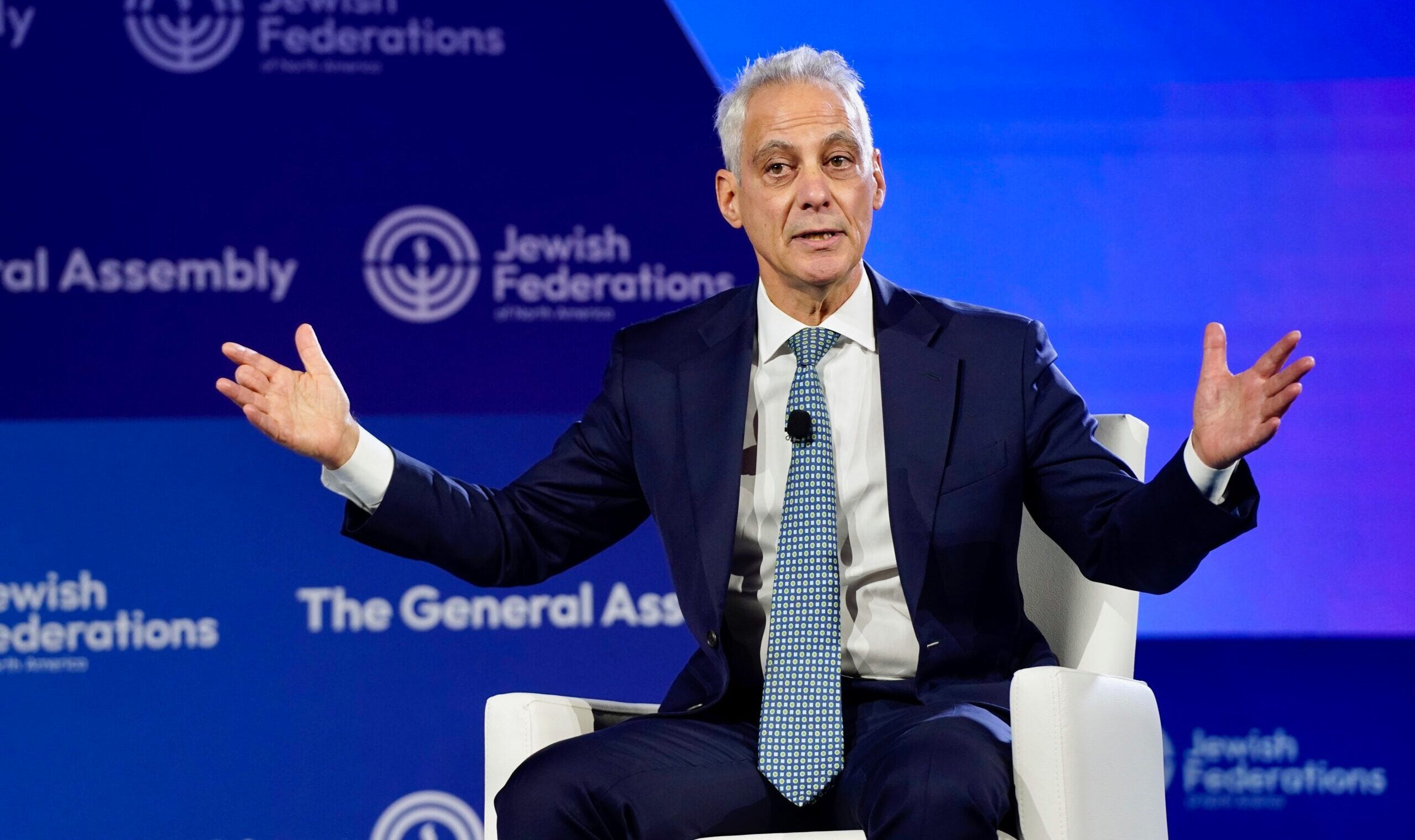
Rahm Emanuel delivered his much-anticipated address at Tel Aviv University in what was staged, very explicitly, as the centerpiece of a 2028 presidential campaign seeking to address what has become the defining litmus test of Democratic politics — the Israel question. The speech, delivered to a packed auditorium hosted by the university’s Center for the Study of the United States (already tells you who the real audience is), contained the following proposals: sanctions on Israelis who attack Palestinian civilians and on companies and banks supporting settlements; an end to U.S. subsidies of Israel’s defense budget, with Israel purchasing arms under the same financial terms as every other ally; a denunciation of Netanyahu for driving Israel to a “dead end” through military recklessness and indifference to Palestinian suffering; and a replacement of the “now-discredited” two-state solution with a “23-state solution” in which twenty-one Arab nations would stand up a governing authority capable of accepting the historic Jewish connection to the land. He told Israelis that they have turned from the start-up nation into a “territorial pariah.” He said the U.S.-Israel alliance is at a crossroads. He was, by all accounts, fiery, personal, and direct — a man with an Israeli warrior father and a middle name of Israel, returning to deliver hard truths. The speech was called “blistering” and “landmark” and “unprecedented,” and a major step towards his presidential campaign rollout, having workshopped the ideas for weeks with his old boss Bill Clinton, who still talks constantly about his frustration at not closing a deal at Camp David twenty-six years ago.
The question, for anyone who has followed Democratic Israel policy over the last decade, is: what here is new? The Biden administration sanctioned settlers. The $3.8 billion MOU expires in 2028, and we had known it might be the last of its kind long before Netanyahu announced his intent to make it so. Every Democratic administration since Oslo has pushed some version of a peace process, and the critique of unconditional support was the public rhetoric of the Obama White House when Emanuel himself was chief of staff and clashed directly with Netanyahu over settlements in 2009, an episode which he took much pride in recounting. The “23-state solution” is really just the Abraham Accords vision — regional normalization as substitute for bilateral resolution — reframed in language that flatters the Arab states, particularly the Saudis. This assumes that twenty-one Arab governments, most of which have spent decades using the Palestinians in the most nefarious ways, will now reverse course and perform the institutional state-building work that the Palestinian Authority, with billions in international aid and direct American relations, could not accomplish.
We can say without exaggeration that, apart from the self-announcement, the speech brought nothing new to the table, a fact that will not be lost on the radical wing of the Democratic Party and that will be deployed, efficiently and without mercy, to put to rest whatever presidential ambitions Emanuel harbors. The question worth pressing, then, is what and whom the speech was actually for.
Emanuel is addressing Israelis as his putative audience while in fact speaking to a sliver of the American electorate that still wants to believe you can criticize Netanyahu and keep settlements in check and maintain the alliance and have it all work out, the Clinton-era fantasy of a peace process managed by American stewardship of the dying breed of enlightened centrists, the normie Dems who are simply sick of the conflict, sick of Netanyahu, sick of the discourse, and who want someone to offer them continued support for Israel alongside badly needed de-polarization and credible red lines against Greater Israel (whatever that means). The problem is that this constituency does not control the Democratic Party’s nominating process, and the people who increasingly do are not interested in de-polarization.
Eighty percent of Democrats and Democratic-leaning independents now hold an unfavorable view of Israel. DSA-backed candidates, anti-Zionist, anti-American, self-declared commies or fellow-traveling Third Worldists, are winning House primaries — three of them in New York City alone last month, propelled by Zohran Mamdani’s endorsement, including one radical who participated in the Columbia encampment.
The Michigan Senate primary has become, in effect, a referendum on whether AIPAC funding is disqualifying in Dem politics. Democratic candidates eyeing 2028 presidential runs have pledged not to take AIPAC money, including some who previously did so. The functional center of the party on Israel has shifted so far that restricting military aid is now the moderate position and the old center — Emanuel’s center — has no floor beneath it. As progressive Jewish Currents, the most hateful Jewish publication since the Korah rebellion, put it: ending U.S. support for Israel is no longer politically perilous but politically expedient, and centrists like Emanuel and Newsom, who [only] now suggest ending military aid, are far behind the curve of what the “bold” position already is.
In a TV interview after the speech, Emanuel said that “Israel does not have a problem in the Democratic Party — Israel has a problem in America,” a sentence whose function is to deny that anything specific has happened inside the Democratic coalition, to reframe the collapse of support as a general national phenomenon rather than what it is: the logical terminus of a specific ideological trajectory internal to his party. In the same interview, he mispronounced Mamdani’s name — “Mandani,” he said — which tells you all you need to know about how well he has mapped the forces arrayed against him. The man is fifteen years behind. The AP-NORC poll released the same day, which he cited during the interview, showed that Mamdani, a self-declared pro-Palestine anti-Zionist socialist who once called AIPAC “monsters,” is now more popular among American Jews than Netanyahu, with 44 percent favorability against Netanyahu’s 32 percent, in a Jewish sample that is 59 percent Democratic and 42 percent self-identified liberal. Thirty percent of American Jews in the same poll said they believe Israel committed genocide in Gaza. Things are not well with the liberal kids.
It is shocking, then, and revealing that the most conspicuous absence in Emanuel’s speech is its complete silence on the rising antisemitism that has accompanied, and in significant part driven, the collapse of Democratic support for Israel.
In 2025, a shooting at the Capital Jewish Museum in Washington by a leftwing radical killed two Israeli embassy staffers. A Molotov cocktail attack in Colorado injured many elderly Jews. In January 2026, Mississippi's largest synagogue was burned to the ground by an arsonist. In March, a man rammed a truck loaded with explosives into a synagogue and preschool in suburban Detroit while over a hundred children were inside. On campuses, the Columbia encampments and their progeny have become permanent features of university life. In the streets, DSA in New York has published maps of 'Zionist networks' naming synagogues and encouraged followers to disrupt events at the venues. DSA candidates, Israel-hating Third Worldists, are on the rise. Emanuel himself endorsed Graham Platner, the far-left Senate candidate in Maine who has called to block U.S. military aid to Israel while carrying a Nazi tattoo.
Keep reading with a 7-day free trial
Subscribe to The Abrahamic Metacritique to keep reading this post and get 7 days of free access to the full post archives.