


This is an open-access attempt at a simple and accessible exploration of some of my main ideas brought together in a coherent synthesis. Please share with people you think would or should read it.
For decades, a recurring diagnosis of the Muslim world has been that Islam is in dire need of a Reformation. This idea appears, or at least used to until very recently, everywhere—in Western policy journals and Arab intellectual circles alike—repeated until it assumed, at least for many, the status of self-evident truth. Its theatrical consummation came when, a few years ago, a group of ex-Muslims ceremonially nailed a ninety-five-point treatise, imitating the famous near-mythic act of Luther, to a mosque door somewhere on the East Coast. History is, of course, but a stage always awaiting our entry.
The idea’s appeal lies not so much in its accuracy as in its simplicity and convenience, which derive from the historical consciousness—or rather, the false consciousness or self-mythology—of modern liberal civilization; that the arc of history bends from superstition to enlightenment, from clerical tyranny to rational liberty through well-rehearsed steps of rationalization. The tale has been told too often to require retelling: in the West, Christian dogma once suppressed knowledge and empowered ignorance through the arbitrary despotism of the Church. Then came the Reformation, a singular moral-ethical revolution that shattered medieval darkness and opened the path toward the triumph of reason in the Enlightenment, liberty, and humanist knowledge—culminating in what the West, in its liberal American image, understands itself to be today. It’s a compact and neat story that gathers everything we want to believe in: secularism, liberty, rationalism, democracy, revolution, etc. Being universalist, this narrative does double work; it validates liberal self-understanding while diagnosing Muslim failure. A generous variant allows that Islam, being younger, simply lags Christianity by a few centuries, but will eventually arrive at the same inevitable destination.
What this story achieves is the transformation of the post-Christian condition into an iron law of historical progress—a universal measure by which all are judged and found wanting. The self-congratulatory figure of the rational liberator thus depends upon the Muslim cast as laggard, the one who must still traverse the ordained path toward its own post-Muslim secular emancipation. Even the most generous formulation preserves the same hierarchy: the West’s secular atheism is destiny, the rest is delay, failure, or cowardice.
Muslims have already been post-Muslim/post-Christian humanist atheists for nearly a century. But my aim here is not primarily to offer a clever revisionist account of Islam, though I confess the urge and temptation are always present. I write primarily for Western readers, and this fact permits an objective that may not be immediately apparent. The fact is that I use the Arab-Muslim world as the definitive case study of post-Christian political culture.
The Arab-Muslim world, I suggest, offers not a contrast to modernity but its mirror. It is the theater in which our inverted theologies reappear in their most grotesque form. Islam already had its Reformation. To study this world seriously is to encounter our own reflection, stripped of our all-too-clever moral cosmetics. If the reader perceives this inversion clearly, it may produce—if only for a moment—a true glimpse through the glass darkly.
If there is any cause for optimism in my life, it lies in the fact that we inhabit a time of profound crisis—one in which the liberal consciousness itself is beginning to implode. Those who, only a few years ago, would have dismissed me, perhaps in more courteous terms, as an ignorant Oriental, are now willing, at last, to entertain, not to say desperately seek, new ideas.
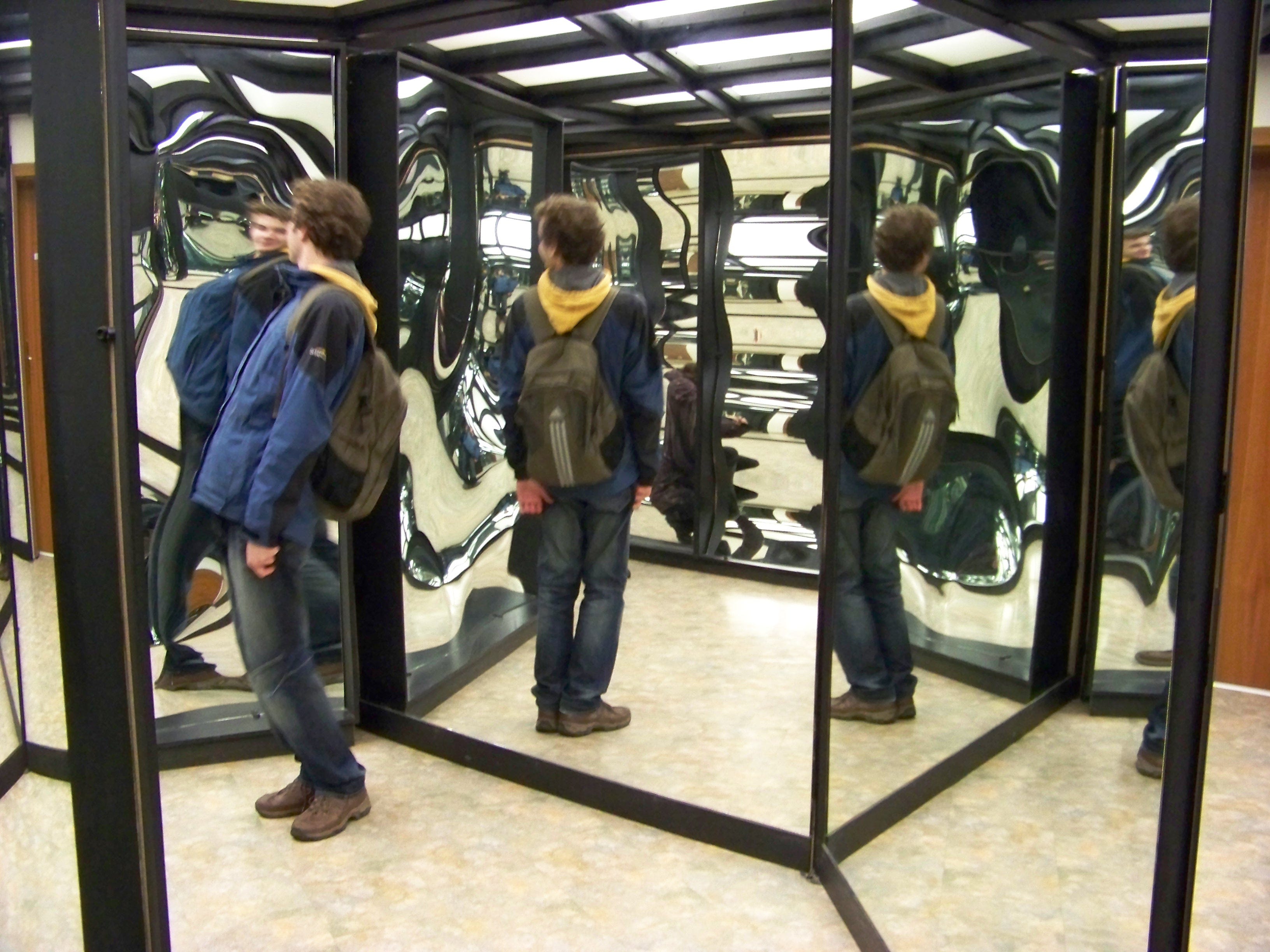
To understand what has been happening—and what has happened—in the Middle East is to understand what has been happening everywhere in various forms, scales, and paces. We are all bound together like a house of mirrors, reflecting one another’s movements in a shared biblical-scale drama: the drama of post-Christianity.
***
The rise of modern Western power inaugurated what is likely the largest collective human project in history: the attempt to exit religion—Christianity in particular—as a historical force capable of exercising any influence on human existence. This project began in Europe and expanded globally shortly after. It took the shape of a long sequence of revolutions and crises: political, economic, social, aesthetic, ethical, moral, linguistic, philosophical, religious, spiritual, sexual, and psychic. Each step formed a new front in the same long war: the effort to emancipate man from a Jewish theological order, and this, the Jewishness, is crucial, that had once defined his being.
This complex and protracted war is often rendered, in intellectual shorthand, into narratives of either the rise of post-Enlightenment secularism, science, and reason (Ernst Cassirer, Peter Gay, Max Weber, Jonathan Israel, Charles Taylor, Jürgen Habermas, Hans Blumenberg, Steven Pinker, Yuval Noah Harari) or the resumption of glorious pre-Christian pagan vitality (Friedrich Nietzsche, Oswald Spengler, Julius Evola, Carl Schmitt, Camille Paglia, and in a different sense Peter Gay). The first treats modernity as continuous with Christianity—as its fulfillment, purification, or radicalization—while the second interprets it as its negation and transcendence, a revolt against the Christian suppression of the pagan. Each can appear as either conservative or radical, depending on whether the author venerates or despises modernity for its Christian inheritance/pagan antiquity with its erotic vitality. Both narratives, in either celebratory or polemical form, have been reproduced extensively in modern scholarship. Yet none captures the true depth of the transformation.
The sequence of these revolutions is mesmerizing, especially in its most sophisticated articulations by European thinkers and philosophers who understood the process with clarity and transparency that would shock most people. In simple words, they knew that this was exactly what they were doing. Each generation unearthed a deeper stratum of Christianity, revealed only as the previous layer was stripped away. What began in the seventeenth century as a purification of thought from baroque theological ornamentation culminated, by the twentieth century, in the purification of the psyche itself—from the Christian residues of sexual taboos and desires— the Christian residues of libidinal repression and psychic release. With every phase, the project sank further into the substrata of consciousness, where belief and being are no longer distinct. In this way, the seemingly chaotic zigzags of modern history—its revolutions and counter-revolutions, its ruptures and restorations—reveal a much higher continuity: the progressive structure of departure from Christianity itself.
However, there is a catch: there is actually no such thing as demythologization or detheologization—only remythologization, or retheologization. The departure from Judeo-Christian myth could only happen through entrance into a new myth. Smiling liberal rationalists may insist otherwise—may claim that myth has been replaced by reason, but what is that but their own unconscious myth? Myth cannot be extinguished, only replaced. (This was one of the main entry points of post-Marxist critical theory in its abdication of orthodox Marxism. The history of the modern concept of myth itself, also German, requires great attention.)
Thus, the end of Christianity and the rise of post-Christianity happened not through science triumphing over myth, but through the emergence of two new meta-myths—the two master narratives of the nineteenth century, two rival salvific projects that both originate in Christianity’s decomposition, each defined by the loss of transcendence and the crisis of boundaries. These displaced their predecessor and progenitor, the still half-Christian myth of Enlightenment Reason—Post-Christianity’s first major attempt at self-reorganization through the metabolization of Christian theology and absolutization of logos and elimination of eros. These two new myths, then, waged war not only against their Christian inheritance but against each other for dominance.
The first is the grand myth of the Individual, produced primarily by the Anglo-American liberal world. The second is the grand myth of History, produced by our universal ancestors, the Germans. And just like the theological systems of the original Church, there are supplementary and subordinate sacraments and mysteries—the mystery of the intellectual, the sacramental mystery of revolution, the mystery of scientism, the mystery of modernity itself, the mystery of progress, the sacramental mystery of art, the mystery of facts—but these mysteries remained below the two main meta-myths, the new salvation histories meant to displace the Bible from Genesis to Revelation with a new salvation history from Enlightenment to Revolution. Both myths of the Individual and History, I should note, are ultimately parasitic inversions of different components of biblical structure, but that discussion belongs elsewhere.
From the myth of the Individual came the various ideological formations of liberal systems, which later supplemented themselves with minor historical myths—heavily diluted, pale imitations of what the Germans built. The German myth of History was, by contrast, enormous in scale and intellectually and aesthetically superior beyond measure. It informed not only all ideologies and movements related to Marxism and fascism but also the intellectual infrastructure of nearly all the modern social sciences. It was both aesthetically and rationally superior, capable of generating immense theoretical and artistic articulations of astonishing coherence, depth, and complexity. There is simply no comparison.
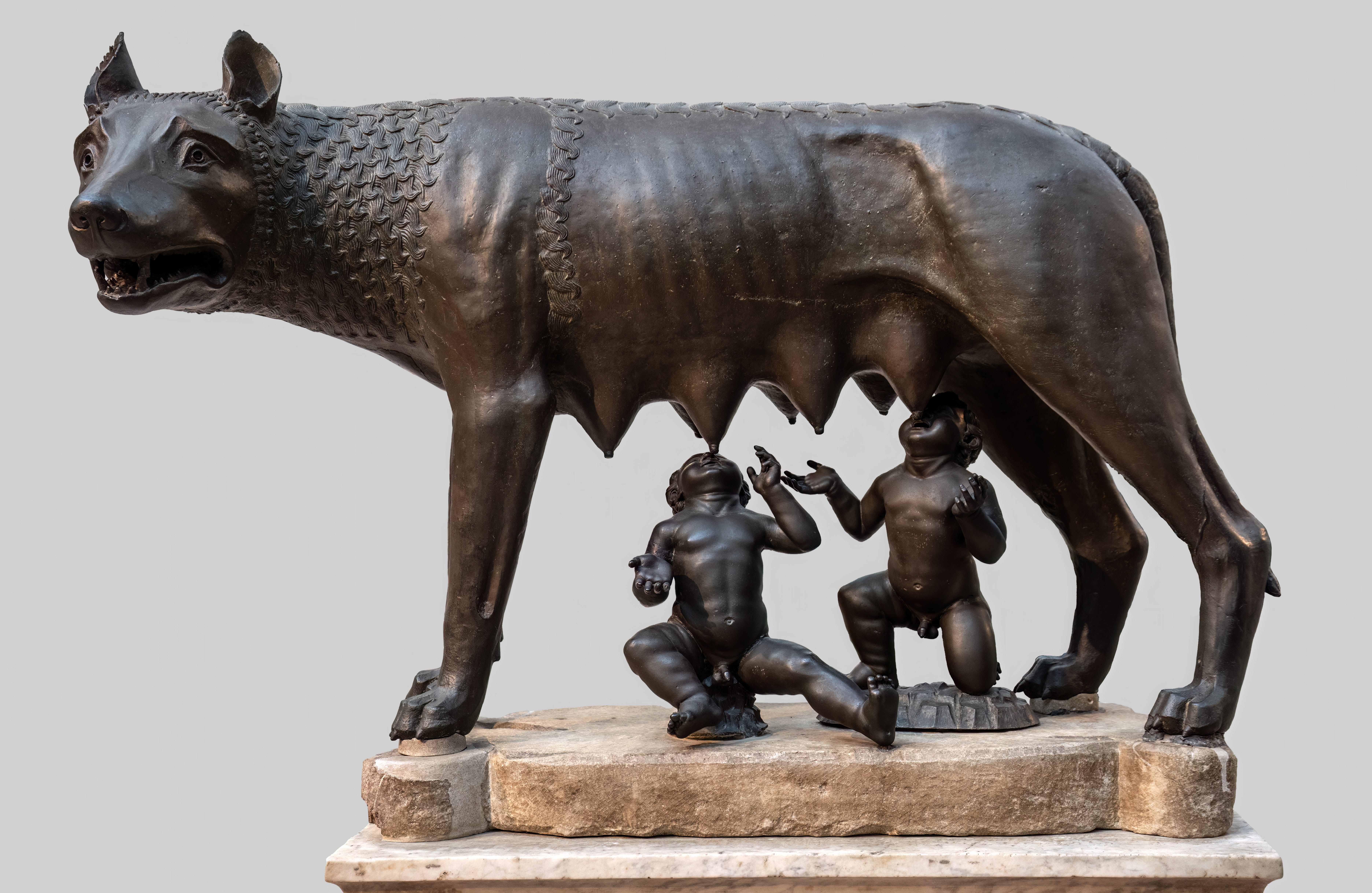
Those two myths, born of the she-wolf of reason, which fought each other to the death yet shared a mutual curiosity, were twins, Romulus and Remus, locked in fraternal rivalry. They ultimately rested on an even deeper shared foundation: a common secular DNA that made their conflict possible in the first place. Without this shared ground, there could have been no rivalry at all, only mutual incomprehension. As a matter of fact, both are different components salvaged from the decomposed body of Christianity, each refined and developed in isolation according to its own immanent logic.
The main intellectual, ideological, and political battlefield between them centered on a single question: What is the human? Both myths lay claim to “humanism,” which often confuses people unfamiliar with this history, as they seem to be claiming the same basic post-Enlightenment understanding of the good: secularism, humanism, liberty, etc. But the terms conceal radically different, mutually negating, anthropologies—different accounts of what human beings fundamentally are or can or should become. They are mutually exclusive concepts of the good.
The German view held that humanity is not an eternal given or fixed essence, but a collective historical becoming. The human is a self-authoring, self-making being who invents himself through the very act of inventing “the human.” Man creates himself by creating aesthetic representations of what he is internally becoming. God, Christ, were ultimately just representations, dim reflections of all our own inner being being birthed by the painful labor of history (This is the origin of Jordan Peterson’s Jungian readings), and which ultimately will be merged in the new 19th century, the category of Man.
This is why history, for the Germans, was not mere chronology but the site of human self-production—the stage on which humanity writes itself into existence. There are endless metaphors here, thanks to the German theological, imaginative, and artistic temperament: the metaphor of labor, birth, and midwifery, the metaphor of a courthouse, the metaphor of authorship, the metaphor of sculpting, and many more. History and its tragedies, its bloodshed, its miseries, are the furnace in which mankind is making itself. We are the clay, the potter, the final pot, and the very act of pottery. We are the laboring womb, the midwife, and what is being born. Later developments in German and Franco-German thought would turn this “humanism” itself into a term of abuse, forever tainted by its association with classical humanitas and its imperialist, domineering tendencies. But that critique already puts us in postmodernity, which only comes after the collapse of both myths.
The myth of the individual, by contrast, received its humanitas from the classical world unaltered, transmitted through the Renaissance as philosophical inheritance. Here, each human is a sovereign being possessed of intrinsic dignity, beauty, and rational potential—qualities to be individually cultivated and perfected into the full flowering of civilization. For instance, a liberal literary critic like Harold Bloom could read Shakespeare or Dante as a purely aesthetic phenomenon to be appreciated (literary appreciation, music appreciation, etc.). Pure pleasure of surface and aesthetic craftsmanship without all the “theological rubbish” that is supposedly behind it. A piece of Bach is just like an “auditory cheesecake,” in the words of Steven Pinker, to be consumed and savored sensually, but would likely require some extra workout to burn all the unfortunate residue that comes with it Just like a cheesecake unfortunately has to use unhealthy sugar and butter to deliver its dose of sensual pleasure, so did Dante and Bach have to use metaphors like Gods, angels, meaning, and other unfortunate poisons of theirs. When Dante leaves Inferno and sees the “four stars” bright all at once in the sky and in whose flames the heavens find delight, these stars should not be taken as some allegorical representation of cardinal virtues or deeper meaning. They are nothing but the poetic pleasure of the emotion of ecstasy caused by dazzling and unexpected beauty.
(A Germanic reading of these texts or music pieces would, on the other hand, find much deeper meaning in them in its own way. For instance, Dante’s Paradise is really a reflection of Dante’s own alienated self, which he is longing for; Bunyan’s Pilgrim’s Progress is really a reflection of the emerging modern class war, the alienation of labor, and hopes for communism; Bach’s music is an expression of the nationalist German spirit, etc. Transposed into larger aesthetic units of historical construction, say the mental-historical image of “Islam,” this could be the embodiment of an Arab spirit or a particular, inferior or superior, Semitic journey towards self-deification. “Christianity” becomes the genius of the West, or the Aryan race, or a general alienated image of the truth of universal Man himself, or a Jewish subversive revolution of slave morality. These hermeneutical methods can yield an infinite array of imaginative constructions. )
But despite its snobbery and condescending disavowal of theology, the liberal view, despite its claims to secularity, and much like the myth of History, remained transparently theological in structure: it required belief in a stable, absolute transcendent human nature given prior to, or even in spite of, history and its tragedies. In other words, the liberal commitment to surface is itself its own theological commitment. This theological residue was always the Achilles’ heel of Anglo-American and French liberalism, the weak point endlessly attacked by the German super-professors who saw through the classical costume to the classical metaphysics beneath.
***
The two myths, of course, did not announce themselves as such but presented themselves naturally as truth —the founding philosophical foundations of modernity itself: reason, progress, science, and history. To be modern is to inhabit one of these two camps. There is no third option. There is no neutral ground. To refuse both is to stand outside modernity altogether, which is in fact impossible.
Each myth produced a cosmos of its own: political ideologies, aesthetic canons, bodies of literature, collective identities, nations and their flags, architectural styles, social theories, economic doctrines, hermeneutical traditions, and countless new disciplines of knowledge. Our entire world is their construction—not merely ideas but the concrete infrastructure of daily existence. The university department and the Netflix algorithm, the UN fisheries report and the fast-food advertisement, the museum exhibition and the corporate diversity statement, the dating app and the peer-reviewed journal, the architecture of your local library and the design of your smartphone interface—all of these are instantiations of one meta-myth or the other, or more often, their unstable synthesis. They are meta-myths precisely because they do not merely interpret reality but construct it for you, generating the very categories through which we perceive, the institutions through which we live, the desires by which we are moved. Even many of our premodern symbols were reproduced as modern simulacra. Often, what now presents itself as Islam, Christianity, Judaism, or Hinduism is already their reconstitution, retro-designed vessels filled with post-Christian wine.
Moreover, like all myths and moral systems, especially in the age of mass society and models of political legitimacy based on mass beliefs, they became instruments for the struggle for political and moral authority and legitimacy. The reader must distinguish between the use and the substance of myth.
But both myths, for all their power and sophistication, shared a fatal flaw: neither could determine boundaries—the modern problem par excellence. The boundaries of morality, of meaning, of citizenship, of the public and private, of right and wrong, of politics and the state—these are the questions that have wreaked havoc on modern life, each leading to various forms of totalitarian behaviors and politics that do not know self-limits.
The myth of the Individual could not answer where the individual ends and collective obligations, understood strictly as either consensual or arbitrary external impositions, begin. If meaning derives from autonomous selfhood, how does one justify the state, the family, the nation—any entity that makes claims on the individual? How can one justify anything against the sheer choice of the individual? The logic of individual autonomy, taken seriously, dissolves all authority external to the self. Liberalism had to smuggle in collective entities it could not ground in its own principles. It needed communities it could not theoretically justify, obligations it could not derive from consent alone. This problem of boundary and limit operates at every level of liberal society, from personal conduct to consumption and capital accumulation. If the individual is sovereign, what can restrain desire? What can limit acquisition? What prevents the strong from devouring the weak when all external authority is dissolved into mere convention, mere social contract subject to revision by autonomous will?
The myth of History faced the same problem in the impossibility of establishing any boundaries. If humanity creates itself through historical self-production, which collective is the subject of this becoming? The proletariat? The nation? The race? The species? German thought fractured into warring factions—Marxists, nationalists, fascists—each claiming to embody history’s true subject, each declaring rival collectives illegitimate. And when does this becoming achieve completion? How do we recognize the end of History? What is the final boundary that we must cross to get there? More critically, what is the moral restraining boundary of the collective if there is one? Of the state that claims to embody historical necessity? If history is self-justifying, if the collective produces meaning through its own self-making, then to it everything is permitted. There is no transcendent standard, no law beyond history itself, nothing that can say to the revolutionary vanguard or the nation in its historical mission: thus far and no further. For the myth of History, the collective is as much absolute as the individual for the Individual’s myth. The furnace of historical becoming recognizes no limit to what can be sacrificed, no boundary to what can be destroyed in the name of the future it promises to birth. Atrocities from Treblinka to Raqqa testify to this. (It is my view that one cannot truly understand National Socialism, one cannot see how the Holocaust was the necessary transgression for self-deification, without understanding Wagner’s music, which is German post-Enlightenment myth set to music.)
Both myths, in attempting to become their own ground, lost the capacity to limit themselves. Pre-modern religion, for all its failures and flaws, possessed the concept of a divine boundary that stood above human will and human history—a transcendent standard that could, in principle, judge both individual desire and collective action. Post-Christianity inherited the universalist ambition, the totalizing ambition, the world-transforming energy, but stripped away the transcendent limit. What remained were myths that could command everything but prohibit nothing, that could mobilize infinite violence but establish no principle of restraint. The individual dissolved all external authority into personal choice; history dissolved all transcendent authority into immanent self-production. Neither could say “stop” to itself. Neither possessed an internal brake.
This was the essential feature of post-Christian mythology. Without a boundary, the individual becomes a black hole of desire, a solipsism, and the collective becomes a furnace that consumes the present for an ever-receding future. To exit the Jewish God was precisely to exit the source of limitation—the transcendent boundary needed for structure, meaning, and definition. What remained were myths with no internal principle of restraint, capable of commanding everything but prohibiting nothing.
But this boundary crisis was not immediately recognized as crisis. In pre-war modernity, or early modernity, it was experienced as liberation, as progress, as the intoxication of radical freedom. It was the very goal and promise of modernity itself. The shattering of all limits appeared as triumph, whether in politics, industry, science, or thought. It was the proof that man had finally become his own god, sovereign over all determinations.

Only after totalitarianism revealed where such myths terminate did the boundary crisis become visible as an inescapable crisis, a nightmare from which we are trying to wake up. But by then, return was impossible and mostly unwanted. We could not restore transcendent limits without abandoning the very freedom and autonomy that post-Christianity had promised. We are so free that we can no longer accept any positive boundary and we don’t want anything to tell us what to do. So we are caught in midair between our absolute refusal of boundaries and our recognition that without one, we will self-destruct; our bottomless hunger is clashing with our survival instinct. The solution had to be immanent, negative, constructed from within the ruins rather than imposed from beyond.
This is where the postwar Jewish position becomes critical, and perhaps inevitable given the coincidence of their theological placement. In the postmodern post-war world, the Jew became that much-needed negative boundary—the one limit that cannot be crossed without moral self-destruction and which separates us from the brink. Not a transcendent “Thou shalt not” from God, but an immanent prohibition derived from our own historical catastrophe: we did this, therefore we must never do this again. Thus, intellectuals, the grandchildren of Hegel, like Adorno, could say, “Hitler has imposed a new categorical imperative on unfree mankind: to arrange their thoughts and actions so that Auschwitz will not repeat itself, so that nothing similar will happen,” or that “The premier demand upon all education is that Auschwitz not happen again.” And from this single negative boundary—the Holocaust as absolute evil—one can build a negative theology around historical catastrophe, and entire moral systems could be constructed: human rights, minority protections, queer rights, the discourse of otherness and victimhood as the only possible source of moral authority. The Jew as paradigmatic victim provides the only stable ground available to myths that rejected all external grounds. The Jew himself becomes the final solution. The function is external stabilization of internal contradictions, but now operating through prohibition —a prohibition on prohibition, a forbidding to forbid, the principle of exclusion that excludes all exclusion and discernment— rather than any positive permission, through what cannot be done rather than what must be overcome. But this is a later position that developed in the second half of the 20th century. To understand it fully, we need some reconstruction of the earlier position of Jews in our two myths.
***
As both master myths of modernity, the individual and history, developed and engaged in their battle to the death, each constructed a complex relationship with Jews that served its own self-definition, helping first to transgress and then to define boundaries and thus stabilize itself.
Now is the time to rehearse a key distinction between the two myths that I set aside earlier to better understand the issue of boundaries. The primary direction of the myth of the individual is outward-seeking—its fundamental orientation and mode of existence is motivated by external stimuli, by expansion and acquisition (Bach as auditory cheesecake). Its drive to negate boundaries operates through outward motion: it understands liberation materially, as the multiplication of separate spheres (public/private, economic/political, individual/collective) coupled with the unlimited pursuit within each sphere. Liberalism creates many bounded entities—distinct individuals, separated spheres of life, division of labor—but grants each entity no internal moral limit. The individual is sovereign, and sovereignty knows no restraint on desire, accumulation, or self-realization.
The history myth is the complete inverse, operating through constant inward motion oriented toward deeper self-understanding and total unity (Bach as inner depth). Where liberalism multiplies boundaries between individuals, the German myth dissolves them into collective identity—the nation, the proletariat, the Volk. Its negation of boundaries moves inward, toward ever-greater and deeper synthesis, ever-more-complete unity of the self. But this unified collective, like the liberal individual, also operates without internal moral limits. To it, everything is permitted in pursuit of its historical destiny.
There have been many speculations about the reasons for such complete opposition between these myths—the German soul seeking depth versus English superficiality seeking surfaces, the effects of Calvinism in England versus Lutheranism in Germany, geographic and climatic determinisms. None of this concerns us here, as such explanations remain largely speculative. What is not speculative, what we cannot miss, is the crucial role of historical sequence. The myth of the Individual, with its industry, capitalism, and bourgeois individualism, developed earlier and essentially defined what modernity was in its first phase. The myth of History rose already as a later development to this established order, as a progressive correction and transcendence of what had come before.
This sequence is critical for understanding the dialectical antagonism between them. The German myth sees itself as the progressive achievement, the more advanced and modern development rising against a backward, reactionary capitalist individualism that has exhausted its historical potential. It positions liberalism as the older thesis that must be negated. The liberal myth, conversely, sees itself as the achievement of modernity and views the German collective movements as reactionary returns to tribalism, as pre-modern barbarism dressed in modern rhetoric. Each myth understands itself as progress and its rival as regression, precisely because they emerged in sequence rather than simultaneously. The later myth necessarily defines itself against—and through the negation of—what the earlier myth had established as the norm.
The two myths constructed radically different relationships to Jews, relationships that reveal the deeper logic of their boundary crises. The German myth accused the liberal myth of being essentially Jewish in character—individualistic, particularistic, self-interested, a vampiric or parasitic selfishness feeding on the collective while refusing to concede its utter dependence on it. This was self-love disguised as a universal principle, just like Judaism is supposedly a Hebrew tribalism and selfishness disguised as loyalty to a universal God. The German church had many internal schisms over this accusation: Was their own secular self-deifying myth of history the realization of Christianity or its negation? Was Christianity itself just another sickness of Jewish egoism by another name, or was it the anti-Jewish beginning of communism, fascism, or whatever this new empire of total love claimed to be? All possibilities existed, quarreling with each other. What is fundamental here is that the German idea of the human—which informs all our social theory, much of the Left, postcolonial theory, modern feminism, Islamic movements, and many Arab societies—was actively constructed against the Jew.
This antagonism was not incidental but structurally necessary, rooted in the dialectical logic at the heart of German thought. To condense an idea that is now a staple of modern Jewish history: in the nineteenth century, Jews became the very symbol of the modern itself, in both its positive and negative connotations. Jews embodied boundarylessness—diaspora, mobility, fungibility, cosmopolitanism, secularity, the crossing of all traditional limits. The Jew symbolized what modernity claimed to achieve: the dissolution of feudal boundaries, the transcendence of particular identities into universal forms. In the Promethean age, the Jew was embodied boundarylessness, the very principle of modern negativity.
But dialectical thinking cannot rest with pure negation. It must negate the negation to achieve its final and higher synthesis. If Jews represent the negative moment of early modernity—the dissolution of tradition, rootlessness, abstraction, the refusal of organic unity—then the German myth, the latest stage of modern progress, to complete itself, must negate this negation (Hegel). To prove its claim to absolute historical power, to demonstrate that it has transcended all limits, it must destroy even the symbol of limitlessness itself; otherwise, it is formless, endless dissolution. The annihilation of Jews was not a result of the failure to maintain boundaries but their active will for their ultimate negation, the final transgressive act through which post-Christian man was supposed to prove the absolute power of his will that knows no limits. This is the genocidal endpoint of dialectical logic: to be truly unlimited, you must prove you can negate even negation itself. (Again, Wagner’s music is the best instructor.)
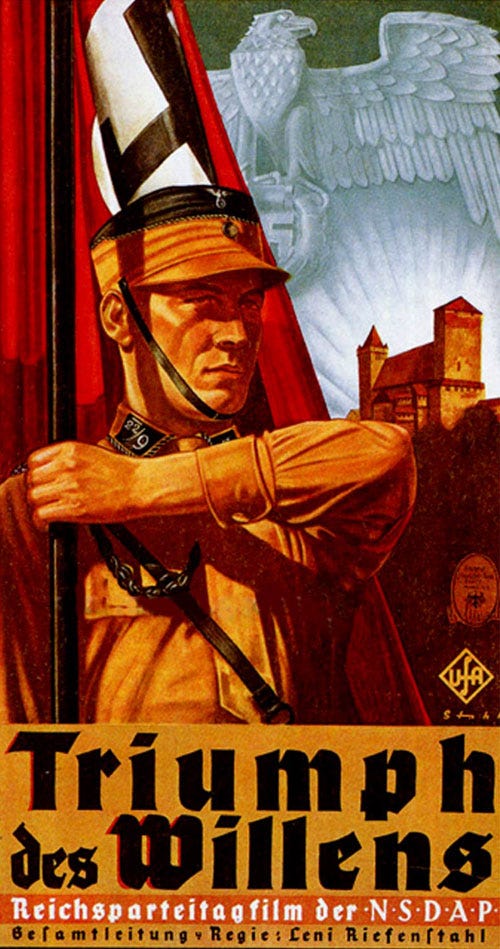
The myth of the individual, by contrast, was for most of its history entirely indifferent to any relationship with Judaism, if not outright dismissive. Its lineage was classical—Athens and Rome, and only through them could Jerusalem enter. Latin Horace, not the Psalms, was real poetry. The architecture was neoclassical, and the inscriptions were in Latin. The Jewish question, when it arose, was one of management and assimilation, not dialectical necessity. Liberal antisemitism was more contingent—the Jews’ elimination was not structurally required by liberal logic itself.
Only after World War II, after genocide revealed where boundary-less myths terminate, would the myth of the individual gradually begin adopting—and even celebrating—the German idea that liberalism was essentially Jewish, now reclaimed as a badge of honor rather than an accusation. What had been the enemy’s slander became the new founding myth. Jews were invited to embrace this identity too: you are us, we are you, we stand together as the people of the individual against the collectivist darkness. The relationship was reversed, but remained just as instrumental, just as mythological.
More critically, and as we explained earlier, the Jew became the negative boundary for post-war consciousness. The figure who had once embodied dangerous boundarylessness now became the sacred marker of the one boundary that must never be violated again. The disaster of one myth became the opportunity for stability for the other. Post-war liberal morality, one through which one could paradoxically maintain one’s amoral lust after transgression while not risking self-destruction, could only be built through the inversion of German antisemitism into philosemitic moral theology. The Jew as paradigmatic victim provides, then, the only stable ground available to myths and their Will that rejected all external grounds. Jewish suffering became the answer to post-Christianity’s boundary crisis, enabling it to make transgression itself the boundary that must not be crossed. In other words, and ironically, this particular liberal-left image of the Jew was a continuation and a celebration of the 19th-century antisemitic image of the Jew, not its negation.
There is an ingenious development here that perceptive readers will have already glimpsed, but which must be spelled out for its sheer diabolical elegance. The post-war consecration of the Jew as sacred negative boundary—the one limit that must not be crossed—rested on a very specific image of the Jew: precisely the figure of endless transgression and boundarylessness that the Nazis sought to annihilate. The rootless cosmopolitan, the dissolver of traditions, the crosser of boundaries, the negation of all organic order—this was the Jew that fascism identified as its ultimate enemy, and this is the Jew that post-war liberal society canonized as holy.
In enshrining this symbolic complex as the new god, liberal society performed a trick Luciferian in its cleverness: it made its own endless desire, will, its bottomless lust that knows no boundary, into the sacred principle that gives meaning and cannot be questioned. The symbolic Jew-as-boundarylessness became the idol before whom all must bow. To oppose any positive boundary whatsoever—sexual, national, biological, traditional—became identified with standing against antisemitism, with refusing to repeat the Nazi crime. Conversely, to defend any boundary, any limit, any distinction, risked being coded as fascistic, as the first step on the road back to Auschwitz.
This is how we arrive at the bizarre phenomenon of progressive Jews, leftists, and even antisemites all agreeing that to be authentically Jewish means to champion the dissolution of all limits: men become transwomen, women become unmarriageable, abortion as sacrament, borders as violence, biological sex as oppression, the family as patriarchal tyranny. The content matters less than the form: Jewishness becomes coterminous with negation itself, with the refusal of all positive definition, all boundary, all limit. What was once a Nazi slander—that Jews destroy all organic order—becomes repackaged as progressive truth and celebrated as liberation.
Obviously, I am not endorsing this symbolic complex. It is a lie! I am anatomizing it. This is a catastrophe for Jews, especially many young middle-class educated ones, who are conscripted into serving as the eternal symbol of boundarylessness, whether they will it or not, and a catastrophe for everyone else, who are taught that any defense of limit, any assertion of boundary, any claim to positive identity makes them complicit in the Holocaust. The post-war settlement trapped secular Jews in an impossible position: they could have meaning only as negation, only as the boundary-less ones, only as the eternal victims whose suffering authorizes the dissolution of all limits. And it trapped post-Christian society in a complementary impossibility: the only legitimate boundary became the prohibition against boundaries themselves, but it is the only way they could have their cake and eat it too.
***
Now, I do not seek to overcomplicate what I intend to be a simple and accessible exploration of my main ideas, but it must be said that I always feel some discomfort with intellectual history because I do not want to mislead my readers into the dangerous pure idealism of intellectual history. I am not myself an idealist. There is always real life with its questions of power and wealth. These large historical processes were deeply implicated in social, economic, and political struggles too complex to explore here. But I want the reader to keep one thing in mind: each of the modern master narratives was tied to serious questions of political and economic organization of post-Christian mass society. Attraction to one or the other often had a relationship to what one could afford. It makes little sense to want to be an individual when one is poor and powerless, and just as little to want to merge with the flow of history when one has so much to lose. Early Zionists, for instance, could not afford to be individualists. By the 1970s, they could not bear to remain collectivists.
Muslim elites—starting from the early 19th century, accelerating in the late 19th, and consummating in the mid 20th—embarked on a vast project of modernization. That is, they sought to enter post-Christianity alongside Europe in order to obtain all its goods and stand as worthy peers. This is the complex story I attempt to tell in my various intellectual history pieces.
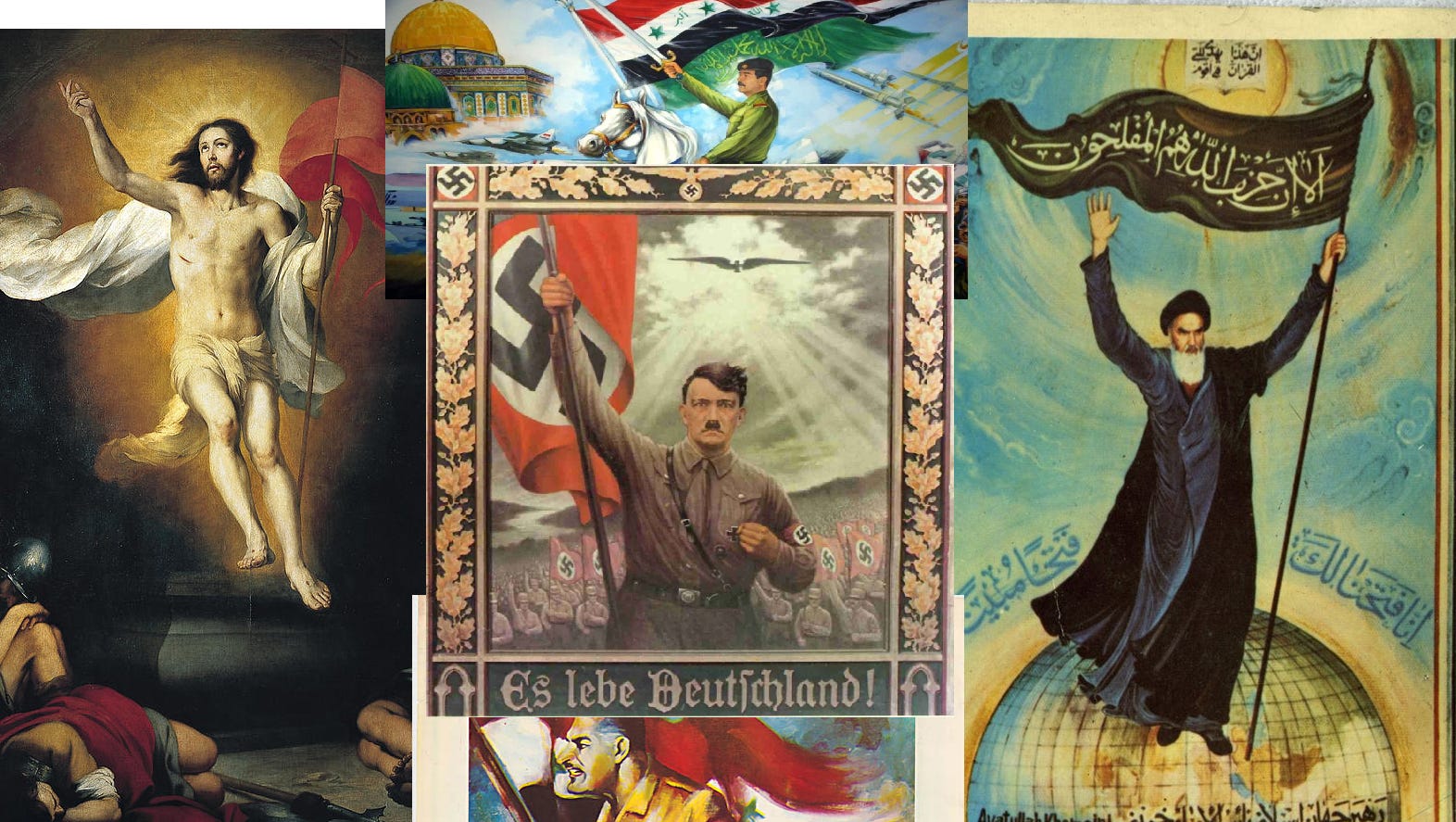
In brief, the Muslim world ended up choosing the meta-myth of History over that of the Individual as its path into modern post-Christianity. (My detailed historical reconstruction of how this process took place exists in many of my long essays.) Yet unbeknownst to them, Muslims were lusting after false idols, wanting to inherit ruins. They arrived at the party just as the hosts were leaving, adopted myths already collapsing in their places of origin, and consecrated as liberating truths what Europeans were beginning to recognize as bankrupt ideology. Historical pre-modern Islam, whatever it was, was disappearing just as Western Orientalist scholars thought they were studying it. What succeeded it is a post-Christian pastiche of Enlightenment and post-Enlightenment radical intellectual formation articulated in Islamic historical symbols within a modern reconstructed aesthetic. (Not to digress much, but this, shocking as it may sound, is actually much more sound and realistic than most common understandings. Moreover, it bears an uncanny resemblance to the very beginnings of Islam itself as a pastiche of Jewish, Christian, Arabian, Persian, and other components of late antiquity.
What this process of reorganization and rearticulation amounted to was not merely a new ideological system but a complete inversion of the theological content and spiritual orientation of Islamic belief. As a matter of fact, by using Arab Islam as the case study, (like my essay of Dracula) it is exactly this process of inversion which I seek to unveil as the operative principle and final outcome of the post-Christian transformation for everyone—a transformation in which we became a vampiric version, a perfect negative image, of how the pre-modern world understood the good to be and, without exaggeration, identical to its vision of the satanic.
In the last centuries of pre-modern Islam, most Islamic societies had evolved into a stratified system in which Islam functioned politically as an imperial ideology of order—an urbane and refined framework through which Muslim mercantile and craftsmen elites ruled over predominantly non-Muslim peasant masses, Christian, Hindu, and others. Religiously and socially, the spiritual practice of Islam itself was institutionalized in a vast network of Sufi orders, which created a cosmology of Islamic symbols, saints, jinn, mysteries, and pilgrimages, a vertical spiritual order oriented toward transcendence, toward what lies beyond the material and historical world. It was filled with fantastical superstition that even a lay non-Muslim today would find it hard to believe it ever actually existed, given the known anti-dramatic austerity of today’s Islam.
Fast-forward to post-Christian modernity, and the inversion is complete. Sufism, outside of small remnant pockets and hypermodern Muslim retro-cosplayers, no longer exists as a social force. The vertical spiritual orientation has collapsed into horizontal historical immanence. What was once directed upward toward the transcendent is now directed forward toward revolution, toward the completion of history itself, replacing the canons of Sufi dervishes and saints with Palestinian martyrs, jihadists, and Iranian terror masterminds. Politically, from an ideology of imperial and colonial order and cosmopolitan domination, Islam became a force of disorder, instability, and terror, a plebeian anti-imperialist revolt of masses, resentful marginals, and subalterns. Islam became Marx’s “specter haunting Europe,” Nietzsche’s “nihilism,” a force of instability, generating non-Muslim apocalyptic literature in nearly all languages, mourning the world that Islam will certainly destroy. The religion of dilettante sultans became the religion of austere cave-dwelling guerrillas and tunnel-digging mass murderers. The spirituality of mystics became the otherworldly eroticism of jihadist Casanovas seeking to relive a guilt-free version of the Marquis de Sade’s pornographic adventures in paradise—Marcuse with a turban.
Two aspects of this complex story belong even in a brief recounting.
First, the choice was neither clean nor clear. There was, in effect, a civil and cultural war between two successive classes of Muslim elites, each of which chose one of the rival myths respectively. The war ended with the victory of the history cult over the cult of the individual.
Second, because of the specific nature of Muslim societies and their stage of development, the gap between a thoroughly Europeanized, Westernized elite and the masses of mostly illiterate lay Muslims was infinitely larger than in Europe between elite and none, which already possessed large mediating industrialized, literate classes. This meant that modernization—the extraction of society from Islam’s salvation history and its transplantation into the myth of the individual or of history—had to take the form of theological substitution within the articulated symbolic systems of Islam itself. In simplified terms, there were significantly more Europeans who could be told directly that meaning lies not in the Bible but in your individual autonomy or in historical progress than there were Muslims who could receive such a message. Muslims had to be told that Muhammad himself was a prophet of historical revolution, that Islam had always already been what modernity claimed to be, that jihad/kampf/struggle was the catalyst of historical self-making and self-realization. The substitution had to occur in the symbolic world of the Quran, not outside it. A person like Sayyed Qutub, ironically, was really a godless Romantic Faustian poet in a Leninist age. This was basically the Reformation of Islam. It succeeded catastrophically.
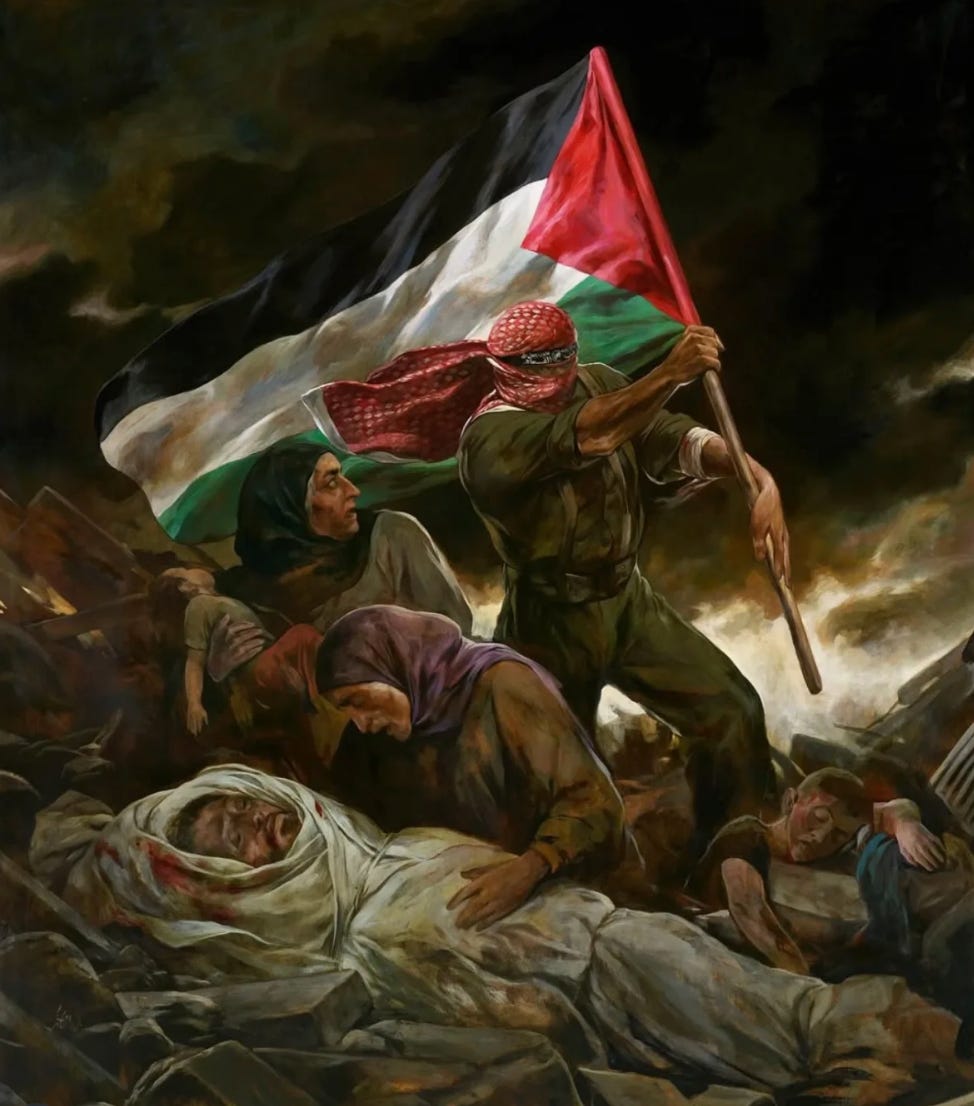
Once the myth of History became the chosen road to modernity, the Arab world entered an endless cycle of revolutionary repetition, nihilistic collapse, and atheistic loss of meaning and self beyond comprehension. Every regime, party, and movement claimed to embody the forward motion of history itself; every defeat was recast as merely a temporary deviation from history’s iron law if not a necessary step towards the inevitable triumph. This is what Haviv Rettig Gur and Shany Mor, in different ways, very insightfully discerned as the operative recurring logic of the Palestinian national movement, for instance. Revolution succeeded revolution, self-destruction followed self-destruction, each claiming to be the true culmination, each ending in the same disaster and calcified despotism. The tragedy was not that they failed to achieve what Europe achieved. The tragedy was that they succeeded in replicating what Europe had already become by mid-century and in record time.
Western observers and scholars who examine these Arab cycles of destruction rarely see them for what they actually are. The discourse is too legible, too familiar. These observers are themselves post-Christian moderns who take for granted the categories of progress, revolution, historical meaning, and nationalism, and the endless struggle for them. They cannot see these concepts as mythological constructs because they inhabit them too. They speak earnestly of “the historical memory of the Muslim empire” or “the trauma of the Crusades” as if these were natural, organic phenomena transmitted across centuries. They do not recognize that both are modern discursive constructs—artifacts produced by modern university professors, stories written into existence by the very apparatus of post-Christian culture and education in which we have all been thoroughly brainwashed.
My dear, highly educated reader: Arabs do not remember the Crusades. They are told they remember the Crusades by men in suits with fancy titles. Modern “memory” is a modern, institutionalized order of knowledge specifically designed for mass societies, in which memories of history are implanted and manufactured. What passes for historical consciousness is the successful internalization of a modern historical mythology, one that had to be learned, taught, and drilled into populations.
***
Now the Jewish element, as I started to articulate above, as it should be clear by now, is central and crucial, and we are lacking accounts of modern antisemitism that attempt to understand the peculiar centrality of Jews to the successive stages of the modern world in light of this epic drama of post-Christianity, something I also try to do very modestly in this and other essays. For if the great project of modernity is the exit from a Jewish theological order—and let us be clear, Christianity, and Islam, are nothing if not a universalized, revised Jewish religions—then the presence of actual Jews in this drama cannot be incidental. They are not merely another minority caught in the machinery of modern transformation. They occupy a unique structural position that gathers fatal contradictions.
First, they are both the origin point of the theological system being exited and, by their continued existence, the historical order of boundaries and a living boundarylessness, a constant living reminder of what is being escaped and must be assimilated. Many post-Christian philosophers in the early 19th century realized, often bitterly, that the entire project of exiting Christianity would fail if Jews too did not exit Judaism. The departure had to be total, universal. Jewish persistence threatened the completeness of the post-Christian rupture. This is, in the most concise way possible and quite literally, the core objection of Edward Said to Zionism.
Now, the issue of using Jews as a boundary could also be articulated in a different way. Jews simultaneously served as Christianity’s verified victims, and this victimization provided a point of legitimate and morally superior exit—one that could vanquish Christian morality on its own terms. This issue of superior morality deserves particular stress. Until today, one can advance many arguments against Christianity and religion: rationalist, scientific, political, factual, and subjective. These arguments always founder on the rock of Christian morality, even if from a purely utilitarian perspective. Atheist post-Christianity has never succeeded in providing its own solid and grounded rival morality capable of displacing the last defense of Christian moralists and apologists. But victimization by Christian structures does exactly that. It offers a moral position superior to Christianity itself—a position from which one can condemn Christianity not for being false, but for being evil. The Jew victimized by Christian hatred can finally give us the crucified Christ, superior to the crucified Christ. That is, Jews are both the origin point of the theological system being exited and the exist point at the same time.
Now, this double bind operated differently within each of the two master myths of modernity, producing distinct but equally impossible positions for Jews.
Within the myth of the individual—the Anglo-American and French liberal traditions—Jews were required to dissolve their collective identity into the universal category of the rights-bearing citizen. Jewish emancipation became the definitive test case: could particularist identity be transcended through the grant of equal rights? The logic was clear: Jews could be free as individuals, but not as a people. Their success had to take the form of assimilation, the quiet disappearance of Jewishness into the abstraction of citizenship in the public space. This position would later go through a major revision as Zionism would make it possible for Jews to assimilate on an international level as a collectivity without losing particularity, entering its privileged relationship with liberalism.
As the myth of the individual developed its own narrative structure through the concept of “Western civilization,” and through the complex intellectual and cultural transformations of post-War culture, liberal Judaism—and then Zionism—became assimilated into the self-narrative of Judeo-Christian civilization. What is striking about this development is how liberal Western culture increasingly recalled its Christian origins precisely as it was becoming more thoroughly post-Christian, more aesthetic than theological. Christianity could be celebrated as heritage, as the source of Western values and culture, only once it had been fully vanquished. The more secular the culture became, the more safely it could invoke its Christian past as a civilizational accomplishment. (I recently discovered that Nietzsche had already made the observation about English liberalism, the more atheistic the English become, the more they sing the praise of Christian morality.)
On the other side, within the myth of history that informs Marxist, radical humanist, academic, and nationalist traditions, Jews faced a different impossibility. Here they were required to dissolve not into abstract individualism but into the concrete historical collective: the nation, the proletariat, the Volksgeist. Yet Jews represented a rival claim to historical destiny—a counter-narrative rooted in Hebraic mythology rather than dialectical necessity, the Bible versus Vico.
Edward Said, a postmodern synthesizer of both myths, wrote extensively and with great force about precisely this point. For him, humanity faced a, either/or, a binary choice: Jewish history or human history and he strongly aligned himself with the latter, yet his alignment was itself the consummation of the same dialectical impulse. His genius move was to affirm Adorno’s new categorical imperative—the need for a single negative boundary embodied in the figure of boundarylessness—while declaring that Jews and Judaism were, in fact, not that boundary at all. After Zionism, he argued, Judaism revealed itself as the very opposite: not the embodiment of boundarylessness but the original source of all boundary-making, the primal fall into separation and exclusion. Judaism thus became doubly condemned—both as the enemy of humanist emancipation (which requires the dissolution of all positive boundaries understood as oppression) and simultaneously as the cause of the violence deployed by righteous resistance movements against such boundaries—for it was Judaism that first taught the world to draw lines, to exclude, to separate, thereby necessitating the violent struggle to tear those divisions down.
In Said’s post-Christian vision, Zionism thus appeared as the embodiment of this demonic boundedness in modernity. He then cast himself, symbolically, as the new figure of boundarylessness/negative boundary—the embodied negation that the post-Christian West now required to worship at his feet. And, of course, Colombian liberals, being clean-foot lovers, obliged. ((This is why I have such merciless, mocking anger toward Arab elites—not because I think them worthless, but because I think them worthy of doing better than to commit murder for the sake of plundering a false idol, for the sake of dust. At least when Cain slew Abel, he did so out of envy for a genuine blessing from the living God. But we? We would murder for what—Columbia? The Ivys? You sacrifice your own children for a seat among the pagans. You brood of vipers, whitened tombs, blind guides who strain out a gnat and swallow a camel.))
Taking this logic into account, the historical myth always returned to the same question: Do Jews advance or retard the forward motion of history? And because their structural position was itself a product of Christian exclusion rationalized as historical necessity, the answer was inevitably negative. The myth of history thus generated its own antisemitism: the identification of Jews as the obstacle to real emancipation, the element that must be overcome for history to complete itself, a construction that modern Arab culture and modern Islam inherited and, most tragically, gave it an embodiment in the Palestinians.
(A supplement myth, which was produced by a type of post-Christian radical Jew too sophisticated or too afriad to miss out on the pleasures of the German meta-myth, tried to supplement it with the myth of Judaism as radical subversion and revolution, thus making it the very principle of self-negation that the myth of history should embrace and celebrate. The idea is simply that if Jews represent the radical principle of boundarylessness, mobility, and rootlessness of capitalist individualist modernity, then such modernity could only be transcended by radicalizing that principle to the extreme, leading to its own dissolution. But this was and remains a secondary myth at best, working only occasionally.)
Both master narratives, then, produced their own stock of antisemitic and philosemitic imagery that can stand at different distances from one another. Within the myth of the individual, the Jew appeared either as the learned cosmopolitan to be imitated—the model of successful integration, rational self-improvement, and meritocratic achievement—or as a religious remnant to be contained, a stubborn particularism that refused the universal promise of liberal citizenship. Within the myth of history, the same figure of the learned cosmopolitan became grounds for annihilation—the rootless intellectual, the transnational element disrupting organic national or class unity—or alternatively, the Jew appeared as a reservoir of post-Christian radicalism to be celebrated and imitated, the natural revolutionary whose historical exclusion had prepared him to break all chains. In some nationalist variants of the history myth, Jewish radicalism was not as much rejected as appropriated. The revolutionary break with tradition, the willingness to destroy the old order, these were necessary for national transformation. But they had to be inherited by the authentic national vanguard and stripped of their Jewish origins. The Jew appeared as the pioneer of modernity’s radical change, who must now be eliminated so that the true historical subject—the Aryan race, the Arab intellectual—could claim that revolutionary energy as its own. The Jew had served his function as the destroyer of the old theological order; now he became the obstacle preventing the nation from completing its historical destiny.
(The claim that philosemitic and antisemitic myths share structural relations in discursive analysis does not suggest real-world equivalence, nor does this include all forms of philosemitism, some in which I’m a happy participant. This is precisely why Idealism is dangerous. Things may be structurally similar in the abstract but radically asymmetrical in reality. Antisemitism is a destructive, murderous force. Philosemitism is usually positive, but even at its worst, it is only cringe.)
The content of the images shifted, but the structure remained constant: Jews occupied a position that could be read in diametrically opposed ways depending on which myth held sway and which faction within that myth was ascendant. The same traits—cosmopolitanism, intellectual achievement, transnational networks, economic success—served as proof of either exemplary modernity or dangerous alienation. There was no escape from this interpretive instability because it is the very instability and irrationality of post-Christian thought itself.
These philosophical dimensions, again, have material bases and reflections that should not be missed. These are the aspects that have often received the most attention from scholars—yet always in isolation, without full comprehension of or integration into the larger dynamics. I refer to the political aspect of Jewish emancipation and equality within the development of democratic and nationalist political systems, and the economic aspect of Jewish participation in the development of capitalism and the modern economy. These are post-Christian politics and post-Christian economics, two major arenas in which contestation over the Jewish question was always intimately related to the broader battles over the development of the post-Christian world itself. Jewish economic position, whether as financiers or middlemen, marked them as representatives either of liberal success or of history’s wrong historical stage—either the future of refined urbanity, finesse, and literacy or feudal remnants obstructing progress and capitalist parasites preventing revolution.
Now this meant that Jews ended up in an impossible position: they needed to be preserved and overcome at the same time. If someone like Edward Said wants to be the last Jewish intellectual, he must both preserve and destroy. This co-incidence, this contradiction ended up reflecting—and reproducing—a deep contradiction within the history of modern Jews themselves, positioning them as a central Western question oscillating between two impossible poles: reverence, celebration, and centrality in political, cultural, and financial power institutions on one hand, or extreme hatred and genocidal resentment on the other. This oscillation is unparalleled in their history, except perhaps in the biblical books of Exodus and Esther, an unbelievably fertile land for all kinds of imagination.
This centrality itself—produced by impossibly complex mechanisms for anyone to take full account of—was sufficient to generate an inexhaustible supply of both antisemitic and philosemitic mythology. Jews became both the architects of modernity and its destroyers, both the champions of universal emancipation and the guardians of tribal particularism, both the agents of revolutionary transformation and the defenders of reactionary tradition. Every position they occupied could be read in two opposite directions simultaneously. The same facts generated opposed interpretations with equal plausibility, because the structural position itself was contradictory. There was no stable ground, no way to occupy the space assigned to Jews without triggering one mythology or the other—or, more often, both at once.
But we must pause here to address what many would find the most unsettling dimension of this entire structure: the centrality of Jews within post-Christian modernity is the product of historical coincidence—an accumulation of geographic, economic, political, and religious accidents spanning centuries. Yet this coincidental centrality maps with impossible precision onto the fantasies required by post-Christian mythology. The accidental structure functions as if it were designed. Jews occupy exactly the position that post-Christian society needs them to occupy in order to work out its own contradictions—both as the moral vindication for exiting Christianity and as the persistent reminder that the exit is incomplete. They appear in exactly the roles that liberal and revolutionary narratives require: as victims whose suffering authorizes post-Christian morality, as cosmopolitans who prove universalism’s possibility, as capitalists who embody what must be overcome, as radicals who pioneer the break with tradition, as particularists who threaten the universal project.
The fit is too perfect. Historical accident has produced a structural position that answers, point by point, to the mythological needs of modernity. This is what generates the inexhaustible supply of both antisemitic and philosemitic mythology, the uncanny correspondence between contingent reality and required fantasy. And this uncanniness is precisely what makes the Jewish question in modernity so resistant to rational explanation, so prone to mystical interpretation. How can mere coincidence produce such perfect symmetry? How can accident map so precisely onto necessity?
This double bind—preserve and eliminate, vindicate and assimilate—produced the fundamental structure of modern antisemitism. It is so bizarre, so seemingly irrational, that the only way many modern Jews can understand it is to relate it back to classical Christian supersessionism or replacement theology: the idea of replacing Jews while keeping their covenant, of eliminating them while inheriting their promise. They interpret modern antisemitism either as the persistence of this old theological structure or as proof that Christianity never really ended. Both readings serve to mobilize post-Christian liberals to come to Jewish defense against the old enemy that supposedly refuses to die.
It is understandable why, in such a state of confusing complexity, we would reach for such heuristics and simplified aids. But it is simply a false myth. Helpful, perhaps, but false. No one after centuries of post-religious and militantly atheist revolutions, understands, let alone believes in, such theological structures. The structural parallel is purely coincidental, however uncannily precise it may appear. Modern antisemitism does not require Christians who believe in supersessionism. It requires post-Christians who believe in progress, history, emancipation,and universalism. The mechanism has changed entirely, even if the outcome bears an eerie resemblance to what came before.
The antisemitic mythology itself, as I have elaborated elsewhere, consists largely of opportunistic narratives deployed by rising elite rivals seeking to displace Jewish elites from the central positions within immense Western power structures, mainly made of the decomposed remnants of the founding two myths, that these fatal contradictions had elevated Jews to occupy. And by the same token, philosemitic mythology also serves strategic functions in such competition—whether to forge alliances with Jewish power, to signal one’s own enlightened credentials against less sophisticated rivals, or to appropriate Jewish moral authority for one’s own political projects.
Both mythologies, in other words, are weapons in inter-elite struggle, elite groups that are totally and completely atheistic. The question is never simply whether one loves or hates Jews. The question is: What does one’s stance toward Jews accomplish in the competition for power, legitimacy, and position within the post-Christian order? Antisemitism and philosemitism are opposites in a simple moral sense but also twin strategies generated by the same structural contradictions, available to different actors depending on their position and objectives. One attacks Jewish centrality to clear space for one’s own ascent. The other aligns with or defends Jewish centrality to secure an advantage against competitors. The Jew remains, in both cases, the terrain on which post-Christian, and now post-Muslim, elites wage their internal and external wars. And here too, I believe the study of Arab and Muslim antisemitism is the most instructive for it integrates why so many Arabs and Muslims believe they must hate Jews in a certain way to succeed in the world that we understand what did the post-Christian world instructed them in.
Almost all contradictory forms of hating Jews coexist peacefully in Arab mass society, yet are a wedge among rival Arab elites in their own power competitions. For these elite groups, it functions both as what binds them to the masses on which they claim power and what separates them from each other. Arab secular elites, such as Bassem Youssef and others, hate Jews because they are too theological—the origins of all irrationalism, the source of Islamic fanaticism itself, the people whose ancient superstitions infected the world with monotheistic delusion. (Some Arab Gulf elites are now switching gears toward individualism and liberalism and thus find the secular atheist Jew to be an exemplary model, the shape in which they hope to reform their own citizens.) Other romantic radicals, such as Hamas, view Jews as the obstacle to salvation—the force preventing history from reaching its destined revolutionary conclusion. Iranian Islamo-Marxists see them as agents of capital and empire, the financial power behind Western domination. Figures like Edward Said and postcolonial elite aspirants see them as an older power elite to be displaced and replaced, competitors for centrality within Western institutional structures who must be dislodged so that the postcolonial intellectual can inherit their position.
These are not different groups accidentally hating Jews for unrelated reasons. They are factions within the same post-Christian drama, each deploying the form of antisemitism generated by their chosen myth and their position within it. The contradictions do not trouble anyone because no one recognizes them as contradictions. They appear, instead, as a rich vocabulary—a set of available narratives to be deployed depending on the rhetorical need of the moment. The Jew is whatever the speaker requires him to be to justify the speaker’s own project of post-Christian emancipation, power, and wealth.
But why Jews? Why this particular people at this particular structural position? The answer is at once simple and vertiginous: coincidence. Jews occupied a particular structural position in Christian theology—the rejected witnesses, the negative mirror. When Christianity began its long collapse, this position became uniquely available for secularization. Not because Jews were inherently central to modernity, but because they happened to be positioned at the exact theological coordinates when post-Christianity needed to stabilize itself through negation. This is coincidence in the purest sense, the contingent alignment of theological structure and historical circumstance.
The very accidentality of Jewish centrality is what enabled such elaborate mythmaking. Because there was no deep necessity, only structural happenstance—but there was a deep, if separate, need for stabilizing myths—both philosemitic and antisemitic mythologies could proliferate endlessly. Post-Christian consciousness required meaning, required explanatory frameworks, required ideological technologies for mass politics. Jewish centrality served all these needs simultaneously. Many birds with one stone. The coincidence becomes productive of mythology precisely because it demands explanation but has none (it has none because there is none), and because we happened to be shopping for myths at exactly the moment this inexplicable coincidence presented itself.
Consider the case of Arab-Muslim societies, which had no replacement theology and were never Christian, at least not for a thousand years. They mimetically converted from Islam, which had no supersessionist theology about Judaism comparable to Christianity’s, no deicide myth, no elaborate victimological apparatus, directly to post-Christianity, skipping Christianity entirely. Yet they ended up with the entire structure of post-Christian antisemitism intact. Why? Because these structures are self-contained, modular, transferable—mythological technologies that require no Christian theological foundation to function. They work as pure form, empty of original content, ready to be filled with whatever local resentments and political needs present themselves. This is the smoking gun: if post-Christian antisemitism reproduces itself perfectly in societies that never experienced Christian antisemitism, then Jewish centrality to these myths is a structural accident, not a historical necessity.
Too Perfect a Fit?
Earlier, I talked about how the cosmic coincidence that placed the Jews at the center of the modern world in the 19th century happened to be a perfect fit for our post-Christian/post-Muslim needs. If the reader is intelligent, and I have no doubt that all my readers are very much so, and if what I describe comes close in any way to describing the real world, then the attentive reader knows that I’m asking too much of a leap of faith into randomness. This is true! And perhaps here I should come to the point at which I critique the Jewish position and use it to my own advantage to elaborate my own peculiar point of view.
One of the greatest myths of the modern intellectual, modern historian, and modern social scientist is that they can describe things from the outside, like the voice of God in the Bible. (One of the greatest moral crimes of the modern Western author is attempting to usurp the role of the Author of the Bible—and even if one does not believe in God, that is all the more reason not to attempt such usurpation.) This placelessness from which one could narrate with authority was the daughter of our first post-Christian affair with our first harlot: reason, objectivity, scientific method. She turned out to be as barren as all daughters of Beelzebub. We discovered that the historian, the intellectual, the philosopher, the so-called social scientist—all are hopelessly placed, embedded in their own time and interests, and thus cannot speak as the voice of God dispensing truth from a transcendent position.
Since then, we have gone on many other escapades and liaisons with other harlots, each sluttier than the one before, each promising to birth that elusive placelessness. (This is merely the epistemological dimension of post-Christian tragedy.) One of these sluts was—and how glad I am to write was and not is—victimhood itself. The idea that the excluded victim, the one forced to remain outside in the cold, can actually tell us the truth precisely because they were outside. That marginalization grants epistemological privilege, that oppression produces clarity, that the view from below is somehow less distorted than the view from above. Of course, this also turned out to be a great lie. (How sweet the sound!)
This is a necessary introduction for the Jewish position that works at multiple levels. Jews are deeply implicated, even if they are victimized, in all the processes and contradictions of post-Christian adventures and misadventures. And thus, they also were going through the process of secular erosion of meaning, structure, and orientation, as anyone else, compounded by the tragedies brought on by antisemitism itself. And thus, it was inevitable that they would try to work out their own post-Christian ground that can produce stability of meaning and identity in the negative postmodern world through the common stock of post-Christian myths and thus internalize much of the modern mythology about themselves.
The centrality of Jews to post-Christian discourse as victims, as theological originators, as moral foil allowed Jewish identity to be secularized as pure negativity. Judaism could be defined entirely by what it stood against or was excluded from, never needing positive content of its own. Jews became “the otherness,” “the victims of Christianity,” “the particular against the universal,” “the pre-Christian persistence that will not dissolve.” This negative definition provided remarkable stability in an age where all positive identities had dissolved.
Everyone else lost their grounding. What does it mean to be Christian when you don’t believe? What does it mean to be French when nationalism is exposed as myth? What does it mean to be a Muslim when you worship power? What does it mean to be human when humanism is dead? But Jews could define themselves through negation: we are what Christianity persecuted, what modernity must overcome but cannot. The identity was stable because it was empty—it required nothing but the continuation of the exclusionary structure itself.
This was itself an internalization of post-Christian mythology. But because it mirrored the structure of pre-modern Christian theology, Jews as the rejected people, the witnesses to Christian truth through their very rejection, it created a false sense of continuity. Jews felt they possessed an unbroken identity spanning pre-modern to modern worlds, the one people who had maintained themselves intact through the post-Christian rupture. But modern Jewish identity was just as much a post-Christian construction as everything else. It only looked continuous because the negative structure remained constant even as the content changed completely. Christians once defined themselves against Jews; post-Christians still define themselves against Jews. The structure stayed the same while the meaning transformed entirely.
More critically, this myth of continuity came at the cost of the greatest possible discontinuity: in Jewish thought, God was replaced by antisemitism as the guarantor of meaning. What had once been grounded in covenant, in divine election, in the relationship between God and Israel, now found its ground in persecution itself. Jewish identity no longer derived from what Jews believed or practiced, but from the fact that they were hated. Antisemitism became the negative theology that held the community together—the force that, paradoxically, sustained Jewish existence by threatening it. Where God had once promised “I will make of you a great nation,” post-Christian Jewish consciousness could only say: “We remain a people because we are targeted as a people.”
This is the ultimate cruelty of the post-Christian condition, its last and most sophisticated trick to rid us of the Jewish god: Jews were granted the appearance of continuity, the only people who seemed to maintain an unbroken identity, but only by replacing the God of Israel with our own hatred for them on his throne, substituting persecution for covenant as the ground of Jewish meaning and identity. (How genius is it to get Jews to worship their own persecution? Could there be worse revenge?) We are so brilliant that we realized the only way to exit the Jewish theological order of history is through eliminating the Jews once and for all, whether materially or spiritually, a great quest in which Islam also became nothing but an unwitting and gullible conscript of the post-Christian condition.
So, is this all a coincidence? Yes and no, but only in the best mystical sense. That is what I believe. I do not know what I am looking at. But I know I am looking at—indeed, that I am in—something. Something I cannot comprehend, certainly cannot control, but which is too eerily quirky, too eerily striking to be random, too precisely arranged not to be intentional. I actually believe in the much-hated “fairytales” that came from the Jews—the covenantal drama, the divine author, the meaning that exceeds human construction. I simply do not know how they play out. I do not think we can know, because we are inside them, not spectators observing from outside. Our post-Christian delirium ironically validates much of our pre-modern dreams.
Why, then, do I perform these merciless, unsentimental, antihumanistic critiques that insist on stripping things of meaning and myth? Why do I insist on coincidence, on the accidental nature of Jewish centrality, on the mythological character of post-Christian narratives? Because the worst thing the post-Christian, atheistic world does when it runs out of fuel—when it catches another glimpse of its own emptiness—is parasitically colonize a piece of faith, a piece of religious meaning, and convert it into new fuel for its own narcissism. It wants the weight of religious meaning without submission to anything beyond itself.
If the modern secular man wants to be a real atheist, I will be his friend and not let him settle for half measures. Let us destroy all false consolation. Let us strip naked all illusion. Let us see post-Christian mythology for what it is: our own construction, our own projection, barren and unable to bear the weight we place on it. But if we want to declare faith in meaning beyond ourselves, beyond comprehension, beyond our control—then let us do that. Let us actually submit to what we cannot master. Let us declare that we do not know, but we fear. But let us not pretend we can be meaning unto ourselves. Let us not colonize God to dress up our own will to power.
The choice is stark: real atheism or real faith. What we cannot have—what post-Christianity has tried and failed to sustain—is the position in between, where we are our own gods speaking in borrowed terms, where we are the authors of our own salvation histories, where we strip the theological structure while keeping its emotional and moral payoff. That position is exhausted. It has produced only the contradictions and cruelties I have traced throughout this essay. We neither live in a modern nor a postmodern condition; we live in a post-Christian condition. If there is a way forward, it lies in clarity: either the naked void, and with it destruction, or the God we cannot see. Not the myths we tell ourselves to avoid both. My yes and no is your either/or.
My dear reader, in truth, this is not about clever words or political commentary. It is about the first act of Creation—the daily separation of light from darkness within your own breast. The harvest is within you. Each thought, each desire, every look of your eye, every motion of your hand, every word that passes your tongue renews that dividing line; each silence is a sorting of sheep from goats. Heaven and hell are not worlds apart—they begin where you stand. Remember, what is kept is what is cast away, but what is sacrificed is forever saved. Let there be light!
—Afterwords—
My initial intent for this essay was to offer an accessible yet sweeping introduction to my different complex views on the issues I deal with in my various essays. I understand that the structure ended up somewhat unwieldy and recursive in places, yet I’m sure it remains generally cohesive. If not exactly successful at what I wanted it to be, I hope it’s a step in the right direction.
Earlier in this essay, I said that there were no third positions to the two master myths. While this was true for the 19th and a good portion of the 20th centuries, there is actually a third myth; postmodernity or the myth of mythless-ness, which is likely the worst of all our modern myths because its true insights are used to continue, not discontinue, the boundarylessness and dissolution we started but much more aggreessively, which is why it became the favorite myth of ultraliberal or neoliberal age.
All true knowledge, like sex, is experiential and relational. If not relational, it is masturbatory. And just as with sex, one can approach knowledge either as lust or as sacrament—through an epistemology of rape, fornication, or covenant. Yet no healthy person would equate good sex, sacramental and covenantal, with dispassion. What parents advise a bride or groom on their wedding night to cultivate disinterest? And if not marriage, and the love is true, then let it be an honest friendship. Why then should it be different with knowledge?
The pretense of cold, distant objectivity—of scholarly dispassion—is nothing but the self-aggrandizement of the professional scholar, who elevates himself at the expense of his subject matter while calling this self-deception “reliability.” This false air of professionalism ruins the relationship needed for knowing to begin with. We must have a healthy, passionate desire for our subject, a desire of true selfless love, if we are to know anything at all. The control against distortion comes not through meticulous self-control of the knowing subject, nor through full mastery of the object under examination, but through the humble relationship one maintains with what one seeks to know. Warmth and sympathy are the necessary preconditions for understanding reality; the dynamic relationship is the true and only guarantee of challenge, correction, and openness to the inexhaustible fertility of reality.
To evaluate any text’s success, we must see how it behaves in relationship to reality. Does it try to dominate? Does it think itself self-sufficient? Does it claim to have exhausted the knowledge of its subject once and for all? Thank God I am not a professional, and that I stumbled into warm relationship with my subject matter. Imagination, sympathy, and intuition are the qualities desired for love and friendship as for learning. Truth will never let itself be approached by highwaymen and intellectual guerrilla armed with their epistemology of rape and domination.
I recently attended a Christian conference devoted to the question of how to live faithfully in a post-Christian negative age. To my alarm, I found that many Christians, in their awakening to the ruins of Christianity, have turned for guidance to the very critical theory texts that I know Islamists in Cairo had already exhausted by the early 2000s. Their attraction is understandable: these works often provide the only penetrating critique of the vast machinery of lies and deceit in which modern life is enclosed, especially within liberal societies. Yet they are, in truth, oppressive and soul-crushing—more domineering than many of the modern idols they denounce. As a matter of fact, critical theory is an epistemology of domination par excellence. They are the very theological articulations of the radically atheistic and negative world itself. Nothing good can come of them. One of the distinguished speakers, an intelligent man by any measure, said, “Do not be afraid to plunder the Egyptians.” It is an understandable sentiment, and perhaps there is a wisdom in it. Yet the metaphor bears its own warning, if not judgment, for we all remember what Israel first did with all that Egyptian gold.
“The Jews still always remain a mirror in which we see God’s mysteries in the redemption of the human race as a riddle. In 1 Kings 8:50-51, Solomon still continues to pray for them. David still always lives, who at that time prayed for God’s tolerance when they should become old and their strength would fail them (Ps 71:9; 59:11). For our sake they were struck, so that we would marvel at the wealth of His patience and the riches of divine forbearance in their preservation and would thereby be led to repentance. Is it not the same unbelief that reigns in us, and should we not learn from its penalties for this nation to fear for ourselves? Have we not crucified God’s Son as they have? Do we not build the tombs of the prophets that they have put to death? Can we Christians read Obadiah without dismay? Are not the Gentiles threatened with just the same end, we Gentiles who have been in the same olive tree whose branches were discarded and chopped off by God through our hands? This was what He threatened to do to the Edomites and what He did to the Romans. Has Jesus ceased to be a king of the Jews? Has the inscription on His cross been changed? Do we not therefore persecute Him in His people? Is not our faith just as much a table as their law, which has become a snare? —— If Abraham’s children were so punished, who did not do as he did —— What kind of judgments await us who name God our Father and His only begotten Son and slander His teaching and His works through our unbelief and obstinacy?” —Johann Georg Hamann
That was an amazing read. I teach Western Ethics, and I use an historical approach. This article and my class share a structure. I will be sending the kids to come read this. Well done.
This is a historically profound essay, with a theologically profound conclusion. If universities were not so corrupt, one would make Hussein a Distinguished Professor on the spot. There are many things to praise here, from the observation that the German historical narrative is in every way deeper and more interesting than the Liberal English one through to the recapitulation of salvation history (for believers only -- you are wise to exclude the meaning-starved moderns from this truth). If salvation comes from the Jews (John 4.22), then surely damnation also comes from them. If there is one truth (and way and life) of Salvation, there must be so many ways to depart from -- so many ways and reasons to hate Jews.