
Iran's Gulf Gambit
A Bet Against a Ticking Clock

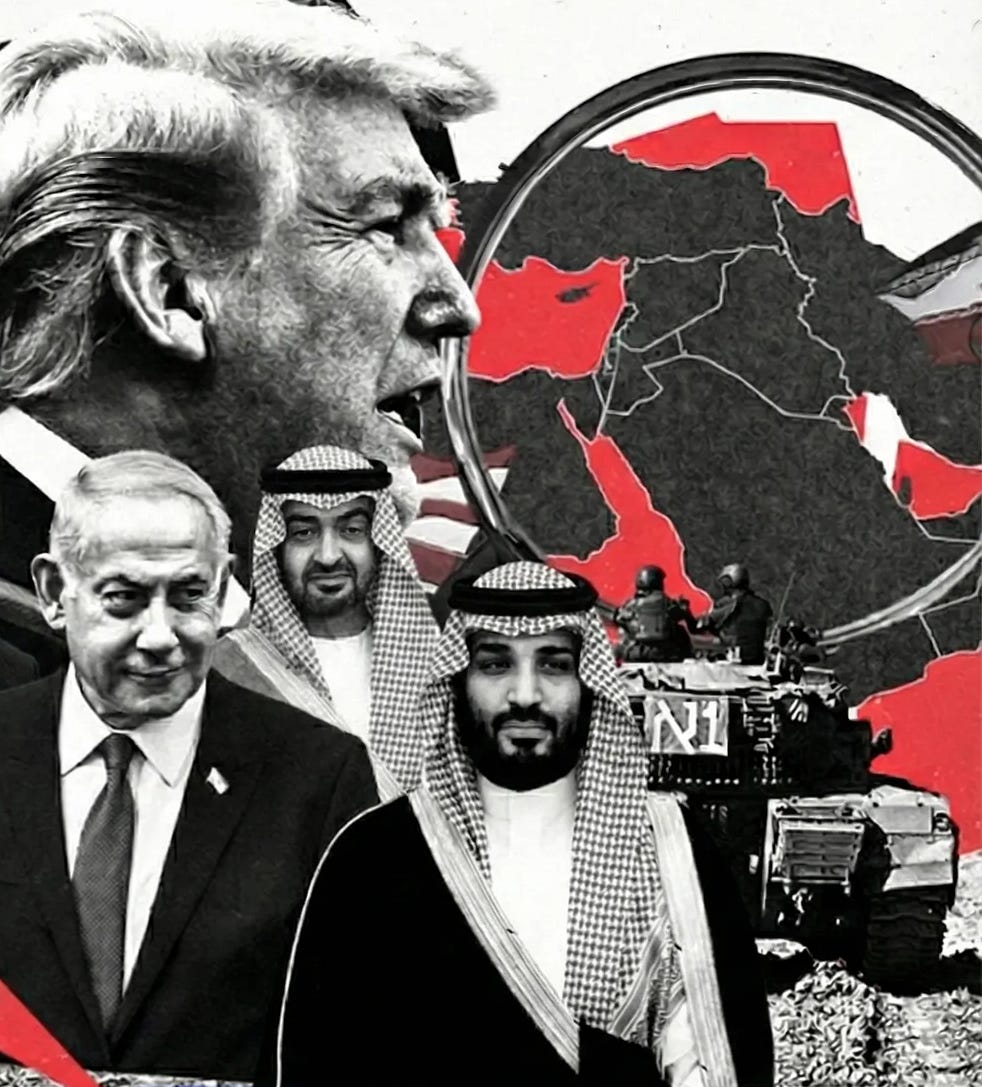
It is perhaps a good day to remember that, despite the facial hair affinities, Iran is not Hamas. Its missiles are not home-made projectiles lobbed without guidance systems from the rubble of a collapsed UNRWA building. When an Iranian drone strikes the airport or the Fairmont in Dubai, it strikes them because someone in Tehran decided it should — a deliberate strategic choice, not an accident of indiscriminate targeting.
There is a clear strategy here. The question is whether it is a sound one.
Tehran’s desperate gambit is as follows: the Gulf economic model — the Emirates’ model above all — is built on the promise of the oasis of stability in a neighborhood of chaos: that capital flows freely, that tourists, businessmen, Russian oligarchs, and expats arrive safely, that the skyline is always glamorous. The GDP of the Gulf states is functionally a confidence index. Strike the airports, the hotels, the commercial districts of Dubai and Doha and Manama, and you strike the foundation on which the entire post-oil diversification project rests. Iran is clearly betting that the Gulf states’ extraordinarily low tolerance for economic volatility will translate into political pressure on Washington to end the operation before it achieves its objectives.
There are good reasons to think this bet could work, and Tehran is not being irrational in making it. The major strategic recalibration in Gulf foreign policy in the past five years — the turn toward hedging with Russia and China, and what Riyadh and Abu Dhabi called “portfolio diversification” — was driven by exactly this experience. Iranian-backed strikes on Riyadh (2019) and Abu Dhabi’s (2022) oil facilities that the United States failed to either prevent or meaningfully respond to taught the Gulf leaderships a lesson they have not forgotten: that American security guarantees are conditional, intermittent, and unreliable under pressure. Tehran learned the same lesson from the other side — that hitting Gulf economic infrastructure produces political results disproportionate to the military investment. Trump himself is a known quantity in this regard; he favors short engagements, dramatic declarations, and rapid exits with even bigger declarations on Truth Social. (I can’t wait to tell my grown children about the day Trump congratulated “both sides” on the conclusion of a “successful war.”) The Iranian calculation is that a sustained campaign of economic disruption across the Gulf will collapse American political will before it collapses the Islamic Republic.
But this time Tehran may be miscalculating, and badly.
The difference is scale. Previous Iranian attacks were deniable, limited, and targeted — a drone strike on an Aramco facility here, a proxy attack on Abu Dhabi there — enough to send a message without forcing a strategic pivot towards cost absorption. What happened this weekend is categorically different. Iran launched ballistic missiles at the territory of Saudi Arabia, the UAE, Qatar, Kuwait, Bahrain, and Jordan simultaneously, killing civilians in Abu Dhabi, striking hotels in Dubai, hitting airports, and targeting the economic and civilian infrastructure of every GCC capital except Muscat. The distinction between a calibrated signal and an act of war against the entire Gulf system at once is not a matter of interpretation.
And this, likely, changes the political logic entirely from the past episodes. When the threat was occasional and deniable, hedging made sense — keep channels open to Tehran, diversify partnerships, avoid being drawn into an American confrontation that might end inconclusively. When Iranian missiles are landing on your hotels, your airports, and your residential districts in broad daylight, hedging ceases to be a viable strategy and becomes a dangerous capitulation that poses greater risk to your future and stability.
The Gulf states did not choose this war, but Iran’s decision to strike their territory was not, as Tehran claims, merely retaliation against American assets on their soil. It was a deliberate strategy to weaponize Gulf economic fragility against Washington — to make the pain of the operation fall on the states most likely to demand its immediate cessation. The US bases merely provided the pretext, but the hotels, airports, and commercial districts are the actual targets, because those are what the Gulf leaderships cannot afford to see burning on international television. Tehran has just demonstrated, in the most visceral terms possible, that neutrality offers no protection against a regime that treats its neighbors as targets regardless of their diplomatic position.
My assessment is that the Gulf capitals are now far more likely to press Washington to finish the job — harder, faster, and more decisively — than to press for a premature ceasefire. Many early signals confirm this. The UAE and other Gulf states announced penalties for anyone filming the attacks and the damaged buildings — not the posture of a government preparing to sue for peace but of one managing the information environment for a protracted fight. Emirati and Saudi statements were calibrated to send Tehran a clear message: that the strikes against Gulf territory validate the operation rather than undermine it, meaning they are willing to absorb the costs. MbS did not call MbZ to discuss de-escalation, but because a desperate Iran that has just struck every Arab capital within missile range poses a greater threat than a defeated one and requires coordination that transcends their own feuds.
The logic of the Gulf’s position is now effectively inverted from what Iran anticipated: the risk is no longer that the operation escalates too far but that it stops too soon, leaving a regime that has demonstrated both the willingness and the capability to strike the Gulf’s economic heart still standing and seeking revenge.
But Gulf tolerance, however firm in this moment, is not infinite. The Gulf leaderships are drawing down a finite reservoir of political and economic capital to absorb the costs of Iranian retaliation — and that reservoir has a floor, one that drops faster if Iran escalates from hotels and airports to critical infrastructure — desalination plants, power grids, the systems on which Gulf life physically depends. Every day that Iranian missiles continue to strike Gulf territory without a visible degradation in Tehran’s capacity to launch them is a day closer to the point where the calculus flips back.
Washington and Jerusalem are effectively operating on a clock set not only by their own military timelines but by the Gulf’s diminishing tolerance for this sustained punishment. The operation, thus, must demonstrably cripple Iran’s ability to project force across the Gulf before the political will that is currently underwriting it exhausts itself.
Tehran’s bet was that Gulf volatility intolerance would outweigh Gulf threat perception — a reasonable bet based on the precedent of past provocations that extracted disproportionate political concessions. But past precedent involved pinpricks, not salvos. Iran just showed every Gulf leader, in a single morning, exactly what the Islamic Republic does when it is cornered, and the answer to that demonstration will not likely be accommodation.
I gained more insight from this essay than from hours of reading the news, thank you!
WSJ: Senior Israeli official tells me that the UAE's MBZ and ABZ are hanging tough rather than pushing the U.S. to give in.
Senior U.S. official says, "They're champs."