
Broken Mirror
On Jewish Self-Presentation and Its Failures


TAM is pleased to publish another essay by Nina Saadat. Nina lives in Washington, D.C., where she works in public policy. Her interests include cultural criticism, Jewish intellectual currents, and intellectual history.
A tremor in the American Jewish establishment is becoming a landslide. Its earliest shudders were felt in 2021 when author Dara Horn published People Love Dead Jews, a book that exposes the affection liberals have for the chosen people after they have been safely massacred. These sympathetic gentiles derive this affection—or really, this gratitude—from the morally rehabilitative effects of subjecting themselves to dead-Jew exhibits and feeling very sorry indeed. The awkward and therefore stirring element of Horn’s observation is that many of these tributes were created and sponsored by Jews in an effort to neutralize antisemitism.
Horn’s diagnosis matured into a social and political force among American Jews. Anecdotally, most of my young professional Jewish friends in DC have copies of the book on their shelves, and the “dead Jews” idea is a common reference among the Jewishly and politically engaged.
The mounting dissatisfaction with Jewish self-presentation accelerated this year with two events in quick succession.
The first was Bret Stephens’s 2026 State of World Jewry address, in which he said that, “...the fight against antisemitism, which consumes tens of millions of dollars every year in Jewish philanthropy and has become an organizing principle across Jewish organizations, is a well-meaning but mostly wasted effort. We should spend the money and focus our energy elsewhere. The same, I might add, goes for efforts to improve the quality of pro-Israel advocacy or hasbara.”
That statement received near-immediate, if unintentional, public confirmation in the form of Robert Kraft’s Blue Square Alliance Against Hate (BSA) advertisement during the Super Bowl. In case you haven’t seen it—56 million have on YouTube alone at the time of writing—the thirty-second spot follows an excruciatingly nebbishy boy who is shoved in a school hallway by a white student in a conspicuous red baseball cap. The boy removes his backpack to find a sticky note reading “Dirty Jew,” only for his tall Black classmate to cover it with a blue one. “Don’t listen to that,” says our dashing hero. “I know how it feels.”

Liel Leibovitz’s response captured the overwhelmingly negative reaction from American Jews online. On the contrary, Mr. Kraft, Leibovitz assured us, Jews are actually sexy, tough, and cool: “A group of hot IDF soldiers is standing around, cleaning weapons, getting ready for action,” he proposed as an alternative scene. “Cut to: Black screen. Caption: ‘Don’t Like Jews? Fuck Around, Find Out.’” Thus, the disapproving online responses from American Jews were often as embarrassing as the ad itself.
Horn, Leibovitz, and Stephens have achieved half an insight. They are right that these cloying requests for sympathy are ineffective at what they claim to pursue. Instead, they are embarrassing wastes of Jewish philanthropic resources. But these commentators have yet to reflect on the political and ideological content of these messages, or on why American Jews produced them for so long despite such clear failure. If Jewish American educators, philanthropists, and organizers do as Stephens recommends and turn their money and energy inward, they should be careful not to let the rot set in on themselves.
The Tenets of American Hasbara
The common messages of American pro-Israel and anti-antisemitism propaganda can be arranged by depth, from the shallowest to the most substantial. I reference them jointly for two reasons. First, the same organizations and people tend to produce both. Therefore, their producers and critics frequently invoke them in the same breath (see Stephens’s above-quoted speech). Second, their moral language is structurally the same. When one part of its vocabulary doesn’t map neatly onto another subject, the connection is made indirectly. For instance, the first tenet is antisemitism as racism—not directly applicable to the state of Israel—but those who leverage it point out that disproportionate negative attention toward the Jewish state is the new form of an all-too-familiar bigotry. Ultimately, Jewish institutional representatives have ceased the effort to distinguish between anti-Zionism and antisemitism, efforts that I must say were often as pedantic as they were futile.
Antisemitism Is Racism
The idea of antisemitism as a form of racism is the daydream from which cultural products like Kraft’s ad emerge. Its protagonist is the long arc of history bending toward justice: emerging from the ashes of the crematoria, liberated by a newly integrated American military; through the Nuremberg Trials and the birth of Human Rights; to the Civil Rights Movement, in which Jews lawyered Black Americans into formal legal equality; and onward to an egalitarian future—not, as Third-Worldists fantasize, one in which the oppressed take violent revenge, but one in which racial distinctions lose all meaning except as symbols of equality’s triumph. The enemy can only be the Nazi and the Klansman: an anonymous, evil, deranged figure who stands in the path of the benevolent juggernaut of progress and is, inevitably, crushed. In this vision, Jews and Black Americans share a morally uncomplicated victimhood whose dignity is redeemed in liberal-justice eschatology.
Robert Kraft is eighty-four years old. He was four on VE Day and fifty when the Soviet Union fell—poised to sprint to the Fukuyaman finish line within his lifetime. But the intervening years have shown that reality is darker and more complex than fantasy. The 1960s saw both Jewish propulsion of the Civil Rights Movement and the Ocean Hill–Brownsville strike, as well as Black Panther anti-Zionism. The late 1970s and 1980s brought the Andrew Young affair and Jesse Jackson’s “Hymietown” remark; the 1990s saw the LA riots, the O.J. Simpson case, and, most egregiously, the Crown Heights riots. One would think the election of a Black president in 2008 would all but eliminate racial tensions, but in hindsight, it only accelerated them.
The Black Lives Matter (BLM) movement of the late 2010s and early 2020s catalyzed two relevant changes. First, it anchored the millennial and Gen-Z Black activist generation in the Third-Worldist-victim zeitgeist. Axiomatically anti-Zionist, its ideological supporters concocted an imagined community with their “kin” in Palestine.

The second relevant change, and the one that most affected the capitalism-friendly progressive class that contains Kraft, was the movement’s corporate appropriation. This phenomenon has been extensively discussed during and after its roughly decade-long lifespan. Cudgeled by fear of boycotts and cancellations and goaded by the competitive game of marketing, senior executives signaled their virtue through quota policies and advertising campaigns.
The social-media emblem of this class was the black square on Instagram. Created by a pair of millennial marketing executives in the heady days of June 2020, it briefly became imperative that anyone with an Instagram account post the image to signal their anti-racist bona fides. Everyone—from high school students in deep-blue states to Tom Brady—joined in to avoid social ostracism. The gesture had the dual advantages of being extremely low-effort and popular, which must have inspired Kraft when he created the Blue Square Alliance. Beyond the advertisements, enamel pins, and the melodramatic call to “Stand up to hate!”, what is one of its flagship initiatives? Unity Dinners: a partnership with the Jewish college organization Hillel International and the United Negro College Fund. They seem to have petered out in 2025. There is no more on-the-nose symbolic representation of Kraft’s worldview and its sputtering decline than this.
I do not expect these efforts to have the intended effect on the level of Jew-hatred among Black Americans, which available data indicates is relatively high, or among any other group. Instead, they serve as life rafts for those survivors of the DEI backlash who are still genuinely liberal, decent, and too dependent on old Jewish Democratic money to go full Tentifada.
The post-Christian myth of messianic racial fraternity that flourished in the 20th century is collapsing quickly and definitively; it depended on a predictive historicism, a philosophy of history that claims to know the future, that has not only been overturned by reality but should have been recognized as hubris from the outset. It would be a healthy exercise for Jews of means and interest to reflect on the deadness of this project.
We’re Here. We’re Queer.

This (WHWQ) close cousin of Antisemitism Is Racism jangles the keys of Israel’s multiracial composition and egalitarian gender policy in the faces of American liberals and leftists. Look, says Israeli actress and author Noa Tishby, at the Tel Aviv Pride Parade! At Israel’s rainbow-colored society, says David Suissa of Jewish Journal: a mere 30% of Israel’s population are white Ashkenazim! Women serving in the military, says StandWithUs! Look at the Arab-Israeli representation in the Knesset! One ought to compare the Jewish state not to the dystopia of The Handmaid’s Tale or apartheid South Africa, but to a flatter, drier, browner Bay Area, replete with the associated tech bros.
Although WHWQ rests on the same ideological architecture as Antisemitism Is Racism, it is a step above it because it is more substantive. The litany of talking points is not wrong: Israel is multiracial by American aesthetic standards, Arab Israelis do enjoy political representation, and Israel’s laws around gender and sexuality are comparable to those of any Western nation. The Nova Music Festival and kibbutznik victims of the October 7 attack demonstrate that Israel not only had a progressive population, but that its politics had nothing to do with its vulnerability to horrific slaughter. Nonetheless, this line of argument has two related and crippling weaknesses.
First, like Antisemitism Is Racism, it cedes too much to those who will never be convinced because it doesn’t understand its purported interlocutors. Leftist anti-Zionists are structurally Marxist accelerationists, not progressives. They see Israel’s extension of liberal rights as an effort by a settler-colonial entity to placate the underclass, act as a fig leaf on the global stage, and, ultimately, further entrench its power. That is why they accuse American Jews who raise these facts of pinkwashing; there can be no defense of the settler state of Israel, and whatever liberty it can afford to extend is only evidence of its relative strength. See the far-Leftist support for Iran: not in spite of its repressive authoritarianism, but, in part, because of it.
Second, Israel’s progressive political wing is a fragile minority. Israeli demographic change and the political aftershock of the October 7 attacks may have already doomed anything recognizably comparable to an American progressive cause in the Jewish state to irretrievable marginality. WHWQ can only defend an Israel that flatters the sensibilities of elite, urban American liberals. Jews who are honest with themselves must decide, if they haven’t already, whether Israel is a means to the progressive end, an exemplar of their aesthetic and political preferences, or whether their support for Israel rests on something a level deeper than their domestic instincts.
Israelism

This third, richer source of ideological pastiche - I’ll refer to it as Israelism, with the caveat of possibly endorsing our adversaries - is the domain where Judaism, which for many signifies little beyond anti-antisemitism, and Zionism converge to establish a more robust theoretical framework. Its main claim is that anti-Zionism is a disease of ignorance, curable by a particular narrative of Jewish history that justifies the Jewish state. In the broadest possible strokes, the story goes as follows: Ancient Jewish civilization in the land of Israel, establishing indigeneity; exile and suffering in diaspora - high points include the accomplishments of great religious and secular thinkers (from Maimonides to Einstein) - but the lowest moments (Crusades, Inquisition, pogroms, the Holocaust) are the catalysts for historical transition; the establishment of the state of Israel by recently oppressed and genocided indigenous people; and finally, Israel’s defeat of hostile Arab armies in self-defense and the transformation of desert and swamp into utopia.
Israelism is a standard deviation more rigorous in both content and truthfulness than the previous two efforts. Though it is comparable to Gazology as an example of self-referential mythmaking for the educated Westerner, it is far more serious, factual, and hopeful in its storytelling. It is also unequivocally the case that Jews must have a political entity with a powerful military to secure their survival. On this point, the Israelists have a firm grasp of material reality.
Yet as propaganda, Israelism falls flat. This is not because non-Jewish Americans are incapable of immersing themselves in the aesthetics of other groups; see not just the elite fascination with the “Palestinian cause,” but also the centuries-long infatuation across classes with Native American-themed kitsch. Mass-produced souvenirs, pulp fiction, and movies depicting the wild and noble Indian demonstrate that the ineffectiveness of Jewish romanticism cannot be dismissed as the American public’s inability to fall in lust with another culture. Instead, Israelism plucks a pair of discordant heartstrings whose notes do not harmonize.
The first string assumes a post-Christian structure in which the Jewish moral position derives from authenticity, distinctiveness, and, above all, victimhood. Where the Jews may have had a brush with power initially, it is safely buried under the sands of time. Only the most pedantic crank would dwell on the injustices committed by the imperial Phoenicians, for instance. What matters to the moral imagination is that the overwhelming bulk of Jewish history appears as a long drama of exile, brilliance without power, and perseverance under duress. The axiomatic question the Jew confronts has only to do with himself, and therefore, he is his only tragic victim. Does he remain a Jew, with all the associated spiritual magic, at risk of losing his life? Or does he assimilate for safety? This movement closes with the Holocaust, which answers with terrible finality that there is no escape from Jewish identity or its ramifications for one’s fate.
The second act wrenches the listener out of this contemplative mood and demands that they rise in praise of organization, competence, and victory. Its shift is out of key with the established paradigm. If we implicitly understand the Jews to be good, or at least to be the protagonists, because of their powerlessness and obscure genius, how could we now admire them for their effectiveness and pragmatism? For their military formidability? For becoming like the rest of us after all, a nation among the other nations? If we carry the moral physics of the first half into the latter part of this story, don’t the Palestinians occupy the Jewish role in the drama as the romantic, oppressed, indigenous, stateless underdogs?
Now we should understand not just why Israelism has failed to catch on among non-Jews (except, perhaps, among ideologically motivated evangelical Christians), but also why it is profoundly risky to inculcate young Jewish minds with this framework. It is philosophically and emotionally unintelligible. Jewish students have already found themselves uneasy with this presentation. At an adolescent age of debunking, this discomfort may prompt either total apathy or positive hostility.
Israelism remains beholden to the superficial liberal historicism of the previous two pillars, ornamented with the translation of the Shoah experience into post-colonial shibboleths. It is eclectic and inconsistent, trying to be hard and dramatic without actually arousing drama. To what should its audience aspire? Non-Jews have no role other than enemy, apologizer, or admirer. Even Jews must conjure fervor over the struggle to become milquetoast Western liberals—a recipe for impotence and frustration.
Western Civilization™

Western Civilizationists™ advance a three-legged, mutually reinforcing claim of self-identification and justification. Pro-Israel Western Civilizationists™ shift their weight between these legs, but place the most on the third.
The first is the Hegelian climax described in Francis Fukuyama’s The End of History?. We, the Westerners™, have reached the ceiling of political technology. There is neither improvement in nor prevention of the spread of liberal democracy as the global governing structure.
“The triumph of the West, of the Western idea, is evident first of all in the total exhaustion of viable systematic alternatives to Western liberalism,” Fukuyama writes.
Here, Fukuyama evokes the fading post-Cold War hopes once embodied in the Color Revolutions, the Arab Spring, the Iranian Green Movement, and even the cultural spirit that animated Obama’s presidential campaigns. It remains the case that even the anti-Western governments these protests oppose possess no political vocabulary outside the very Western liberalism to which they seek to formulate a systematic alternative. And though the spread of nationalist particularism is a step toward the end, discrete groups must either “realize [their] own uniqueness and remain stuck in history” (Fukuyama) or converge on homogeneity. This is the fulcrum on which Israelism both depends and continues to unravel: Israel is cast as a democratic beacon in the Middle East, yet its irreducible particularity sits uneasily within a worldview that treats the rationalization and convergence of governance as history’s end.
The second pillar offers both support and substance to the first. It is evident that the West™ has reached the theoretical peak; its practical implementation has, consequently, driven technological innovation at an unprecedented scale and speed in human history. This technological advancement underpins and sustains the security and lifestyles that Western populations have come to expect - not only maintaining these standards, but also accelerating them ad infinitum. In this context, technology and security serve as the material foundations on which the political frameworks are upheld. For liberal pro-Israel Western Civilizationists™, the Jewish state is an obvious exemplar of technological and, therefore, utilitarian moral excellence.
Conservative, if relatively secular, pro-Israel Western Civilizationists™ recognize that the two preceding two pillars are rooted in the relationship between Athens and Jerusalem, forming their third and critical leg. This canonical source functions as the epistemological, linguistic, and symbolic wellspring from which human effort is directed, organized, expended, and justified. Absent the influence of Athens and Jerusalem, humanity would be left with nothing but the bare human condition: primitivity, stagnation, and base power competition. Instead, our intellectual tradition, which extends from the two great cities, encompasses a continuous dialogue from our earliest intellectual ancestors’ pursuit of knowledge and goodness to the present day, fostering a Civilization™ grounded in reason, morality, and cultural development.
Western Civilizationists™ understand themselves to have real-life enemies in Chinese, Islamist, (more tenuously) Russian, and, domestically, woke parties that seek to replace them as the global hegemon and insert their own vocabularies. These are the barbarians at our gates. Israel occupies the forward line on Hadrian’s Wall, followed by the United States, and then by a sputtering Europe.
The Western canon and sensibility are further presented as an antidote to domestic decay, particularly in the psychosocial sphere. One is asked to contrast the unmarried, childless, pornography-addicted, perhaps transgender, endlessly distracted, and deeply depressed subject with the wholesome, healthy member of a large family. Whether as cause or effect, the revival of Western Civilization™ is linked to the transformation of an alienated population of the former type into the latter. It is, therefore, a dehumanized and conceptualized catholic savior: a universalizable idea that, while emerging from particular locations, can form the individual human heart wherever that heart resides.
These are the notions that animate both conservatives and dissident liberals who support Israel. They even prompted such avowed atheists as Richard Dawkins and Ayaan Hirsi Ali to declare cultural affinity with, or full conversion to, Christianity, while casting Jesus as a distant, secondary character or neglecting to mention him at all. (To be clear, I do not know precisely what led Ali to faith, and to her credit, she has not discussed many intimate details. Nonetheless, the initial framing and public announcement of her conversion are part of the atmosphere.) Christianity is the adoptable symbolic emblem of the West™, a badge of affinity one can pin to their chest. It appears to these figures, and to a large audience, that the Axis and Allies, the Communists and the Free World, are being recast both on the literal battlefield and in the minds of their children. Clarity of one’s alignment is a moral and strategic necessity.
Western Civilizationalism™ is particularly appealing to Jews, who can see themselves as the underdog protagonists (the mark of post-Christian justification) and the surviving stewards of Civilization’s original seed. It provides an acceptable yet substantive basis for the claim that the tiny Jewish minority must be a “light unto the nations”; it enables them to preserve their distinctiveness while simultaneously participating in global and human drama. It is no wonder that they cast themselves as central characters.
Furthermore, Western Civilizationalism™ has supplied the language for a distinctive cultural milieu and the institutions that sustain it. Consider the schools, conferences, nonprofits, and media companies that have sprung up in its name over the last ten years. Western Civilizationalism™ has become the self-perpetuating vernacular of mainstream conservative politics.
As with the previous category, people in this camp tend to make largely accurate claims. It is indeed true that America and Israel’s strategic rivals occupy that position for ideological reasons rather than because of poverty or the misdeeds of the former. Unrestrained Muslim immigration and the ideas associated with wokism have had disastrous consequences. The foreign-policy prescriptions of Western Civilizationists™ are directionally sensible: a strong U.S.–Israel alliance, the promotion and expansion of the Abraham Accords, and similar measures strengthen the allies’ economic and geopolitical positions. This is not the cynicism of someone who would prefer a self-righteous and unresponsive international posture. It matters for the lives of millions of people that these state-level decisions be made with material interests in mind. Western Civilizationalism™ elevates and justifies pragmatic, mutually beneficial American and Israeli activities.
But, like the previous types, Western Civilizationists™ misunderstand their environment and themselves. The identity claim regarding the canon flattens its textual content into a loose aesthetic and shows little interest in its actual and contradictory implications. The drag brunch in Tel Aviv has as much to do with the canon, defined broadly enough as not to exclude key players, as the contemporary Catholic Mass and the AI seminars at the University of Austin. That does not mean the reference is meaningless. The Western canon indeed orients psychological, philosophical, political, and aesthetic discourse. But it is more comparable to a canvas and palette than to a paint-by-numbers kit. Western Civilization™ cannot be what its proponents tacitly claim it is: a positive, organizing teleology. Once one moves beyond the first pillars of text, which, of course, also contradict one another (the Bible is not Plato’s Republic), it can be defined only negatively, in terms of what it is not.
Moreover, this account of Western Civilization™’s adversaries obscures the fact that they, too, operate firmly within the Western intellectual tradition. Here, the Fukuyamans identify a critical truth. While the enemies’ foot soldiers may be borderline illiterates acting out of material and epistemic necessity, the founding leaders of the Chinese and Islamist threat were educated and radicalized in Western institutions, reading Western texts. The Russian intellectual tradition is arguably as Western as any other one would consider. The wokes are parasites on the core Western institutions, no matter how much those institutions have attempted to placate them. The Third World is not invading us. Our own ideological dust is being carried back into our eyes by their wind.
This circumscribed outlook suggests that Western Civilizationists™ are more interested in self-consolation than in objective analysis and persuasion, whether they know it or not. While debates are held, books are published, and projects are financed in the battle over the Jews and the “West,” the true audience remains within these same groups. Who is purchasing Douglas Murray’s live-show tickets, for instance? I can report from experience that there are two types in those seats: older, upper-middle-class American Jews seeking reassurance that their viewpoint has both intellectual backing and financial support, and young conservative networkers.
When self-soothing becomes institutionalized and well-funded, it creates its own class of professional beneficiaries. Western Civilizationists™ are cultivating their own smaller, considerably more respectable version of the left-wing activist class—complete with funding, photoshoots, article bylines, coauthorships on airport books, conferences, and prepackaged arguments that persuade no one of anything, though they do reassure older donors that their ideological camp still possesses vitality, that life does not continue solely on the Third-Worldist left.
Ultimately, Western Civilizationalism™ requires a narrow and shallow reading of its very foundation. It renders the value of Jewish life contingent on continued loyalty to this idol. What if American and Israeli geopolitical interests become divorced? Can a pro-Israel Western Civilizationalist™ outlook tolerate this reality long enough to provide a useful answer? Can it even consider the possibility?
Big Fish
Bret Stephens is right: Jews shouldn’t devote much energy to worrying about what non-Jews think of Jews and Israel. Americans have sound reasons to grasp why the war in Iran serves U.S. interests; many people more knowledgeable than I am about the intricacies have explained them far better than I could. Suffice it to say that beyond a moderate spike in gas prices, the war has very little effect on the lives of the overwhelming majority of Americans. The less time a person spends ruminating about “the Jews” as such, the healthier he is.
The Jewish corollary is structurally similar, but it demands more painful self-examination.
In his piece on the Palestine complex, my host concluded that at the center of its meta-form is “the individual human being choosing to reject God and seek vain satisfaction in the feeling of victimhood, superiority, and self-justification.” Fortunately, the Tanach provides several examples of people who did precisely this, ultimately found God’s forgiveness, and accepted His prophetic mission.
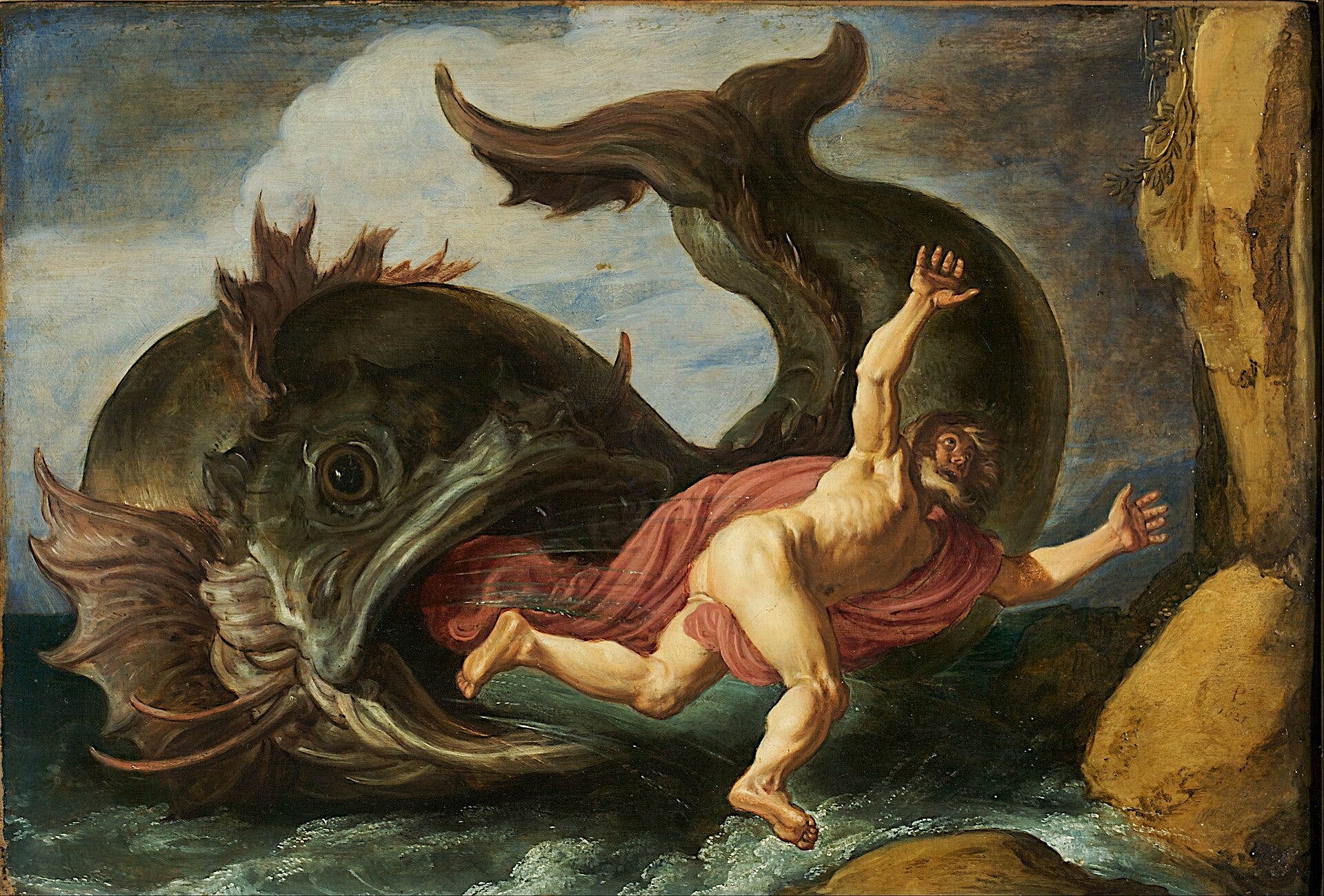
One such figure was Jonah, who fled from God’s direct command. After God sent a tempest against the ship on which he was attempting to escape, the other sailors cried out to their totems while Jonah remained asleep. The sailors awakened him and implored him to pray to his God, whom they believed might yet take mercy on them.
“What meanest thou, O sleeper? arise, call upon thy God, perhaps God will think upon us, that we perish not.”
After casting lots and discovering that Jonah was to blame for the storm, the men asked,
“...for whose cause this evil is upon us; what is thy occupation? And where dost thou come from? What is thy country? And of what people art thou?”
The sailors’ questions to Jonah are the questions every hasbara campaign attempts to answer. What is your occupation? Where do you come from? What is your country? Of what people are you? The messages surveyed in this essay represent successive attempts to answer these questions in terms that the questioner will find legible and desirable. Each conscripts the Jew to a vision not his own: liberal eschatology, progressive identity politics, post-colonial indigeneity, Western civilizational teleology. Each places the sacrifice on an altar built by others and waits for fire that does not come.
Jonah’s answer refuses every available vision. He does not narrate his suffering and victimhood, nor does he advertise his utility. He does not claim kinship with the sailors’ causes or locate himself within the arc of their history. Instead, Jonah says: I am a Hebrew, and I fear the Lord, the God of heaven, who made the sea and the dry land.
His statement is of both maximal compression and alienation. It is utterly strange. It offers no transaction, no alliance, no basis for the kind of sympathy one extracts through shared victimhood or mutual interest. It does not even console, since the God Jonah names is the author of the very storm threatening the ship’s destruction. What it offers, however, is the truth, which is terrible and non-negotiable: this is what I am, this is whom I serve, and the disaster you are experiencing is a consequence of my flight from Him.
Stephens is right that the fire will not come, and that the resources currently being burned in its pursuit would be better spent elsewhere. Jews should stop chasing the approval of people who will never grant it. But his recommendation, sound as far as it goes, does not go far enough. The main problem is not that hasbara is tactically inept, which it is. The problem is that it is a species of idolatry – an attempt to win favor by translating Jewish existence into the moral vernacular of a post-Christian world whose very categories are shards of a theological order that was never ours. Victimhood, progressivism, nation-building, civilizational guardianship: these are pieces of a mirror that shattered when the Christian West lost meaning, and Jews who pick them up will find that they cut the hand without reflecting the face.
To turn inward, then, should not merely mean redirecting institutional energy. It is to confront the question that the outward performance was designed, in part, to muffle. What are Jews for, beyond the world’s uses for them? The condition described in Tanach is one of chosenness experienced as arbitrary, a demand for fidelity that precedes comprehension, and a covenant whose obligations are inherited before they are understood. God does not require utility but faithfulness. The distance between these two demands is the distance between hasbara and Judaism, and no amount of philanthropic ingenuity can bridge it.
Jonah, it is worth remembering, did not want the job. He fled. God pursued him. The storm, the whale, the reluctant prophecy at Nineveh - none of it was a product of Jonah’s genius. And when asked, he did not deliver his answer from a position of safety or superiority. He was a fugitive asleep below decks while the sailors above him cried out to their own totems. His confession was not a prepared address but was dragged out of him by catastrophe. And yet it remains the first moment in the book where he speaks truthfully about who he is and what he owes. The desperate machinery of self-presentation may be, at bottom, a kind of sleep: noise generated to cover the sound of the single Voice one would prefer not to hear. To cease producing it would not be a strategic correction but a spiritual one. It would mean waking up.
 | A guest post by
|
What a great article.
It is important that you mention the story of Jonah - how he was terrified when confronted with his own chosen-ness, and how Jonah knew exactly who was in charge of his story.
This knowledge is the necessary antidote to another phenomena of a "Jewish turn inward", as you phrased it:
Nietzschean Israelism.
Nietzschean Israelism is currently spreading among Jewish-American and Israeli right-wingers , sometimes directly imitating Groyperism. The salience of my analysis is confirmed by Jewish Groyperism manifesting itself here in the comment section in ideal typical form, actually in the first comment written to the article.
Nietzschean Israelism means that the "Jewish turn inward", the divesting from non-Jewish paradigms that "conscript the Jews to a story not his own", is not followed up with a return to God, but serves simply to free the willpower of "the Jews" to do whatever they desire, which, for the disciple of Nietzsche, is power (of course).
Hasbara, Western Civilization™ etc. are bad for the Nietzschean Jew not because they represent an attempt to find a place in a ruined moral order, but because they are constraints on Jewish willpower, and Nietzscheans reject any constraints on the human will.
A rather not so wise Arab "critic" of Zionism once made, more by luck than judgment, a sound comment: If the Bible is read by a Jewish atheist as a piece of "national history", i.e. if he replaces "HaShem" as the protagonist with the "nation", he might arrive at a radical social Darwinist vision, not a struggle with god but a struggle with the goy.
In that way, Jewish Nietzscheans do not justify Israel's wars as Jewish self-defense (that's cowering to the Goyim!), but celebrate them as a return of the "agentic" Jew with "five children and an F-35" who "creates life and takes life".
The "return" to this "Jewish paradigm" (that, as you show and i try to work out by adding words, is not really a "Jewish" paradigm") represents merely an excuse to leave behind those pesky, brittle ideas of Western Civilization™ to which boundaries human will should be confined - the Jewish Nietzschean does not follow his divestment up with a submission to the will of the ultimative boundary-giver.
The signs of the Jewish Nietzschean - meme language, Moral Sadism (https://critiqueanddigest.substack.com/p/the-age-of-moral-sadism), and an adaption of the Nietzschean idol of the anti-Christ, the Ubermensch (here as the Uberjew).
The defining quality of all hasbara and its American Jewish counterpart is its CRINGE, its lack of humor and self-awareness, its desire to adopt a non-Jewish trope, any non-Jewish trope as long as it makes the Jews the "good guys" in the eyes of the non-Jewish audience as that audience exists in the imagination of the hasbarite. Jews are either unjustly murdered and thus inoffensive, or more goyish than the particular segment of goyim being addressed. If the segment is Greenwich Village hipsters, then Jews are more transgressive and gayer than they are. If it's Fox News flyover boomers, then Jews wuz da real Constitutionalists (hi, Yoram Hazony.) This was always hollow, hypocritical crap, but in today's hyper-ironic milieu, it goes over like a lead balloon.
Personally, I'm a proponent of Modern Hasbara theory. Embrace and amplify the accusations, mock your opponents (whose goal is to get you to turn out your pockets to demonstrate you're not a thief, which they already knew, but your frantic explanations amuse them.) Jews Are The Real Racists! Instead of tedious explanations about how, properly understood, Judaism is a universalist faith and we love goyim, ackshully, post a funny Rabbi Mizrachi clip about how goyim deserve death for watching sportsball. Discuss the hilarious JPROOF story. Etcetera.
Stop trying to convince your enemies to love you with Facts and Logic. It's lame.