
Beyond Borders, Beyond Reason
Deconstructing the Myth of Post-Nationalism and Its Cultural Politics

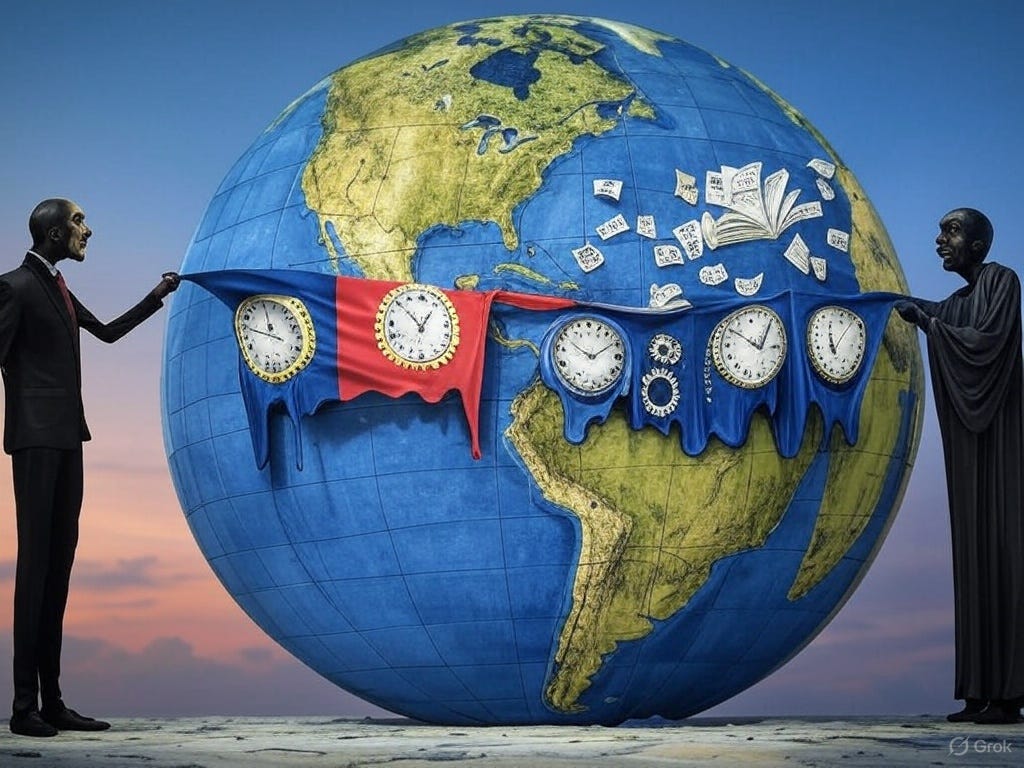
Once, an emperor summoned his court to marvel at his new robes, woven from a thread so fine it erased all borders, cloaking him in the most supreme garment the world has ever seen. "Only the Ivy wise see it," his tailors promised. Nobles nodded, merchants clapped, and scholars scribbled praise for the invisible weave. But as the emperor paraded through the streets, a child, unburdened by pretension, blurts out the obvious: the emperor is parading in his undergarments.
In many ways, this is the story of post-nationalism, a myth that until the recent global backlash against it was so pervasive and powerful that it was rarely discussed, and the current epochal backlash against it. At its core, and like all ideologies, post-nationalism is a grand myth, a patchwork from intellectual fragments that worked to mystify, convince, moralize, legitimize, or delegitimize. It is the myth of establishing, beyond question, the moral supremacy of a new power structure. If nation and race were the myth of the 20th century, it should be clear by now that post-nationalism is the myth of the 21st.
What is the myth of post-nationalism? Any myth ultimately draws its power from a simple, morally appealing story, and post-nationalism is no exception. The narrative unfolds as another post-Enlightenment philosophy of history, whether biological or dialectical, in which humanity trudges through history’s bloodshed to arrive at an enlightened present. Central to this “enlightenment” is the belief, which underlies all our intellectual culture and language today, that we have finally outgrown the sins of nation and ethnicity, long blamed for war and prejudice, and we are inevitably marching towards a post-national world. Humanity has outgrown its ancient religion and now it’s time to outgrow its modern religions: nations and states. Borders become needless relics, collective identity dissolves into a fluid cosmopolitan mosaic, and loyalty itself becomes regressive. Here, men and women reimagine themselves as free, self-making subjects, beholden to no inherited essence; all supposed boundaries—whether on a world map or between genders—shrink away in a Bonobo-esque utopia of perpetual flux.
By casting the nation-state and the much hated “ethnonationalism” as the prime engine of oppression, post-nationalism beckons toward a global commons where nomadic individuals, unmoored from locality, loyalty, duty, biology, or ethical expectations roam and trade under a universal post-national light. Post-nationalism thus becomes its own telos, which provides a constellation of modern virtues, chief among which are world peace, efficiency, free self-expression, and experience. In this telling, only our shared humanity remains sacred, buttressed by unlimited diversity, sustainable technology, and the promise of endless reinvention—an ideal often presented as American lifesyle minus the electrification and expressed in a new language that combines corporatist blandness and vague liberal sentimentalities in a new form of international toxic positivity: shared humanity, diversity, empowering marginalized voices, universal values, multi-stakeholder approach, sustainability, building bridges not walls, people-to-people, global solutions, togetherness, inclusion, celebrating all identities, etc. On the other hand, enemies are extremists, right-wingers, and science deniers.
Those immersed in the worlds of NGOs, USAID missions, international institutions, elite universities, or Western foreign policy know that post-nationalism is more than an airy ideal—it’s the dominant shared worldview binding a new global class of “internationals.” These are people who feel more at home in metropolitan hubs across the world than in the outlying corners of their own countries. Economically and culturally, they function as a class, sharing vast networks, advanced educational credentials, common linguistic codes, and a unified spectrum of opinions and tastes—from theology and aesthetics down to their favored cuisines. Far beyond a mere social stratum, they have become the engine that drives today’s middle-class consensus, shaping culture, prestige, and political horizons for millions. They are urbanized, nomadic, capitalist, atheistic, modern, and atheistically modernist. Far from an empty fantasy, post-nationalism stands as a mythic force whose reverberations are shaking the world’s foundations.
What needs to be asserted is that post-nationalism is not a natural historical progression but an engineered mythology serving the interests of global corporations, NGOs, and academia; a fabricated ideological construct designed to justify a new transnational elite power structure. It is a parasitic ideological formation that deconstructs national and cultural identity while legitimizing unaccountable global governance.
Can we deconstruct the myth of post-nationalism by mapping the components that sustain it? Far from a tidy fusion of moral universals, post-nationalism is a collage stitched together from incompatible ideologies—neoliberal economics, Third Worldism, Marxist cultural critique, poststructural deconstruction, scientism, and American-style liberal cosmopolitanism. Each of these ideologies, rooted in critiques of the modern nation-state, has ironically ended up fortifying a new, post-sovereign order that is more opaque and less accountable than the old regimes.
Neoliberalism and Its Allies
Arguably, no so-called “ideology” today—across both the right and the left—inspires more derision than neoliberalism. Even among conservatives who wax nostalgic for Reagan or Thatcher, a powerful faction now condemns the “neoliberal turn” as the catalyst that deindustrialized the West, dissolved its borders, and ceded sovereignty to an invisible cadre of globalists. For them, neoliberalism forms a convenient starting block in any grand narrative of modern decline, the original sin explaining today’s unraveling.
Yet, as with “capitalism,” one must note that neoliberalism was never a formal creed claimed by its own practitioners. Instead, “neoliberal” functioned as an enemy term, coined by those who reviled the emerging global order. What was that order, exactly? A sweeping policy shift—initiated in the United States and swiftly institutionalized internationally—that elevated market access to the status of universal principle. The unrestrained mobility of capital and increasingly fluid mobility of labor were the central economic aims. Deregulation, privatization, and a singular focus on individual freedom formed the core pillars, effectively recasting nation-states as agents of transnational economic management rather than sovereign governments of local communities.
Intellectually, many trace, or rather imaginatively project, what we now call “neoliberalism” back to the post–war climate. At that juncture, Western governments—still reeling from the trauma of the Great Depression and grappling with empowered labor movements born of the Second World War—installed policies to forestall the prospect of another economic cataclysm and to accommodate popular demands for social security. Under the banner of Keynesian demand management and social-democratic welfare, states intervened more heavily in their economies than ever before, smoothing business cycles, propping up employment, and providing a safety net for the least fortunate. This ruling orthodoxy, lauded by mainstream politics for delivering stability and redistribution, was anathema to a coterie of radical dissenters who saw in it the seeds of both economic stagnation and creeping authoritarianism.
Foremost among these critics was Friedrich von Hayek, a German intellectual firebrand and principal organizer of what would become “neoliberal” protest against all forms of state-control of economic and social matters. Rallying like-minded spirits worldwide, he convened them under the semi-clandestine umbrella of the Mont Pèlerin Society. For a quarter-century, their critiques of the prevailing order were met mostly with scorn and neglect, leaving this band of free-market apostles to toil at the fringes of acceptable opinion—waiting for a moment when the mainstream might finally heed their warnings.
Hayek’s hostility to state intervention and control, of course, is rooted in his experience during the fateful first half of the 20th century. In the view of Hayek and his students, socialism and fascism converged as two heads of the same monster, each devouring individual liberty through an all-powerful state. Markets, by contrast, represented an ingenious bulwark against tyranny, since the spontaneous interplay of voluntary exchange could supposedly outmaneuver any totalitarian scheme for total control. For them, the stakes of political life were simple: either unleash market forces or risk the creeping grip of oppression.
With the stagflationary crisis of the early 1970s and the protracted slump that followed, neoliberal doctrine at last stepped into the limelight. By the 1980s, the liberal-right had claimed power in the United States and Britain, and governments worldwide began espousing its prescriptions for escaping crisis: reducing direct taxation, deregulating finance and labor, loosening union power, privatizing public services. Once dismissed as an eccentric heresy of the 1950s and 60s, Hayek’s free-market credo, by way of his student Milton Friedman, now received benediction from Reagan, Thatcher, and other heads of state. He became the chief visionary economist of the epoch. The collapse of Soviet communism, right at the decade’s end, crowned his victory—conjuring up, for neoliberal apostles, an echo of Hayek’s unwavering insistence that state control is conceit.
Still, it was in the 1990s, after the USSR had disappeared that neoliberal ascendancy entered its purest form. Without the adversarial field of the Cold War, even center-left governments in advanced capitalist nations coolly upheld the free-market policies championed by their conservative predecessors and regulatory barriers fell like dominoes. The vocabulary was somewhat softened but the underlying direction remained constant: in Europe and America alike the neoliberal project reigned supreme. Its ideas did not dominate but actually generated decisions and behaviors of leaders both on the left and the right.
However, Hayek and Friedman were the intellectuals from whom the neoliberal project sought only its economic legitimacy. Its moral and political legitimacy is often sought, and found, in Karl Popper and Hannah Arendt, figures no less suspicious of the state and its power than Hayek. Popper’s Open Society, celebrated by his most famous student George Soros, and Arendt’s Origins of Totalitarianism reflected broader political, philosophical, and moral concerns about preserving pluralism and human dignity in the face of modern tyranny of all-powerful states.
Arendt, posthumously, lent the neoliberal project a distinctly moral and philosophical gravitas through her enduring preoccupation with the fragility of political freedom in the modern age. Arendt’s formative work, Origins of Totalitarianism, dissected how mass politics and bureaucracy could coalesce into a system that obliterates individuality. Like Hayek, she had witnessed firsthand the ravages of National Socialism and Bolshevism; she similarly concluded that any monolithic state power is liable to crush those very features—plurality, spontaneity, a public space of debate—that permit genuine human dignity. Yet, whereas Hayek portrayed market competition as the best bulwark against tyranny, Arendt focused on the vigor of civic engagement, the capacity for collective deliberation and action. No straightforward champion of “free markets,” she still reinforced the conviction that robust, independent spheres of social life are indispensable if we are to resist the Leviathan of the modern state.
Perhaps no figure better exemplifies the liberal conscience harnessed to neoliberal ends than Karl Popper, author of The Open Society and Its Enemies and mentor to magnates like George Soros who established his infamous Open Society foundation in 1993. Popper’s polemics charged at the philosophical bedrock of totalitarianism. He traced it back through Plato, Hegel, and Marx, arguing that historicist or utopian visions—those which claim to prophesy humanity’s inevitable destiny—foster the very illusions that lead to oppression. In Popper’s worldview, truly free societies must embrace piecemeal engineering and falsification rather than centralized blueprints and ideological dogma. Here again, the common enemy uniting him to Hayek and Arendt was totalitarian power, believed to thrive whenever the state attempts grand, top-down transformations of society. Another European Jew who witnessed the horrors of Nazism and Communism, Popper produced the Jeremiad liberal text against totaitarinism and state-power.
Most importantly, in his book, Popper reserved some of his most scathing scorn for nationalism. He refused to grant nationalism any degree of respectability, demanding it be scandalized in open and free society and seen as “not a principle… rather, a typically irrational reaction.” Furthermore, he insisted that "nationalism appeals to our tribal instincts, to passion and to prejudice, rather than to reason. It is a step backwards towards the closed society, towards the herd, towards irrationalism."
The works of the three European intellectuals, despite their different interests, converged in their fierce opposition to state power. Taken all together, Hayek, Popper, and Arendt, the twentieth century emerges as an epic drama of the grand clash between freedom and the specter of totalitarian regimes. They all shared a profound distrust of centralized power—highlighting how fragile freedom can be under the claws of the modern state.
Yet none of these thinkers—neither Hayek nor Arendt nor Popper—ever intended to champion a borderless, cyber-fueled market empire ruled by a new global class, nor did they conceive of a “neoliberalism.” Their theories took root in a specific historical crisis: the wreckage of fascism and the looming specter of Communist totalitarianism. In that setting, suspicion of state overreach was perfectly logical and even obligatory. It was only after the Cold War, in a vastly altered geopolitical landscape, that their positions found their way to a new all-encompassing anti-nation-state dogma. The misreadings, half-readings, loss, and distortions of their works that served to consolidate the power of the new class were a matter of almost natural course of events.
But in practice neoliberalism was never about genuinely shrinking the state; it was about shifting and reassembling the mechanisms of power. Instead of emancipating ordinary people from heavy-handed government, it repositioned authority upward to newly crafted international regimes and financial institutions. Nation-states, stripped of their social-contract obligations, became managers for transnational capital, while a global cadre of bureaucratic elites took over decision-making—now distanced from the checks and balances of local democratic accountability. A nation became merely a unit of management in a global rule-based order. Under this arrangement, national sovereignty did not simply dissipate; it was fragmented and absorbed into a new architecture. In many places, public welfare and regulatory frameworks were dislodged from national governments and repackaged as international protocols or agreements—tools that, far from liberating society, imposed top-down intervention in the name of market efficiency.
What emerged was not less state intervention but a new form of meta-state intervention facilitating the rise of a transnational power structure. The rhetorical goal was to unshackle capital and labor from national barriers. The actual outcome, however, was the erosion of localized political agency in favor of centralized, unaccountable governance by global institutions. The real story of neoliberalism, then, is not the retreat of the state, but the reconfiguration of who wields state-like power, culminating in the hollowing out of national social contracts once premised on collective security and civic belonging. By marketing itself as a project of liberty and minimal governance, neoliberalism effectively masked its role in constructing a new worldwide order—one orchestrated from above by a coalition of global actors who, ironically, remain just as, if not more, interventionist as any old-style nation-state.
The Ingathering of the Myth of the 21st Century
No power structure endures without a unifying myth—some grand narrative that soothes anxieties, harnesses consent, gives legitimacy, and obscures the true sources of domination. As the neoliberal project started the disassembling of nation-states and remapped authority onto a global institutional tier, it also required an intellectual and cultural force to sweep away the older ideological residue and establish the moral supremacy of the new one. Surprisingly, the cadre that rose to provide this legitimating myth was not a generation of free-market zealots in corporate boardrooms but the very heirs of Marxist critique and radical anti-colonial thought. In universities and cultural institutions worldwide, the academic cultural left—postcolonial scholars, postmodern theorists, and poststructural philosophers—launched devastating critiques of Western hegemony, Enlightenment rationality, and national mythologies. By dismantling the foundational myths of the modern nation-state, they cleared the ground for a new, transnational creed that would legitimize the power of a global elite.
Postcolonial studies epitomize this paradox. On the surface, it brands itself as the moral conscience of the once-colonized, a movement determined to debunk the Eurocentric order. Yet the very thrust of its critique—its still Western-centric fixation on the Western categories of cultural obsession of hybridity, migrancy, and nomadism—aligns too neatly with neoliberal ideals of frictionless labor and capital. If Popper and Arendt can be used to disarm the resistance of illiberal states abroad, Said and Foucault can be used to disarm and deconstruct the resistance of the conservatives at home. Like neoliberalism’s quest to annihilate national constraints, postcolonialism scorns any self-contained identity, insisting that liberation means perpetual flux. By systematically discrediting grand narratives of the West, it made itself the handmaiden of the global market’s appetite for eroding boundaries. By deconstructing Western canon and aesthetics, it cleared the path for a new sensibility, Western through and through in its avowed anti-Westernism. In place of “knowledge,” it foregrounded an endless unraveling of the past, a perpetual deconstruction of inherited structures. Such radical negation paves the way for precisely what neoliberalism promised: an unbounded field for international forces, unimpeded by the traditional obligations of nation or community.
A key moment in this intellectual turn was the adoption of poststructural theory, which recast power as a pervasive, insidious force emanating from institutions—foremost among them the nation-state. What began as a post-Marxist project to unmask hidden forms of domination expanded into a crusade to dismantle entire systems of governance. The state is really just one big invisible prison. The new academia demonized the state’s role in shaping collective identity; it now saw passports, borders, and national narratives as instruments of deep-seated will to dominate. The critical energies once devoted to class struggle now turned against the working class seeking to annihilate its sense of order. This doctrinaire hostility to centralized authority dovetailed almost seamlessly with neoliberal efforts to chip away at the old social contract—a breathtaking coincidence that served the interests of transnational elites, many of whom wearing the unconvincing tokens of marignality, far more effectively than it did the normal man and woman.
By the 1990s, this anti-statist paradigm had become so deeply embedded in cultural and area studies that questioning it would brand one as hopelessly reactionary. It became dogma to claim that the modern nation-state was inherently oppressive and that genuine liberation lay in the dissolution of all national, legal, and cultural boundaries. In effect, the ideological foundation for post-nationalism was sealed. Rarely did its adherents inquire: if the dismantled state no longer protects its citizens, who steps in to fill the vacuum? Even less often did they examine whether this purported emancipation from state power might actually consolidate a new form of global governance, one run by multinational corporations, NGOs, USAID, Soros, and international agencies operating beyond the accountability mechanisms once housed within the state. In casting national sovereignty as the ultimate evil, the academic left provided the intellectual camouflage for the reorganization of power—ensuring that old forms of tyranny would simply reemerge under new global management.
The new mythology of post-nationalism thus arises from three decaying pillars of twentieth-century power: the internationalist structures of the old left, the eager Westernizing elites of the Third World, and a sanitized cosmopolitan liberalism. Crumbling American liberalism, the implosion of Soviet communism, and the dissolution of Third World solidarity combined to feed a single, borderless vision of humanity under a single global management leading us to the final liberal from history. Together, the international, the post-colonial, and the cosmopolitan came to form the global. Each of the protagonists claims to champion openness and fluidity, and each, ultimately, legitimates a power structure more distant and impenetrable than ever before.
If the new global order gets established through the parasitic consumption of already existing sovereign national communities and turning, converting, and inverting them into managerial units in a larger structure, so do both postcolonialism and poststructuralism create themselves by the parasitic inversion of already existing Western culture. In broad terms, postcolonial studies is an intellectual movement driven by an outgrowth of Third World Marxist critique of capitalism flowing into a critique of every cultural aspect of Western life, Europe, the patriarchy. It does not produce any new knowledge except by way of inverting and systematic disarticulation all the Western knowledge that already has been produced. In that sense, it is a form of cultural parasitism. Its ultimate objective itself is not knowledge but the radical and final liberation of all mankind, both Western and none, from the historical formation known as the “West,” its religions, culture, philosophy, aesthetics, etc. It then becomes, in its most vulgar form, a manualized list of ethical givens.
In much more concrete terms, postcolonial studies is more of a persona (think Edward Said and identity politics) than a system of knowledge. The persona is standardly known as the “subaltern,” a term which had originated in the writings of Italian communist Antonio Gramsci about the Italian working class but which in the American university turned into an occult term which supposedly express and celebrates the innate, almost otherworldly, subversive ethnic alterity of Third World people, movements, and religions, namely Islam. Turning a caricature into an entire system of knowledge, an occult sense of subalternity became postcoloniality’s most irreducible value. The image of Third World marginality becomes the new moral center of metropolitan Western thought itself, in which the subaltern becomes the master who comes to teach the Western intellectual about Nietzschean life. The village wise man comes to confront the rationality-mongering Western intellectual with the truth of being. To be a subaltern is no longer a social condition to be eradicated but a heroic form of ontological resistance that must be celebrated and used to disarticulate the oppression of the West and Christianity.
The false consciousness, or the mythic self-understanding of postcolonialism started to take shape after the rise of the New Left, with the greatest contribution from Edward Said. It goes something like this: the alienation, pain, suffering, wounds, and lacerations the antisemitic Christian West imposed on the Jew created an innately subversive radical Jewish consciousness from which the oppressed and traumatized Jew forged to himself the critical intellectual arsenal with which to defeat his Western Christian behemoth. At the peak of the modern epoch, and due to colossal historical developments which stretched Europe and its oppression to become the globe, the subversive Jew, his legacy of victimhood, and his tools of resistance were now inherited by the Third World subversive subaltern who rose to become the hero of the last and decisive battle that will radically liberate all of humanity from the “West” starting by Westerns themselves.
Originally, and before it became a dominant occult theoretical perspective in the humanities, the term postcolonial was reserved to describe authors who themselves came from the Third World such as Edward Said, Salman Rushdie, Bhabha, etc. It was a matter of perspective rather than identity, before both converged, that means the active vocation of the continuous dismantling and disarticulation of Western knowledge and society. In many ways, the Third World postcolonial intellectual and author, who were understood as the voice of the subaltern “talking-back” to the West, was always a matter of false advertising for they were always figures that were thoroughly Western in their mental constitution, identity structure, and writing. Their obsessive theme of exile is a long dead trope for modernism and the British novel of empire, and its immediate substitute, migrancy, does little to reinvigorate the original. All of the postcolonial intellectuals’ rhetorical currency is a limited set of literary tropes, including migrancy, deconstruction, identity, exile, decentering, nomadism, and hybridity, a free-flowing subject to compliment the free-flowing global power and capital. Hence, their function is actually and primarily assimilative that helped to create a space for Third World highly educated elites in Western upper middle class society and building bridges between English speaking Third World middle and upper class readership, often in close contact with the West through business and education, and the educated reading public in the U.S. and Western Europe. The global elite in the making.
What is important to note here is not just the matter of the false advertising but also the decisive incommensurability of interest and outlook between the Third Worldist postcolonial intellectuals, assimilating in Western elites institutions and the Third World poor laborers they claim to represent. They presented themselves as a new cast of intellectual spokespersons working on behalf of the supposedly innate subversive ethnic alterity yet concealing their main mystifying function as an inner Western power group on behalf of a new global power under the alternative romantic label of multicultural inclusion.
Thus, it is not an exaggeration to say that climax of imperialism was reached when liberation is understood as a Third World intellectual, residing in Manhattan and teaching at Columbia, started to deconstruct the colonial epistemology through French Theory, ironically reproducing the mire from which he supposedly seeks to pull himself, only infinitely deeper and muddier. Thus, globalism reached a state in which the most unique expressions of the non-Western are Western through and through–the ultimate export of the self back to its center.
At this point it is important to note that ultimately postcolonial theory was a component of the journey of elite intellectual domination by the American and British reading of the French elaboration of the two constitutive strains of German philosophy, Hegelianism and anti-Hegelianism, known as poststructuralism or French Theory. It is part of the story of Nietzschean and Lacanian transformations of the American university and American thought.
Deconstruction Made World
What began as a postcolonial inversion of Western categories—where the so-called subaltern ascends to the status of venerated guru—is closely related to the poststructural ethos that demolishes every last remnant of fixed meaning. Here lies the final pivot: from the external dismantling of Eurocentric knowledge to the internal dismantling of Western, individual, national, philosophical, and religious identity itself. If postcolonialism insisted that national myths and cultural grand narratives must be forever waterboarded, poststructuralism doubles down, insisting that any stable definition of the self—be it rooted in history, biology, or community—is an illusion. In the new academic dispensation, identity becomes both fluid performance and an untranslatable essence. Heidegger meets the wandering subaltern, giving rise to a politics of pure being in which language, race, and body are simultaneously everything and nothing. Little wonder that this worldview fits hand in glove with the managerial ambitions of the global class: an endlessly malleable subject, unmoored from place and tradition, who has history only by accident, is far easier to guide through expert interventions. By the time poststructuralism takes the stage, the old dream of a coherent nation or a shared civic contract is portrayed as an archaic fantasy; only the rootless, borderless subject—ironically dependent on international elite gatekeepers—remains. Such is the intellectual clearing upon which globalization now builds its towering edifice of command and control, who can now intervene in the name of protecting the infinitely fragile, perpetually fluid subject from every conceivable harm, thereby justifying ever-expanding systems of expert governance. Freed from the old ties of locality, tradition, and concrete identity, the individual becomes a rootless subject whose care and guidance can be administered only by those deemed credentialed and expert.
In similarly broad terms, poststructuralism is not so much a new method of inquiry as it is a systematic dismantling of prior Western philosophical methods—particularly those of structuralism and Enlightenment rationality. It prides itself on demystifying any stable source of truth or meaning, announcing instead that all texts, identities, and power structures are contingent constructs. In that sense, it operates as a paradoxical parasitism on Western philosophy: rather than building a coherent method, poststructuralism unravels established notions of truth. Its end goal is not to expand our shared knowledge but to permanently destabilize the very idea of any knowledge, whether of the natural world or of the self, making all social and cultural forms—be they gender roles, political systems, or moral foundations—perpetually open to deconstruction. Like postcolonialism’s exaltation of the subaltern, poststructuralism celebrates the endless flux of discourse over any concrete grounding, turning every certitude into a fluid, contested site of interpretation.
In the most concrete terms, the central objective of poststructuralism is to invent a new logic that makes any possibility of a future return of any form of Western conservatism impossible. It does so through the total deconstruction, that is the systematic removal of all boundaries, of the fundamental and foundational categories of the Western mind without which there is no West, no Christianity, no philosophy, no nations, and no self: logos/reason, meaning, individual, and truth. This task is undertaken through poststructuralism’s primary intellectual principle of dissolution: the idea that meaning-making mechanisms are fundamentally linguistic and uncontrollable, which leads to the final semantic independence of representation.
At this juncture, the deconstruction of the individual itself becomes poststructuralism’s most consequential project. If each identity is merely a linguistic construct, and every system of meaning is open to permanent reinvention, then the once-coherent individual dissolves into a smoke and mirrors maze of shifting subject-positions. The next step, therefore, is to see how this theoretical and conceptual unraveling translates into a profound transformation in the concept of personhood and citizenship.
The parallels, or superstructural reflections, with the political processes of globalization and neoliberal reorganization of the world are unmistakable. The individual was disassembled and gave way to “subject”—an ambiguous, dynamic ever-shifting specter devoid of any stable definition. Less solidity and more fluidity. The individual is stable while the subject is constantly self-creating. The language of the subject offers a way of talking about the individual in further abstraction to maintain the Enlightenment’s focus on the individual while forgoing any possibility of stable definition. After the subject was abstracted from the individual, the remaining concrete physical content of the “individual” was then abstracted into another term: the body. In other words, the individual was broken into two distinct and sometimes antagonistic components: the idealist, creative, dynamic and self-authoring subject, and the material body. If the primary social relationship of the individual was that with society in which the individual exercises their agency through cooperation, contest, domination, submission or protest with or against society, that of the subject is with the body. The individual’s world was social, the subject’s world is bodily. In the last analysis citizenship is no longer the national mediation between the coherent individual, society, and state, but citizenship now functions as the state's mediation between a fluid, ever-changing subject and its physical body. (As a consequence, liberal politics increasingly revolve around issues of bodily autonomy and control, with the state playing a more direct role in regulating the material self.)
The deconstruction in the individual, the dismissal of any solidity or stability of meaning, caused a profound transformation to the modern sense of identity. We shifted from communal identity that was built on various epistemic outcomes of socio-historical formations to an identity that centered on Heideggerian ontological politics–a shift from a historical community to a community of being. Subjectivities are merely constructed, malleable, and performed, so much so that biology is not destiny even if one is born with a Y chromosome, yet in order to speak on any issue one must be of the exact gender, racial, and ethnic background that corresponds to the issue. Identity is both constantly constructed and is being at the same time. Politics then becomes a quest for the recognition of nomadic ontological virtues of race, language, culture, or biology, which must only be accepted for it can never be translated. Heidegger but as a wandering Jew.
